


-
摘要:
为了使吸热器表面能流呈均匀分布,提出了一种塔式太阳能电站定日镜瞄准策略优化方法。首先,基于全场定日镜瞬时光学效率的计算结果对镜场进行分区,对不同分区的定日镜设计不同的瞄准因子;然后,根据瞄准因子计算定日镜的光斑尺寸,通过光斑尺寸与吸热器尺寸比值确定光斑相对大小,并规划瞄准点分布;最后,利用遗传算法优化定日镜瞄准点分布,实现吸热器表面均匀的能流分布。以百兆瓦级塔式光热电站为例,对定日镜瞄准策略进行优化,在典型日中春分日条件下吸热器表面能流密度峰值由赤道瞄准的1.94 MW/m2降低到1.01 MW/m2,均匀性提高53.29%,截断因子仅减小0.86%,在保证截断效率的同时确保了吸热器的高效安全运行。
Abstract:To achieve uniform heat flux distribution on the receiver surface, an optimization method for heliostat aiming strategy in solar power tower station is proposed. First, the heliostat field is divided into zones based on the calculated instantaneous optical efficiency of heliostats throughout the entire field, and different aiming factors are designed for heliostats in different zones. Then, the spot size of each heliostat is calculated according to the aiming factor, and the relative spot size is determined by the ratio of spot size to receiver size, thereby planning the aiming point distribution. Finally, a genetic algorithm is employed to optimize the heliostat aiming point distribution, achieving uniform heat flux distribution on the receiver surface. Taking a hundred-megawatt-scale solar power tower station as an example, the heliostat aiming strategy is optimized. Under typical spring equinox conditions, the peak heat flux density on the receiver surface is reduced from 1.94 MW/m2 with equatorial aiming to 1.01 MW/m2, improving uniformity by 53.29% while reducing the spillage factor by 0.86%. This ensures efficient and safe operation of the receiver while maintaining high interception efficiency.
-
Key words:
- solar power tower station /
- optical efficiency /
- aiming strategy /
- genetic algorithm
-
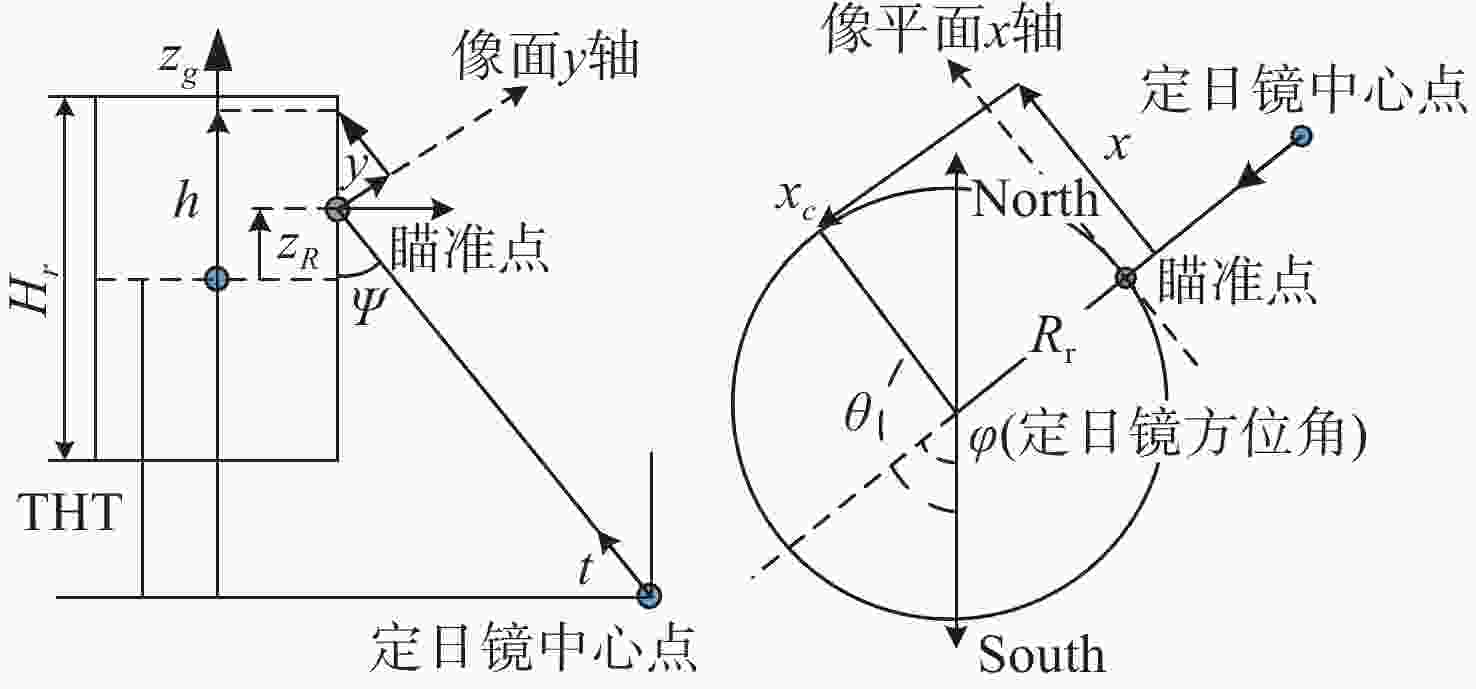
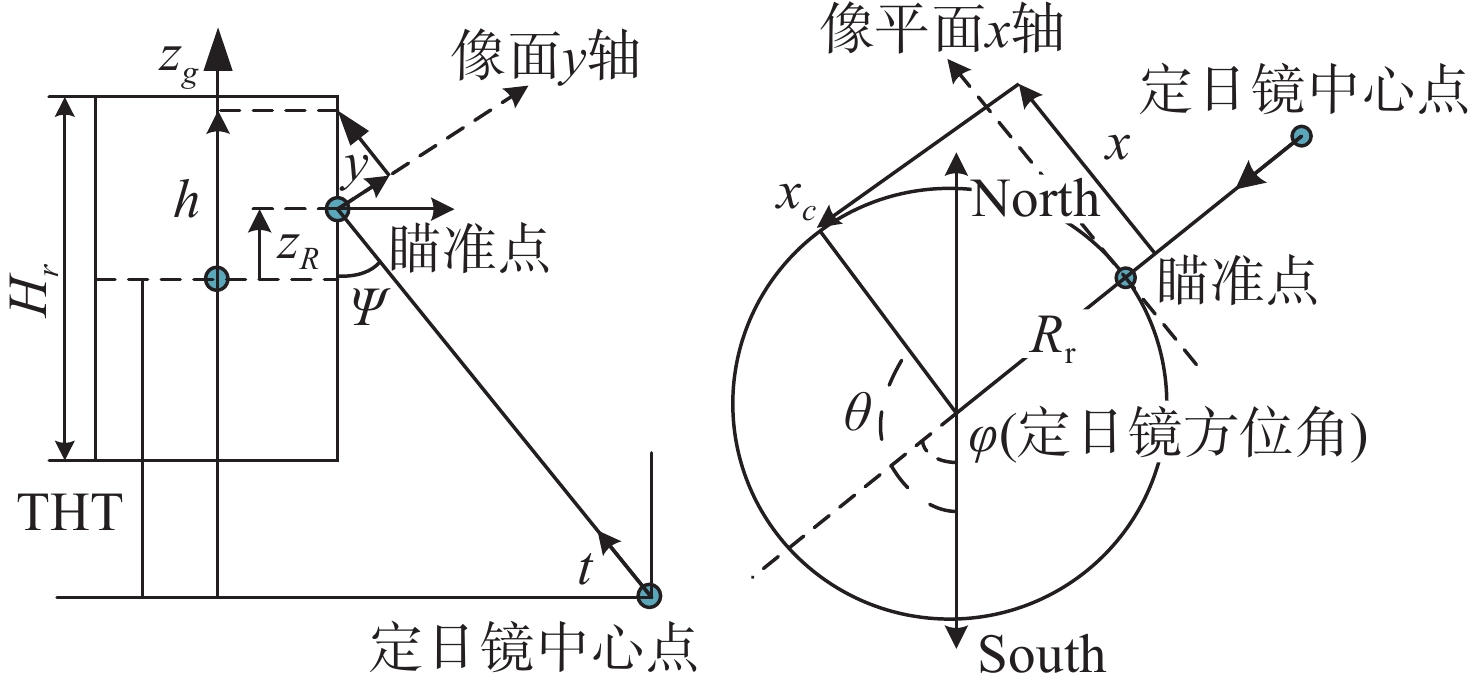
图 1 圆柱形吸热器表面能流分布计算
Figure 1. Calculation of energy flow distribution on the surface of cylindrical solar collectors
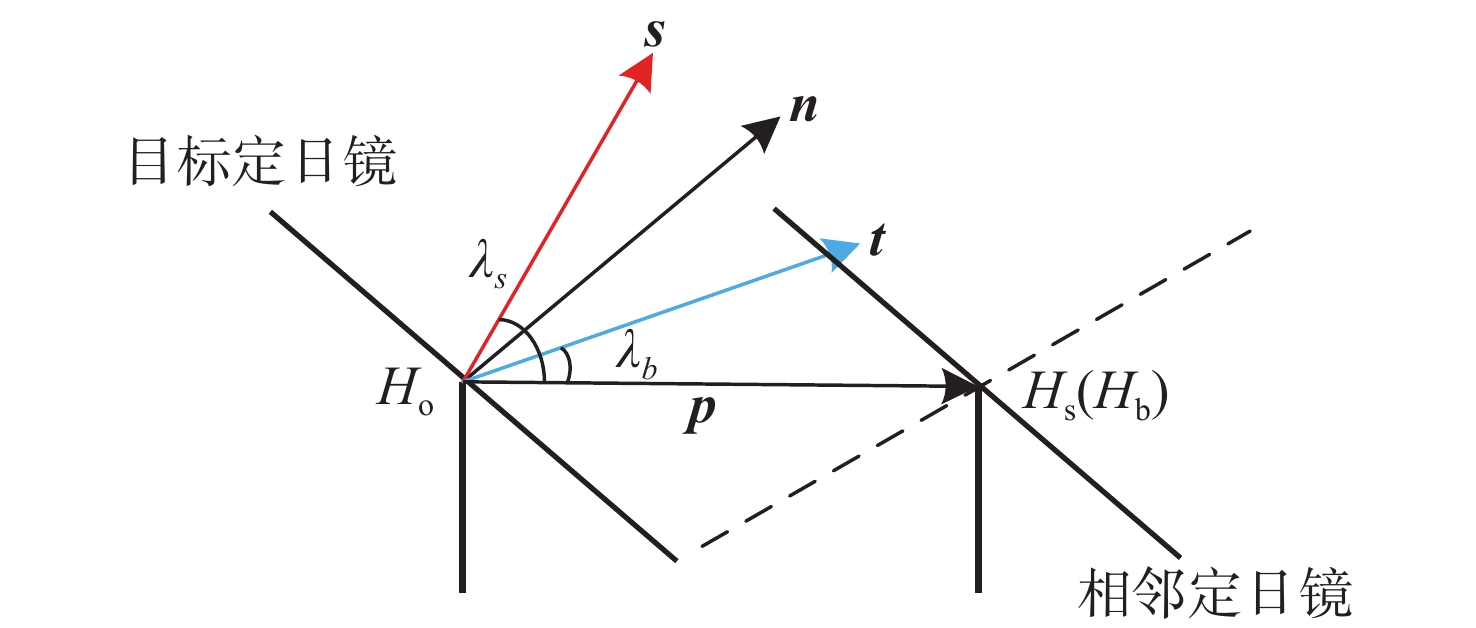
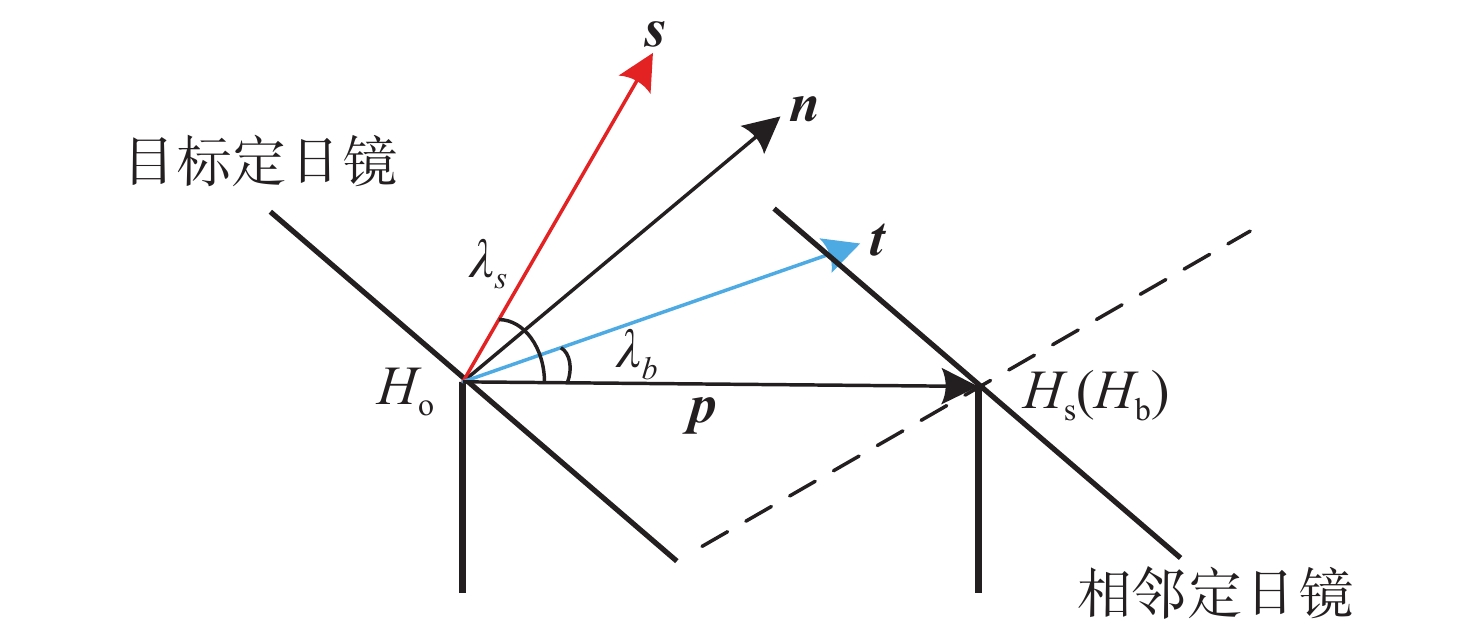
图 2 定日镜存在阴影挡光的条件
Figure 2. Conditions under which a heliostat experience shading or light blocking
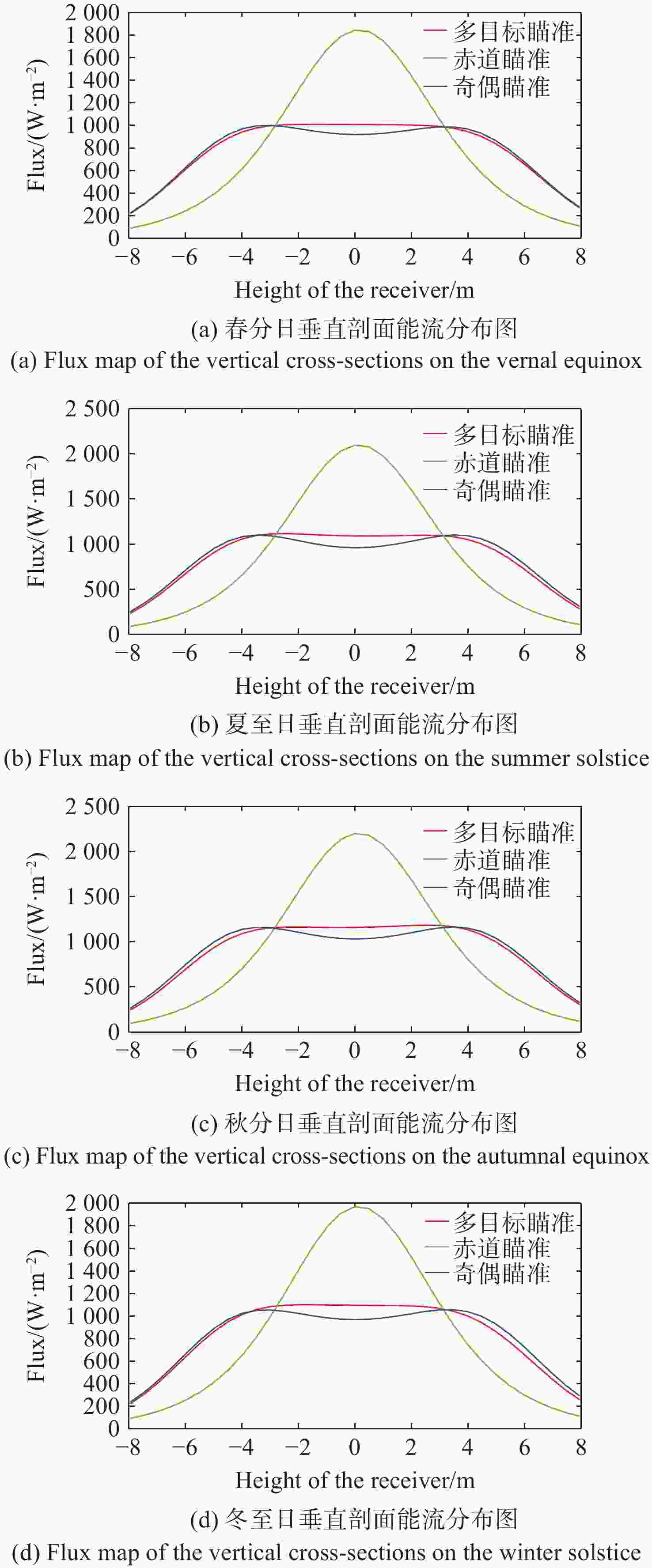
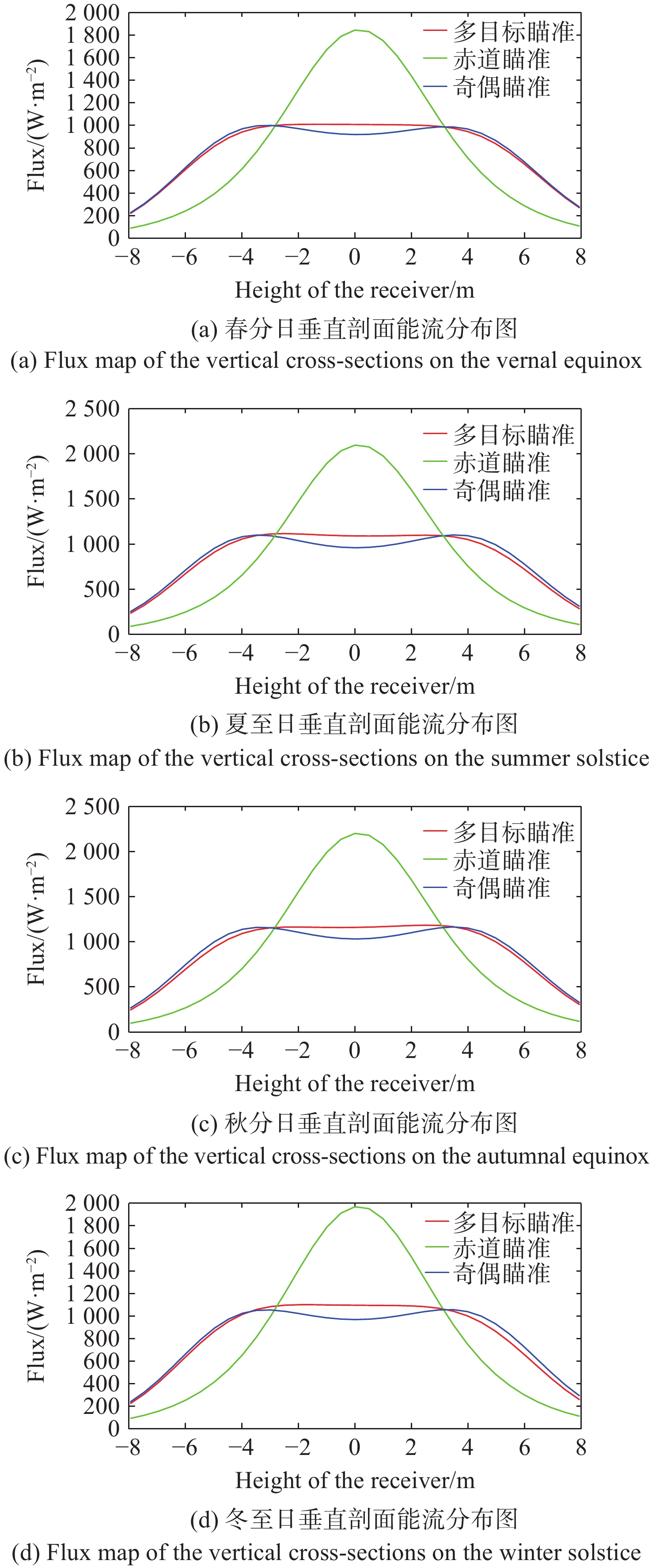
图 4 不同瞄准策略在典型日条件下的吸热器能流分布
Figure 4. Energy flux distribution of the receiver under typical daily conditions with different aiming strategies
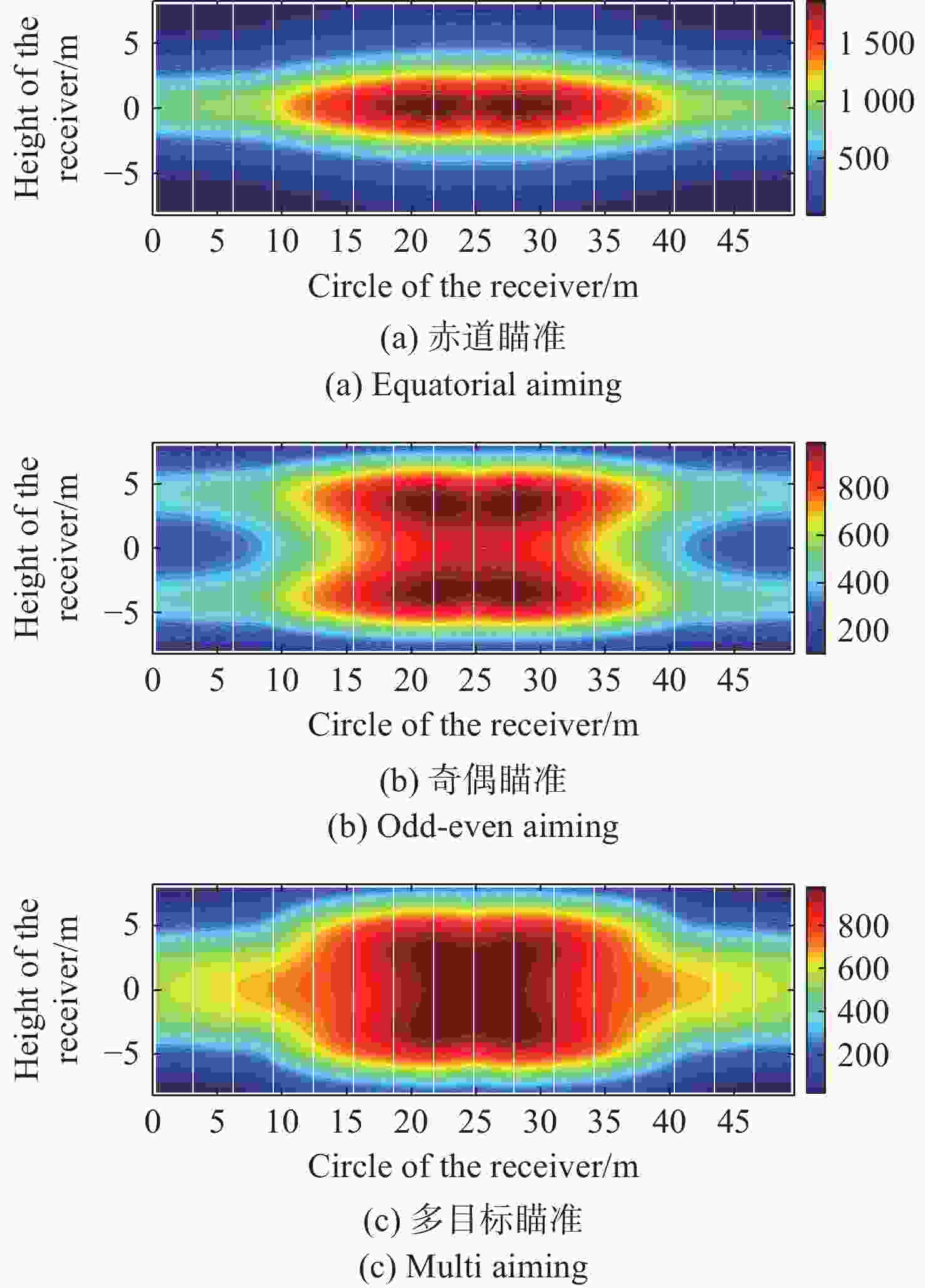
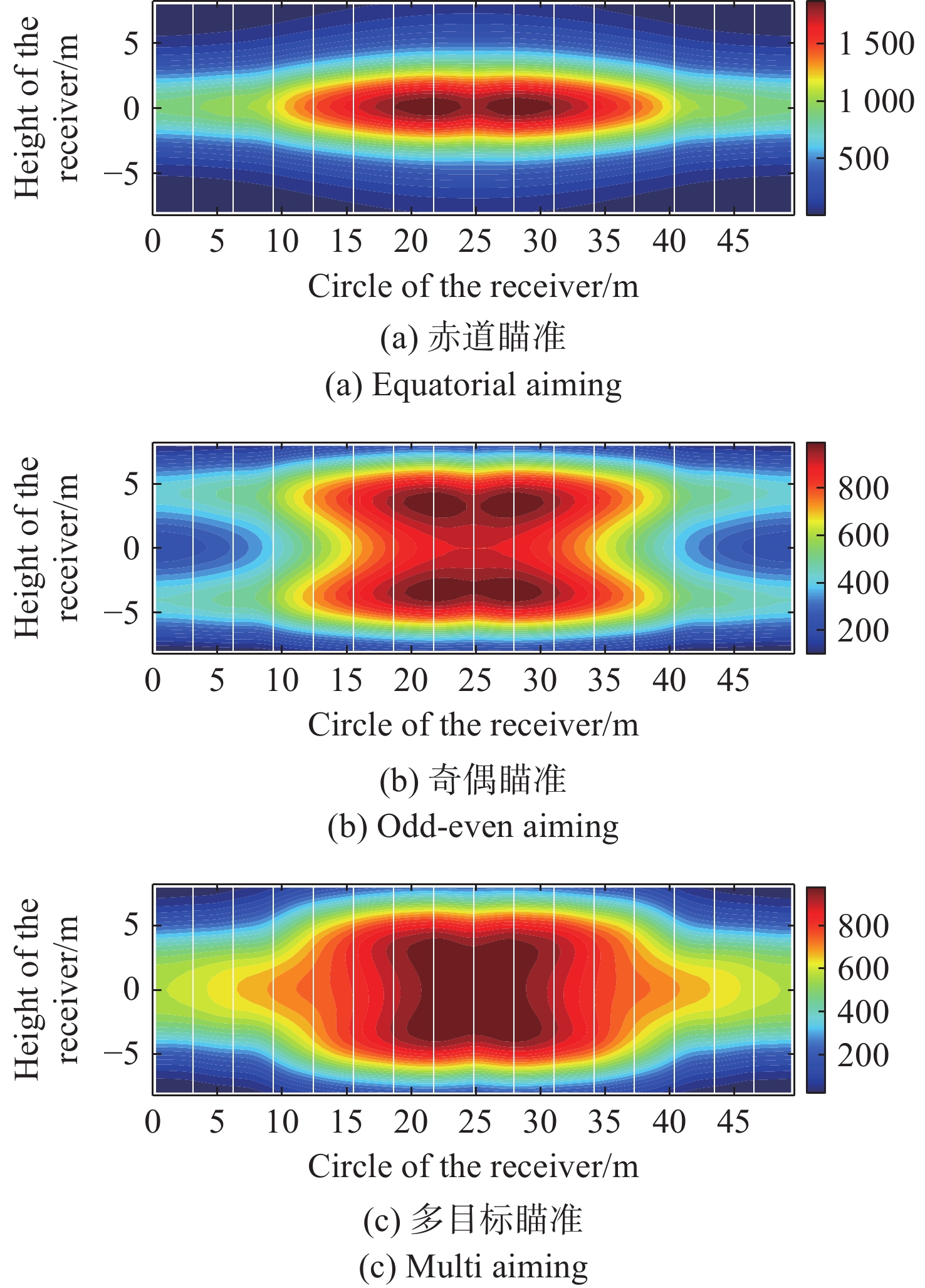
图 5 不同瞄准策略的圆柱形吸热器能流分布图
Figure 5. Energy flux distribution of the cylindrical receivers with different aiming strategies
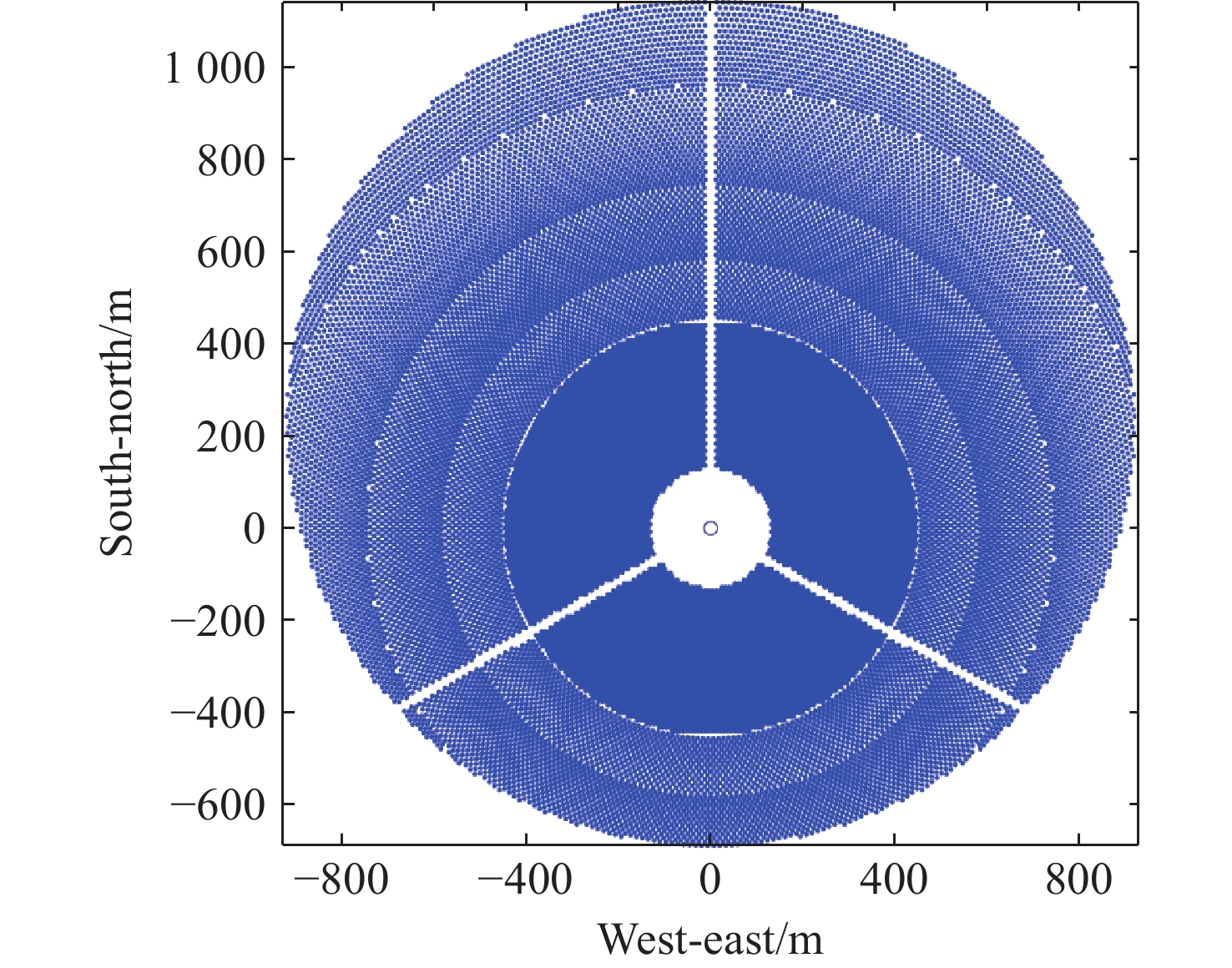
表 1 德令哈地区100 MW光热电站镜场设计参数
Table 1. Designed parameters of the 100 MW heliostat field for the Delingha solar power tower station
参数名称 数值 地理纬度/° 37.36 定日镜数/面 26667 立柱高度/m 3.2 定日镜高度/m 4.81 定日镜宽度/m 6.29 有效反射面积/m2 30 镜面反射率 0.94 塔光学高度/m 220 吸热器高度/m 16.4 吸热器直径/m 15.8  下载: 导出CSV
表 2 赤道瞄准、奇偶瞄准、多目标瞄准在典型日结果对比
Table 2. Comparison of results for equatorial aiming, odd-even aiming, and multi aiming on typical days
典型日(天) 时刻(h) DNI(KW/m2) 瞄准因子[$ {K}_{1},{K}_{2},{K}_{3} $] 峰值能流(MW/m2) 截断因子(%) $ \Delta {f}_{{\mathrm{int}}} $(%) CV 春分日(81) 12.0 0.850 赤道瞄准 1.9431 82.02 0.0 0.4503 [1.8] 1.0268 79.79 −2.23 0.2155 [2.0,2.5,3.0] 1.0171 81.16 −0.86 0.2103 夏至日(172) 12.0 0.972 赤道瞄准 2.0974 82.24 0.0 0.4641 [1.8] 1.1036 79.96 −2.28 0.1822 [2.0,2.5,3.0] 1.1214 81.29 −0.95 0.1617 秋分日(264) 12.0 0.964 赤道瞄准 2.2012 82.02 0.0 0.4501 [1.8] 1.1647 79.78 −2.24 0.2096 [2.0,2.5,3.0] 1.1859 81.14 −0.88 0.2019 冬至日(345) 12.0 0.882 赤道瞄准 1.9698 80.65 0.0 0.4507 [3.0] 1.0578 78.51 −2.14 0.2299 [2.0,2.5,3.0] 1.1026 80.07 −0.58 0.2259
下载: 导出CSV
-
[1] 吕子奎, 房方. 基于能量流的塔式太阳能热发电吸热器动态建模[J]. 太阳能学报, 2022, 43(6): 132-137. doi: 10.19912/j.0254-0096.tynxb.2020-1031LYU Z K, FANG F. Dynamic modeling of solar tower receiver based on energy flow[J]. Acta Energiae Solaris Sinica, 2022, 43(6): 132-137. (in Chinese). doi: 10.19912/j.0254-0096.tynxb.2020-1031 [2] MOURAD A, AISSA A, SAID Z, et al. Recent advances on the applications of phase change materials for solar collectors, practical limitations, and challenges: a critical review[J]. Journal of Energy Storage, 2022, 49: 104186. doi: 10.1016/j.est.2022.104186 [3] JIANG K J, TIAN Z Q, ZHANG Q, et al. Dynamic response characteristics of molten salt solar tower power plant utilizing coordinated control strategies for optimized peak shaving performance[J]. Case Studies in Thermal Engineering, 2025, 75: 107061. doi: 10.1016/j.csite.2025.107061 [4] LI X Y, BAI F W. A review on the thermal modeling method for molten salt receivers of concentrating solar power tower plants[J]. Energies, 2025, 18(2): 292. doi: 10.3390/en18020292 [5] OBERKIRSCH L, ZANGER D A V, QUINTO D M, et al. Static optimal control: Real-time optimization within closed-loop aim point control for solar power towers[J]. Solar Energy, 2023, 255: 327-338. doi: 10.1016/j.solener.2023.03.051 [6] ELFEKY K E, WANG Q W. Techno-economic assessment and optimization of the performance of solar power tower plant in Egypt's climate conditions[J]. Energy Conversion and Management, 2023, 280: 116829. doi: 10.1016/j.enconman.2023.116829 [7] SÁNCHEZ-GONZÁLEZ A, KONTOPYRGOS M, MILIDONIS K, et al. Heliostat field aiming strategy based on deterministic optimization: an experimental validation[J]. Renewable Energy, 2024, 236: 121406. doi: 10.1016/j.renene.2024.121406 [8] CUI M SH, ZHANG Q, JIANG K J, et al. A multi-objective control strategy for molten salt external receiver in solar tower power plant[J]. Applied Thermal Engineering, 2025, 275: 126818. doi: 10.1016/j.applthermaleng.2025.126818 [9] VANT-HULL L L. The role of “allowable flux density” in the design and operation of molten-salt solar central receivers[J]. Journal of Solar Energy Engineering, 2002, 124(2): 165-169. doi: 10.1115/1.1464124 [10] SÁNCHEZ-GONZÁLEZ A, RODRÍGUEZ-SÁNCHEZ M R, SANTANA D. Aiming factor to flatten the flux distribution on cylindrical receivers[J]. Energy, 2018, 153: 113-125. doi: 10.1016/j.energy.2018.04.002 [11] SÁNCHEZ-GONZÁLEZ A, RODRÍGUEZ-SÁNCHEZ M R, SANTANA D. Aiming strategy model based on allowable flux densities for molten salt central receivers[J]. Solar Energy, 2017, 157: 1130-1144. doi: 10.1016/j.solener.2015.12.055 [12] COLLADO F J, GUALLAR J. A two-parameter aiming strategy to reduce and flatten the flux map in solar power tower plants[J]. Solar Energy, 2019, 188: 185-189. doi: 10.1016/j.solener.2019.06.001 [13] RAJ M, BHATTACHARYA J. Precise and fast spillage estimation for a central receiver tower based solar plant[J]. Solar Energy, 2023, 265: 112103. doi: 10.1016/j.solener.2023.112103 [14] COLLADO F J, GUALLAR J. Fast and reliable flux map on cylindrical receivers[J]. Solar Energy, 2018, 169: 556-564. doi: 10.1016/j.solener.2018.05.037 [15] SÁNCHEZ-GONZÁLEZ A, SANTANA D. Solar flux distribution on central receivers: a projection method from analytic function[J]. Renewable Energy, 2015, 74: 576-587. doi: 10.1016/j.renene.2014.08.016 [16] RIZVI A A, DANISH S N, EL-LEATHY A, et al. A review and classification of layouts and optimization techniques used in design of heliostat fields in solar central receiver systems[J]. Solar Energy, 2021, 218: 296-311. doi: 10.1016/j.solener.2021.02.011 [17] 吴凡路, 闫得杰, 姬琪, 等. 天问一号星下点太阳高度角在轨实时计算方法[J]. 光学 精密工程, 2022, 30(2): 210-216. doi: 10.37188/OPE.20223002.0210WU F L, YAN D J, JI Q, et al. On-orbit real-time calculation method of solar elevation angle of sub-satellite point of Tianwen-1[J]. Optics and Precision Engineering, 2022, 30(2): 210-216. (in Chinese). doi: 10.37188/OPE.20223002.0210 [18] 魏秀东, 张凡, 许英朝. 基于摄影测量的定日镜面形误差检测方法研究[J]. 中国光学(中英文), 2023, 16(2): 425-433.WEI X D, ZHANG F, XU Y CH. The measurement method of heliostat surface shape error based on photogrammetry[J]. Chinese Optics, 2023, 16(2): 425-433. (in Chinese). [19] ASTOLFI M, BINOTTI M, MAZZOLA S, et al. Heliostat aiming point optimization for external tower receiver[J]. Solar Energy, 2017, 157: 1114-1129. doi: 10.1016/j.solener.2016.03.042 [20] 常宁东, 冯春, 程鹏达, 等. 基于Bekker理论改进遗传算法的野外路径优化方法研究[J]. 光学 精密工程, 2023, 31(5): 767-775. doi: 10.37188/OPE.20233105.0767CHANG N D, FENG CH, CHENG P D, et al. Research on off-road path optimization algorithm based on Bekker theory improved genetic algorithm[J]. Optics and Precision Engineering, 2023, 31(5): 767-775. (in Chinese). doi: 10.37188/OPE.20233105.0767 [21] 杨健, 赵宏宇. 浮点数编码改进遗传算法在平面度误差评定中的研究[J]. 光学 精密工程, 2017, 25(3): 706-711. doi: 10.3788/OPE.20172503.0706YANG J, ZHAO H Y. The research of floating-point codingimproved genetic algorithmin flatnesserror evaluation[J]. Optics and Precision Engineering, 2017, 25(3): 706-711. (in Chinese). doi: 10.3788/OPE.20172503.0706 -

 下载:
下载:

计量
- 文章访问数: 878
- HTML全文浏览量: 445
- PDF下载量: 38
- 被引次数: 0
