


Design and implementation of a full-chain dynamic simulation system for space-based gravitational wave detection
-
摘要:
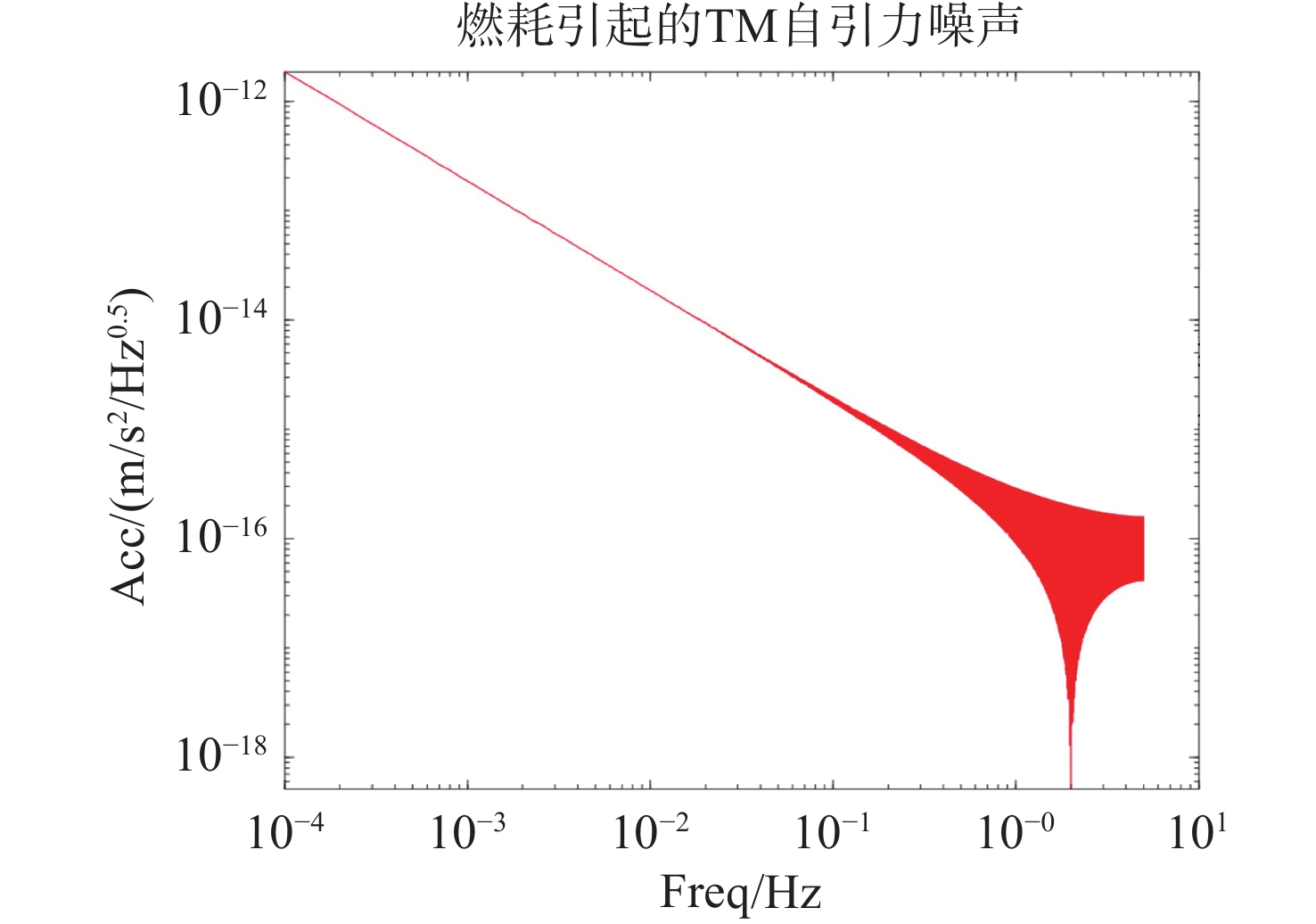
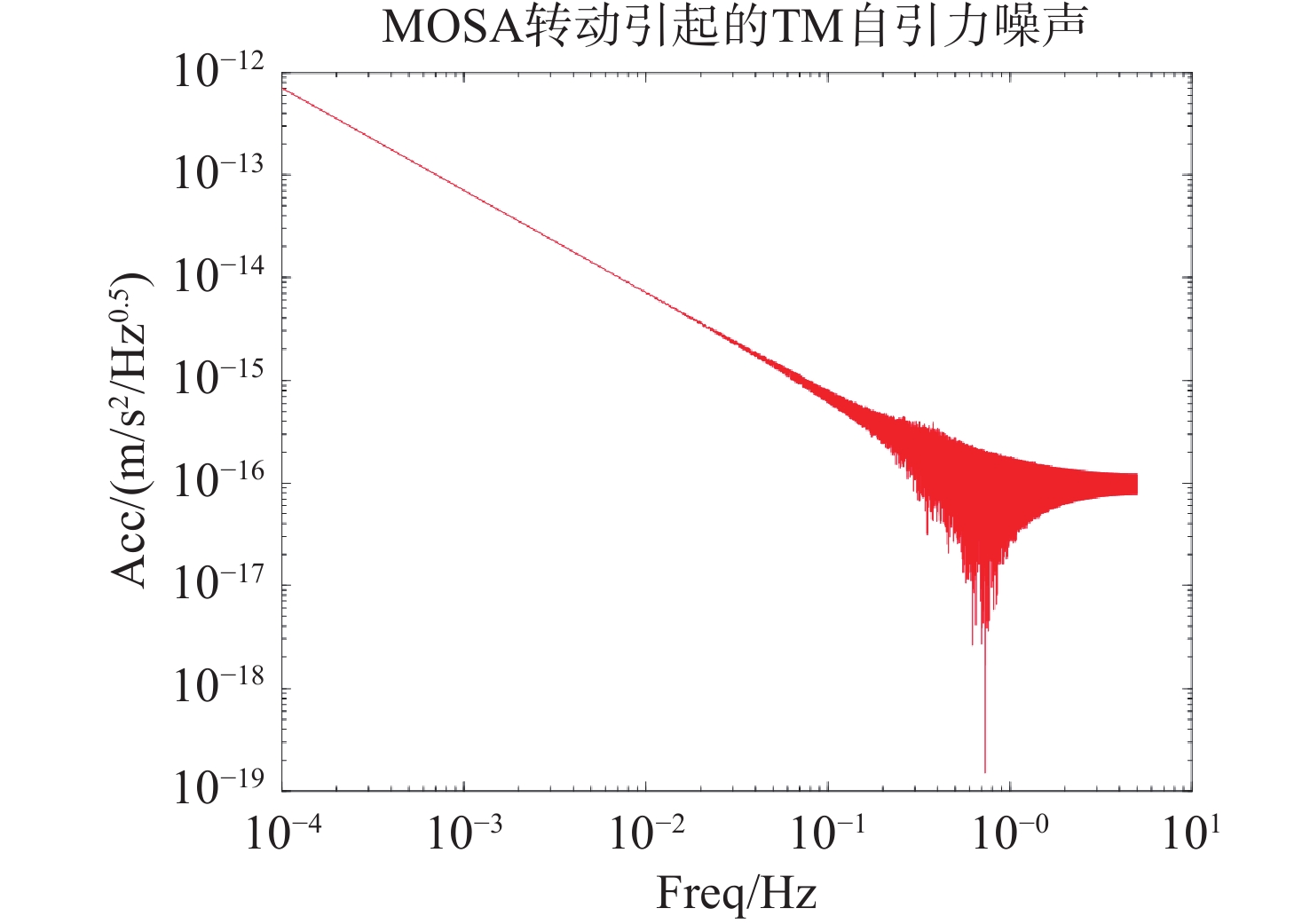
针对空间引力波探测中传统静态噪声叠加方法未考虑多物理场与控制系统之间动态耦合、难以满足高保真度任务仿真需求的问题,本文提出并设计了一套空间引力波探测全链路动态仿真系统,建立了多物理场与控制系统之间的闭环反馈能力。该系统采用动态闭环架构,包含航天器多物理场仿真模块、全链路噪声仿真模块、无拖曳控制仿真模块及数据处理分析模块。其中,物理场状态基于控制作用后的航天器状态计算生成,噪声由物理场状态经全链路噪声模型映射生成。该系统实现了全链路噪声的物理源头追溯与动态仿真。仿真实验发现,可移动光学组件(MOSA)运动与燃料消耗引起的自引力加速度扰动在观测频段(0.1 mHz~1 Hz)内可达10−13 m·s−2· Hz−1/2量级以上,需通过高精度在轨测量与标定等方法进行补偿或扣除。所构建的系统能够捕捉静态模型忽略的动态耦合效应,为空间引力波探测的任务设计、噪声溯源与灵敏度评估提供高保真度仿真平台。
Abstract:To address the issue that traditional static noise superposition methods in space-based gravitational wave detection neglect the dynamic coupling between multi-physics fields and the control system, making it difficult to meet the requirements of high-fidelity mission simulations, it is proposed and designed that a full-chain dynamic simulation system for space-based gravitational wave detection, establishing closed-loop feedback capability between the multi-physics fields and the control system. The system adopts a dynamic closed-loop architecture, comprising a spacecraft multi-physics field simulation module, a full-chain noise simulation module, a drag-free control simulation module, and a data processing and analysis module. In this architecture, the physical field states are computed based on the spacecraft states after control, and noises are generated through full-chain noise models mapped from the physical field states. The system achieves physical source tracing and dynamic simulation of full-chain noises. Simulation experiments reveal that self-gravity acceleration disturbances induced by the motion of the Movable Optical Sub-Assembly (MOSA) and fuel consumption can reach 10−13 m·s−2· Hz−1/2 level in the observation frequency band(0.1 mHz-1 Hz), necessitating compensation or subtraction through high-precision in-orbit measurement and calibration methods. The constructed system is capable of capturing dynamic coupling effects neglected by static models, thereby providing a high-fidelity simulation platform for mission design, noise source tracing and sensitivity evaluation in space-based gravitational wave detection.
-
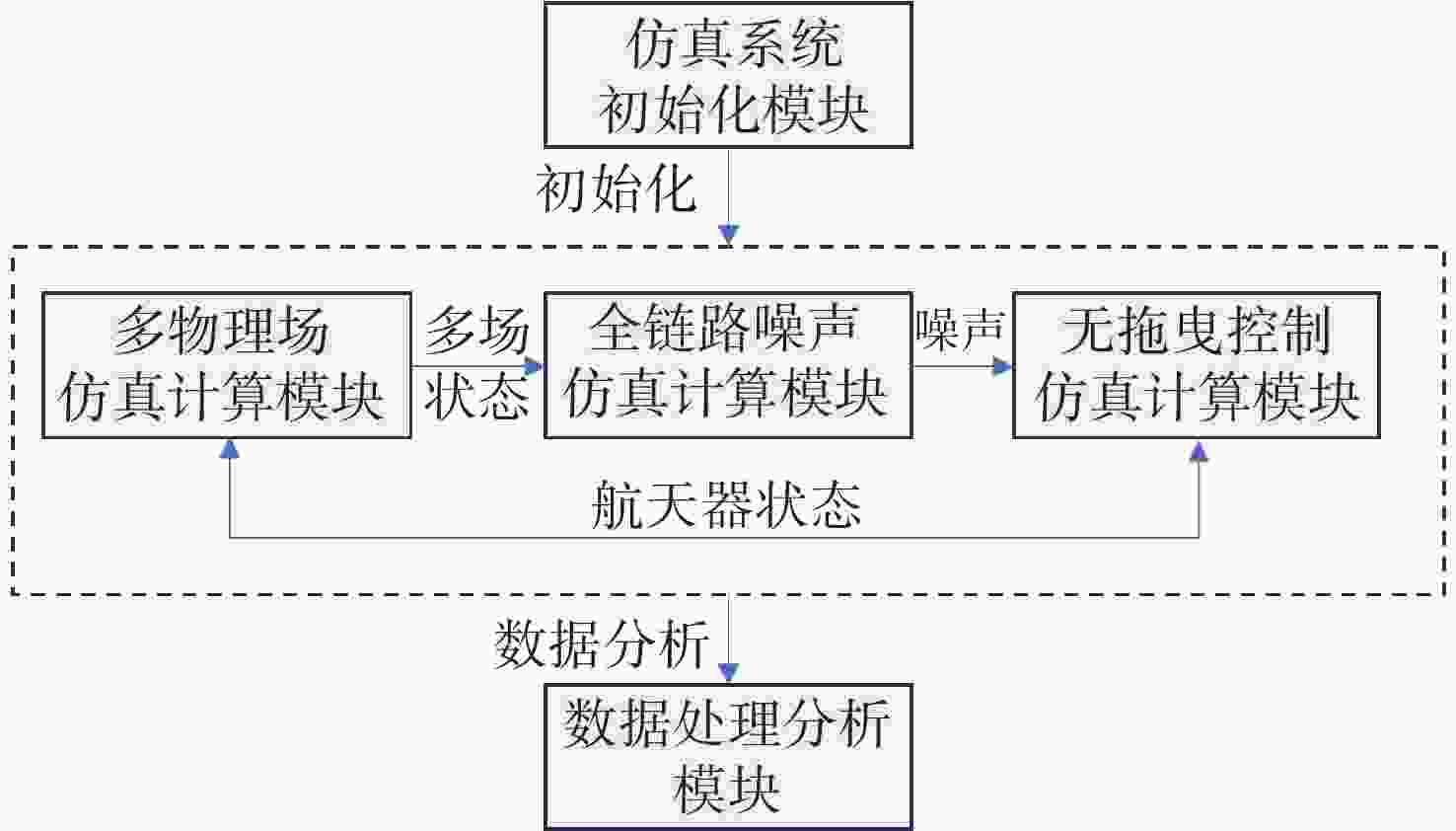
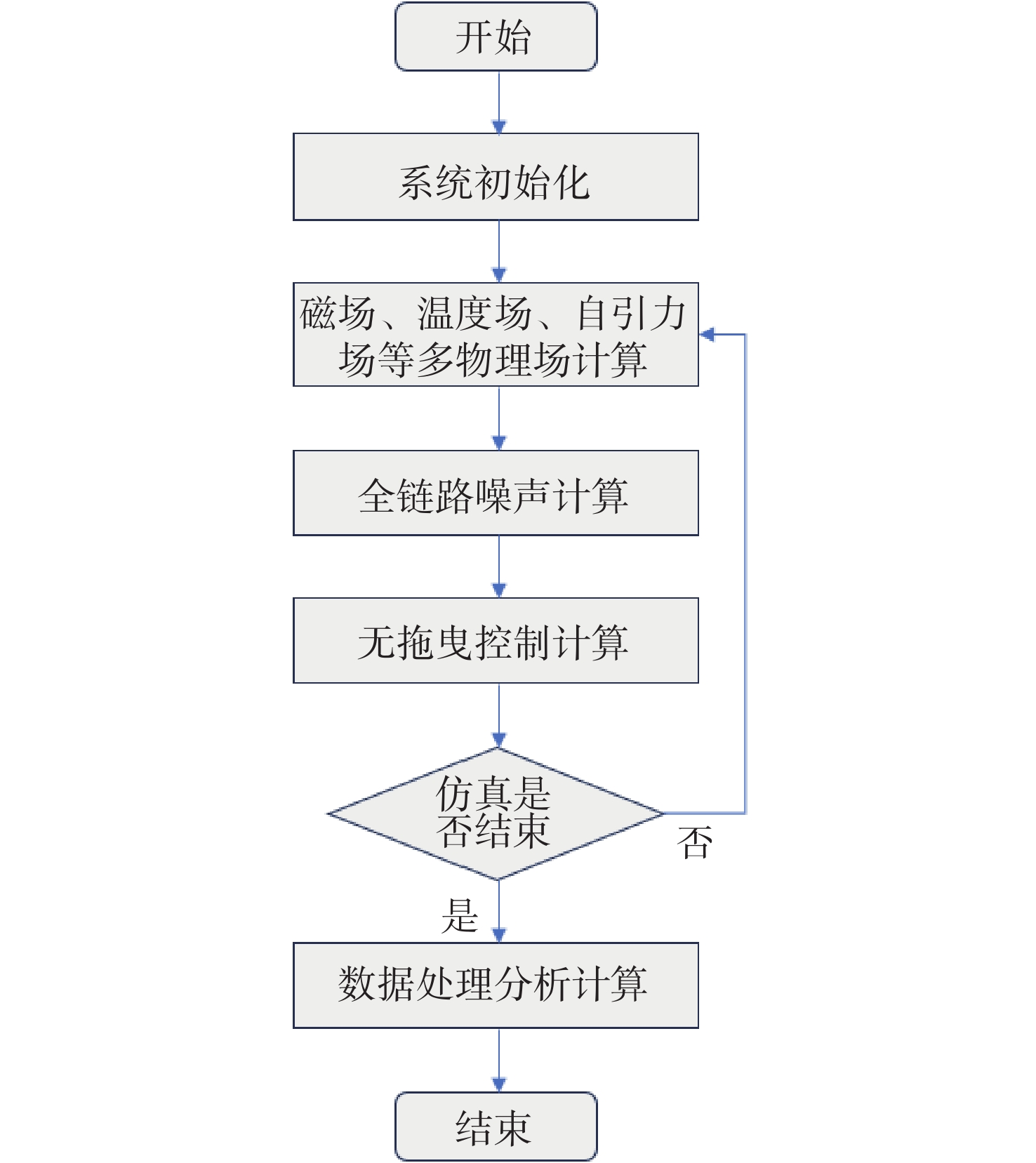
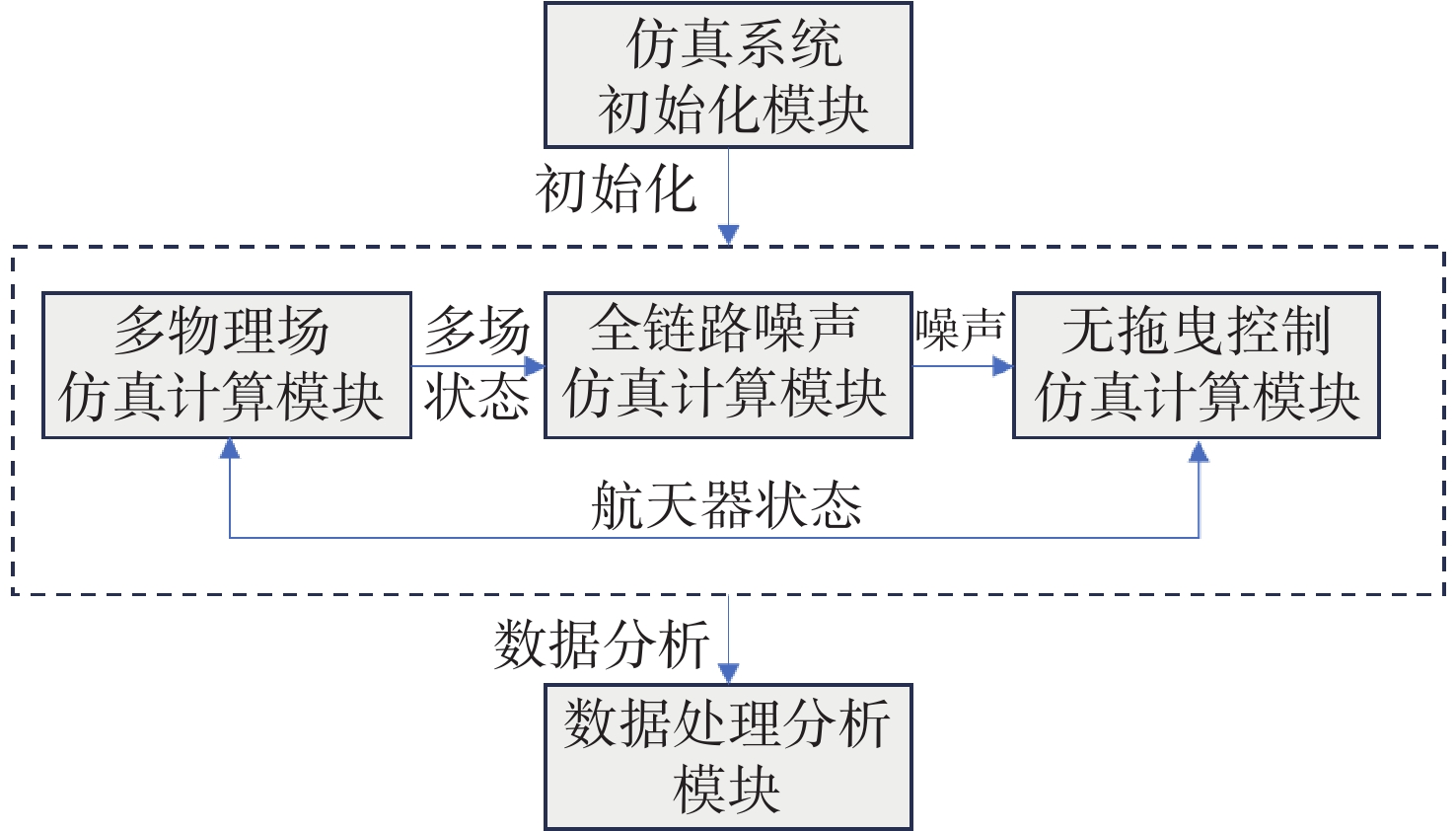
图 1 全链路仿真系统核心模块关系示意图
Figure 1. Core module relationship diagram of the full-chain simulation system
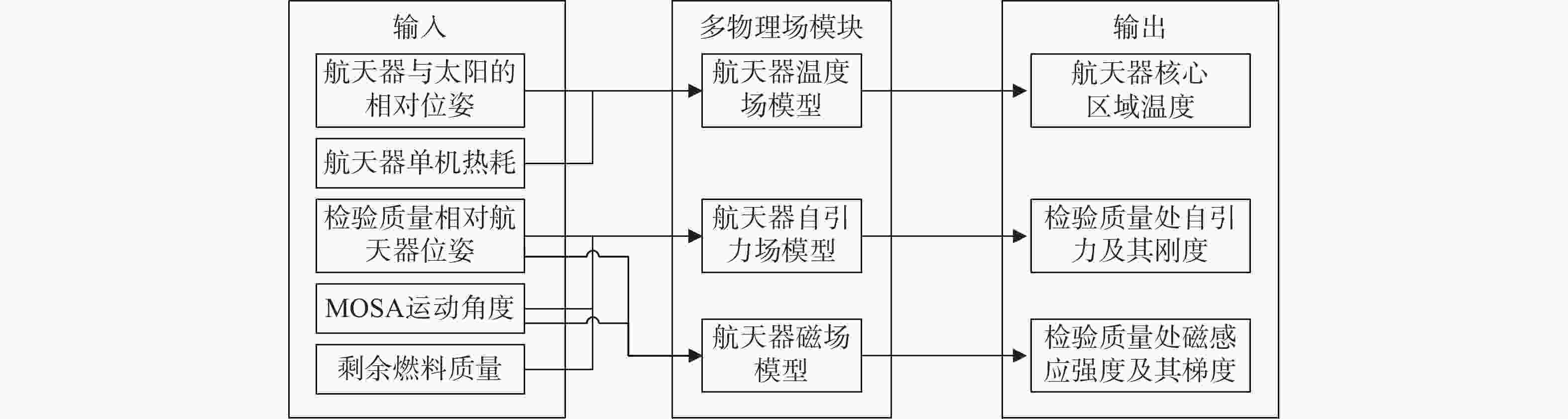
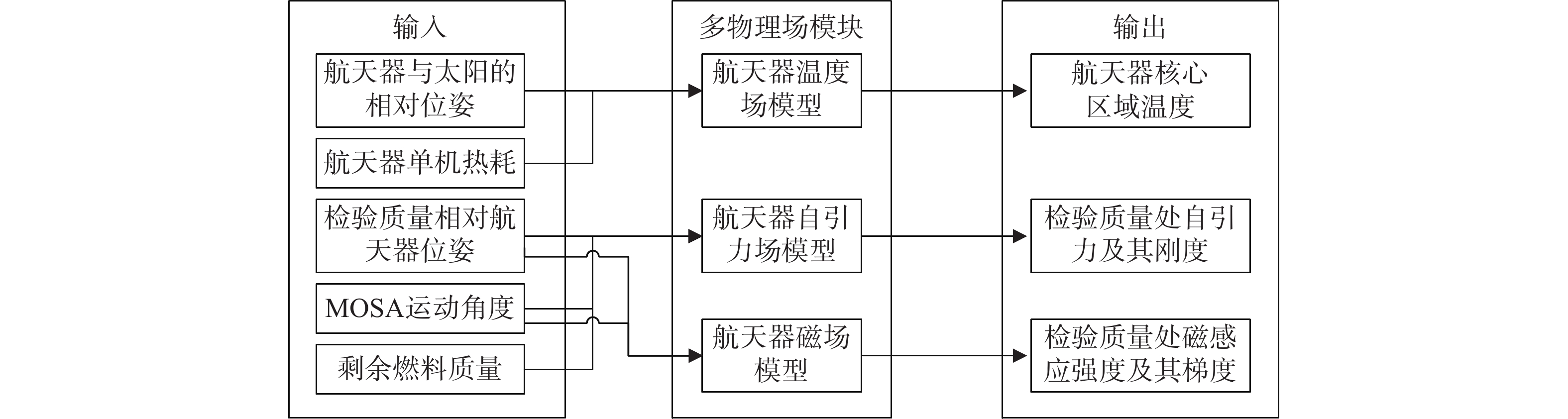
图 2 航天器多物理场仿真计算模块接口示意图
Figure 2. Interface diagram of the spacecraft multi-physics simulation module
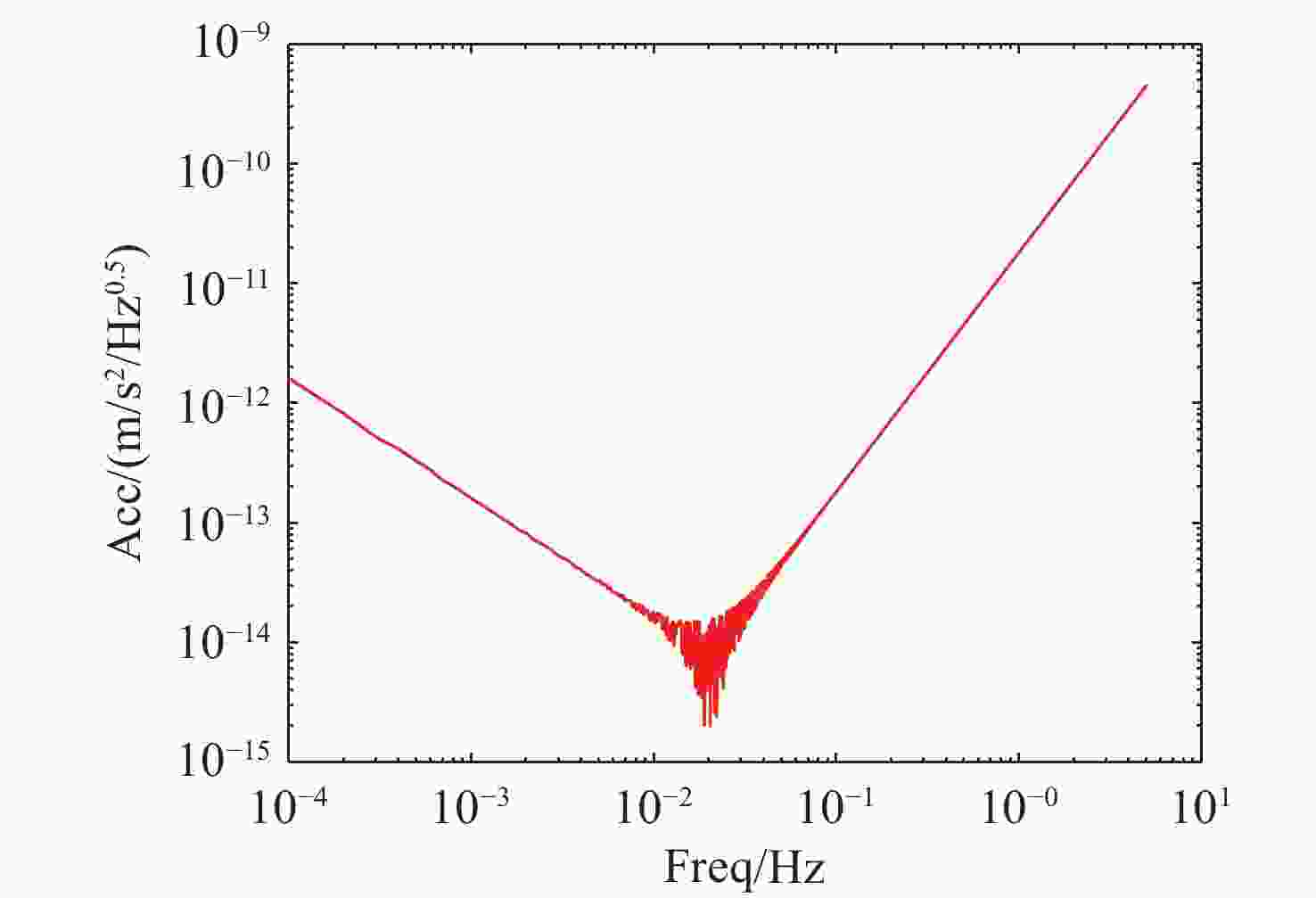
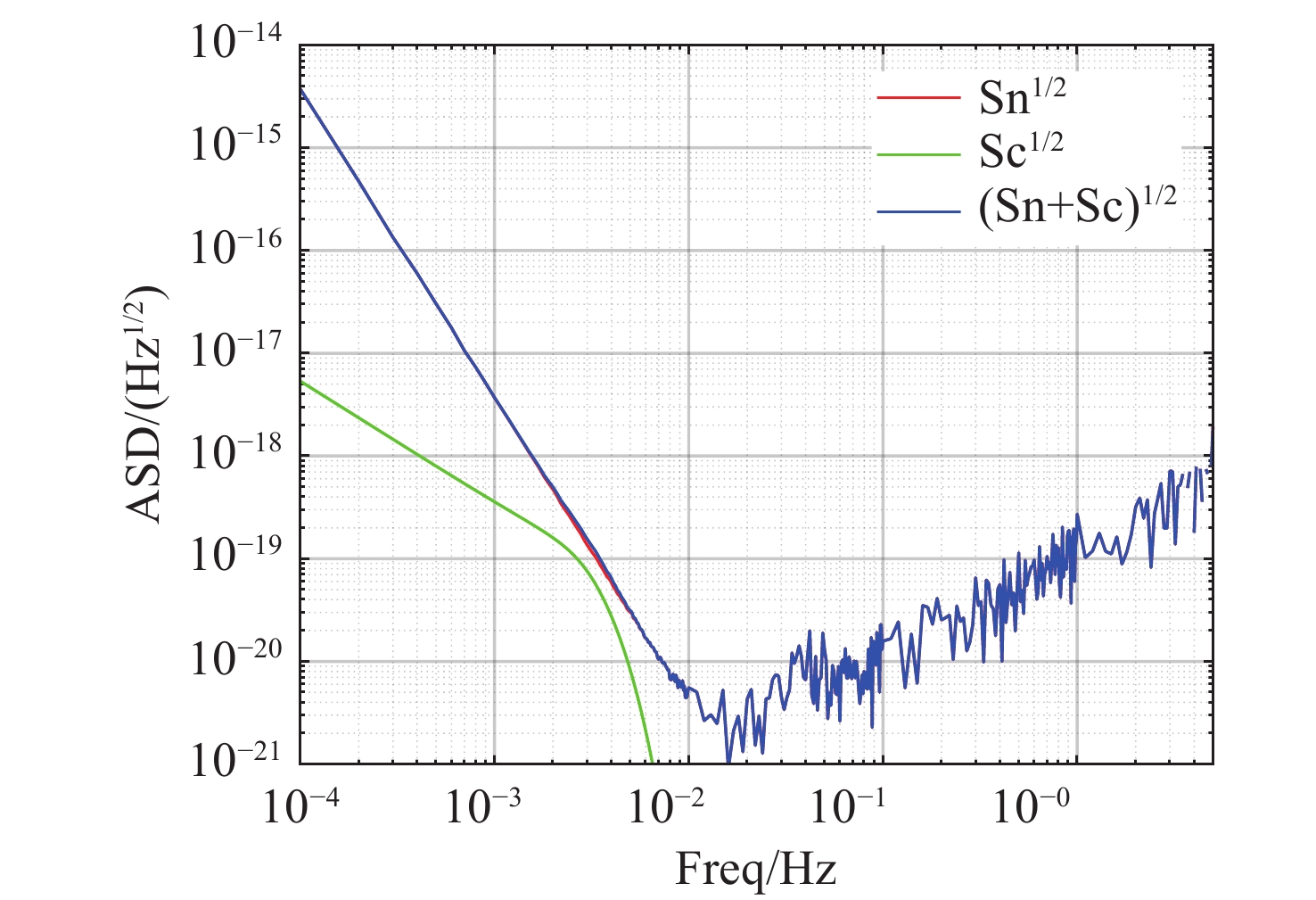
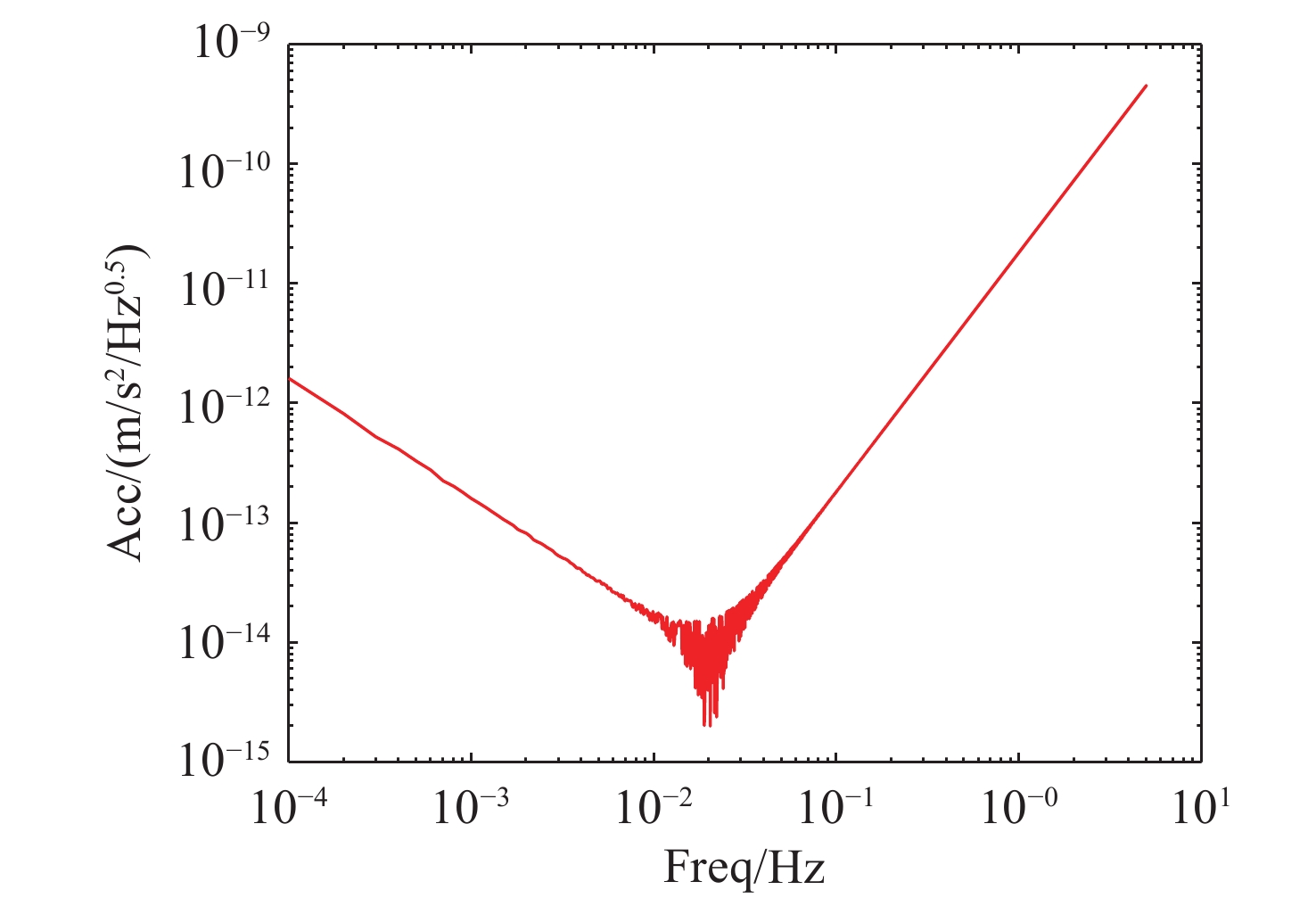
图 10 总残余加速度噪声频域曲线
Figure 10. Frequency-domain curve of total residual acceleration noise
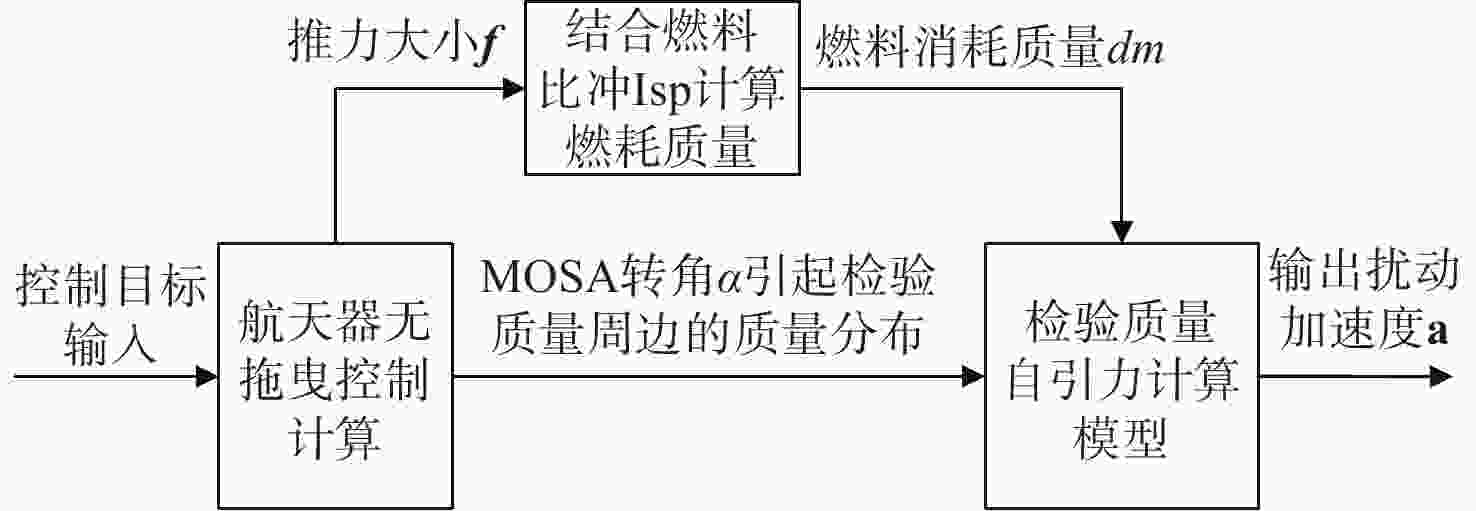
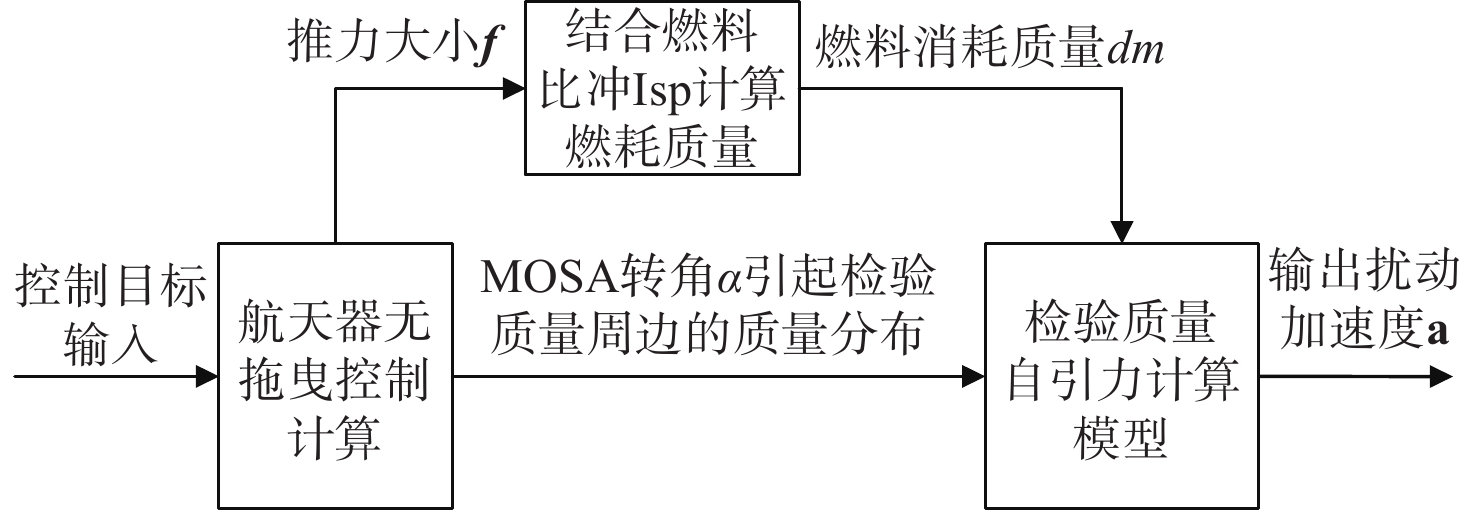
图 17 燃耗与MOSA运动引起的自引力实时计算示意图
Figure 17. Real-time self-gravity calculation schematic for fuel consumption and MOSA motion
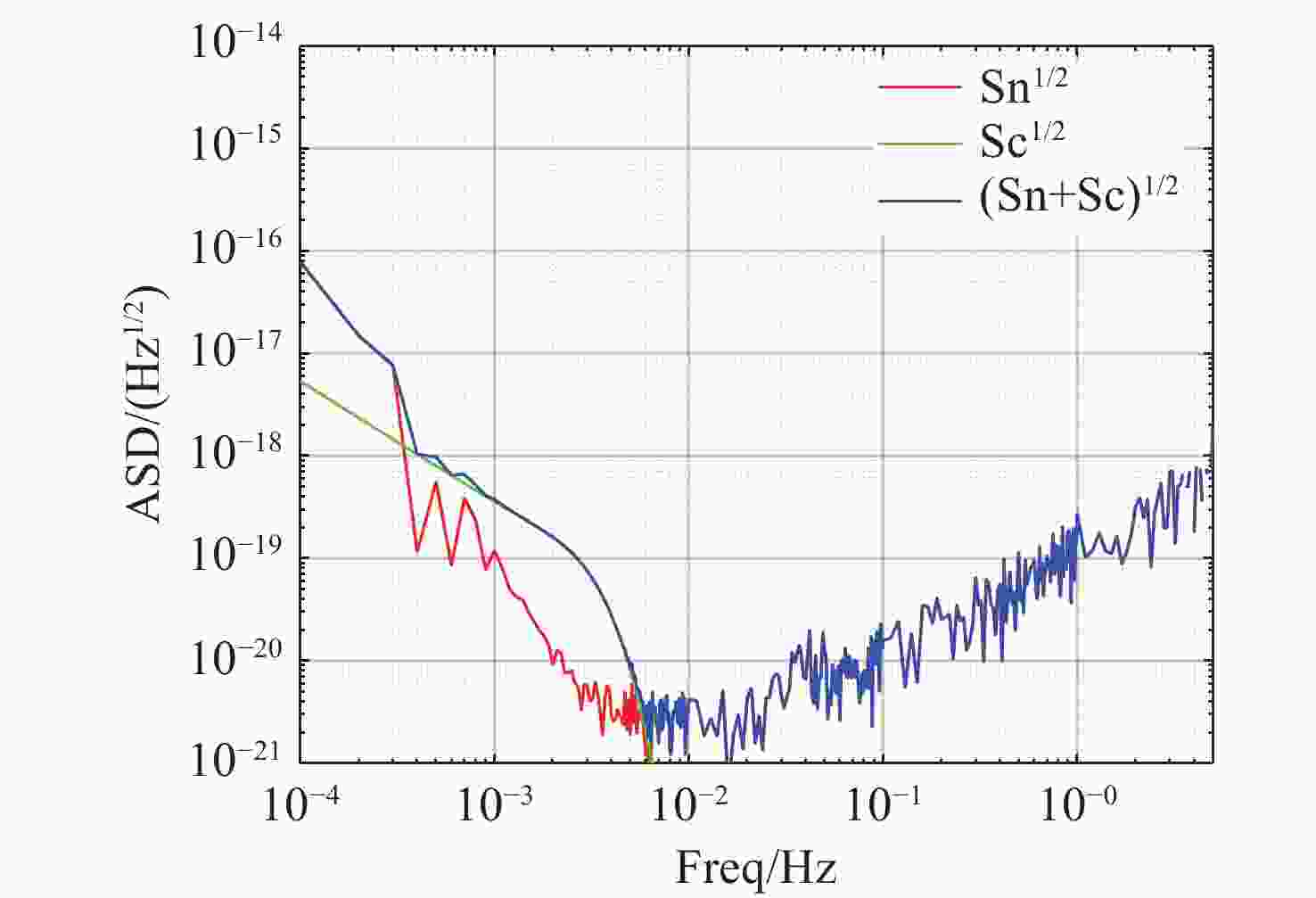
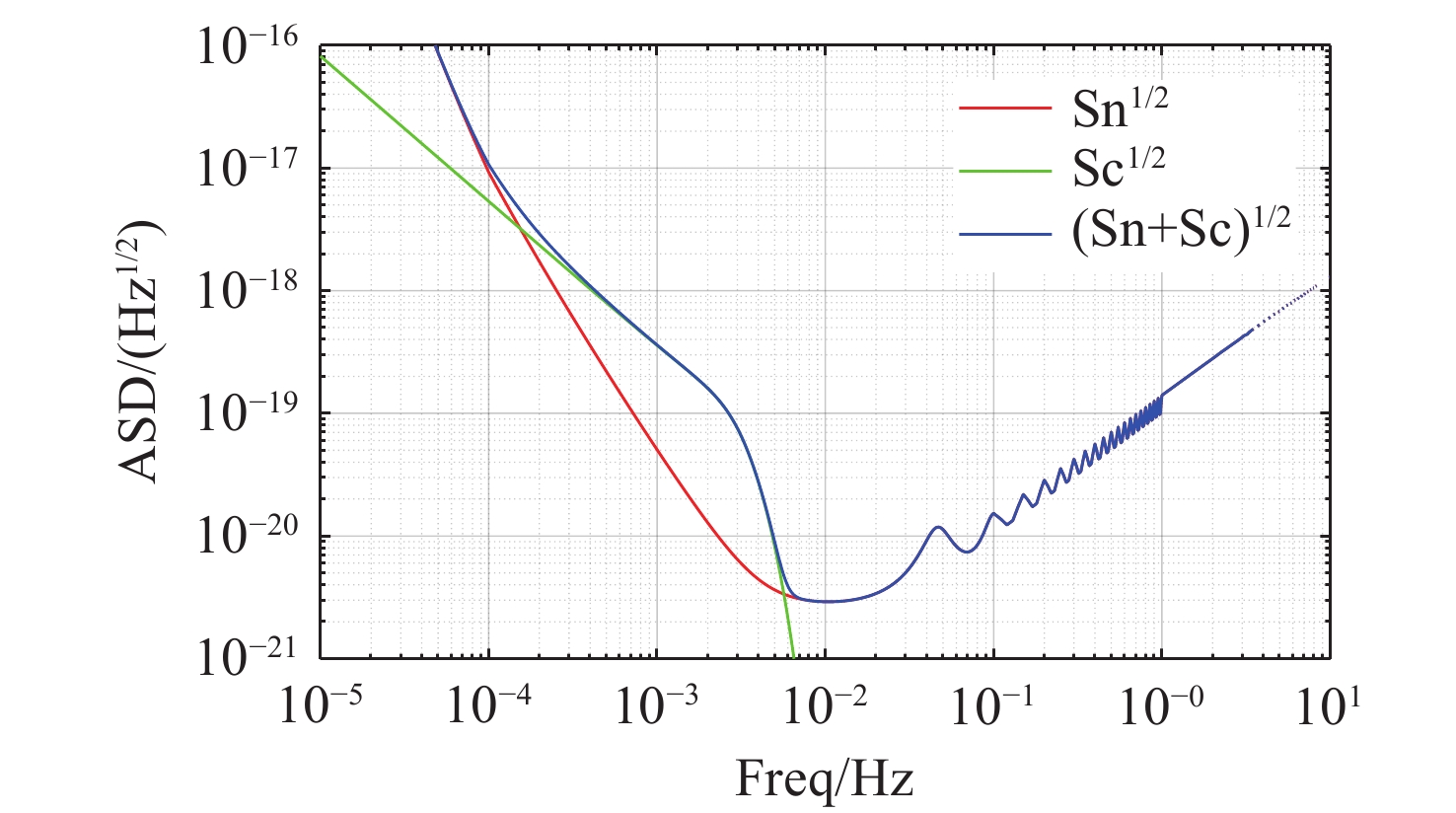
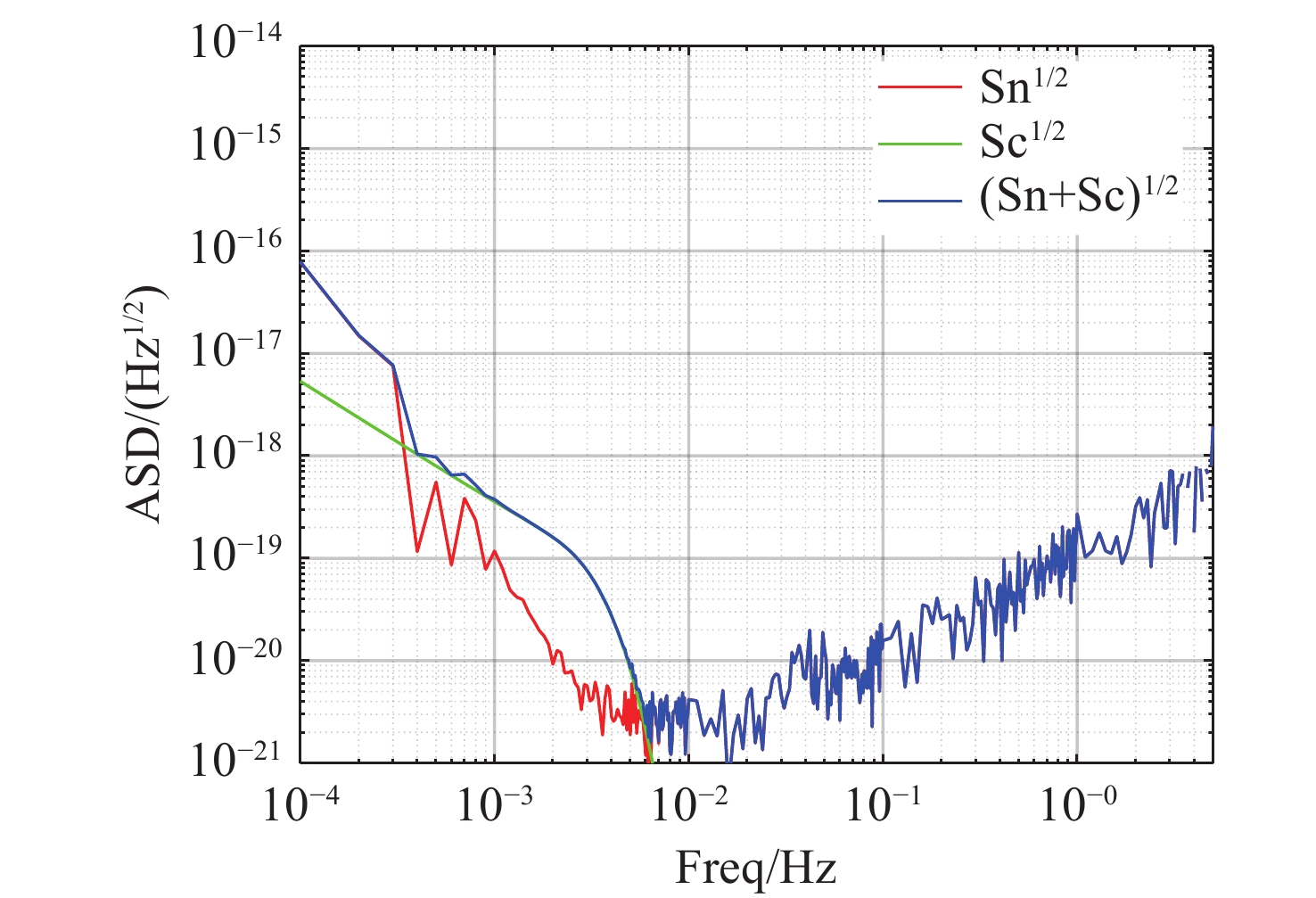
图 18 不考虑燃料消耗与MOSA运动后的灵敏度仿真曲线
Figure 18. Sensitivity curve without considering fuel consumption and MOSA motion
表 1 系统初始化参数
Table 1. Initial parameters configuration
序号 参数名称 参数初值 单位 1. 航天器1轨道初始位置(J2000.0日心黄道惯性系) [ 23957187920.4373 ,147231689435.394 ,
−743327719.789878 ]m 2. 航天器1轨道初始速度(J2000.0日心黄道惯性系) [− 29456.6666347458 ,4946.21532689005 ,259.702466544323 ]m/s 3. 航天器2轨道初始位置(J2000.0日心黄道惯性系) [ 25656431536.5843 ,148250892153.976 ,1495414337.05697 ]m 4. 航天器2轨道初始速度(J2000.0日心黄道惯性系) [− 29179.5437631783 ,5049.83621726837 ,0.103103604679852 ]m/s 5. 航天器3轨道初始位置(J2000.0日心黄道惯性系) [ 26914335435.3447 ,146719986739.374 ,
−743338173.419257 ]m 6. 航天器3轨道初始速度(J2000.0日心黄道惯性系) [− 29405.7565753330 ,5240.56479108545 ,
−259.494463138804 ]m/s 7. 检验质量块质量 1.95 kg 8. 检验质量边长 0.046 m 9. 检验质量磁化率 3e-6 / 10. 检验质量剩磁矩 2e-8 A·m2 11. 检验质量残余电荷量 1.6022e-12 C 12. 检验质量与电极的间隙 0.004 m 13. 激光波长 1.064e-6 m 14. 外差频率 1.8e7 Hz 15. 外差干涉效率 0.7 / 16. 调制深度 0.53 / 17. 光纤温度稳定系数 1e-12 rad·K−1·m−1· Hz−1 18. 电缆温度稳定系数 7e-12 rad·K−1·m−1· Hz−1 19. 本地激光功率 0.00175 W 20. 航天器接收激光功率 1.77e-9 W 21. 检验质量接收激光功率 1e-4 W 22. 激光相对功率波动 1e-4 Hz−1/2 23. 星间测距误差 0.1 m 24. 时钟稳定性 4e-14 s·Hz−1/2 25. 出气因子 2.5 / 26. 残余气体质量 6.65e-27 kg 27. 残余气体压强 1e-6 pa  下载: 导出CSV
-
[1] 罗子人, 白姗, 边星, 等. 空间激光干涉引力波探测[J]. 力学进展, 2013, 43(4): 415-447.LUO Z R, BAI SH, BIAN X, et al. Gravitational wave detection by space laser interferometry[J]. Advances in Mechanics, 2013, 43(4): 415-447. (in Chinese). [2] ABBOTT B P, ABBOTT R, ABBOTT T D, et al. Observation of gravitational waves from a binary black hole merger[J]. Physical Review Letters, 2016, 116(6): 061102. doi: 10.1103/PhysRevLett.116.061102 [3] WANNER G. Space-based gravitational wave detection and how LISA Pathfinder successfully paved the way[J]. Nature Physics, 2019, 15(3): 200-202. doi: 10.1038/s41567-019-0462-3 [4] DANZMANN K, RÜDIGER A. LISA technology—concept, status, prospects[J]. Classical and Quantum Gravity, 2003, 20(10): S1-S9. doi: 10.1088/0264-9381/20/10/301 [5] PRINCE T A, TINTO M, LARSON S L, et al. LISA optimal sensitivity[J]. Physical Review D, 2002, 66(12): 122002. doi: 10.1103/PhysRevD.66.122002 [6] LUO Z R, GUO Z K, JIN G, et al. A brief analysis to Taiji: science and technology[J]. Results in Physics, 2020, 16: 102918. doi: 10.1016/j.rinp.2019.102918 [7] LUO Z R, WANG Y, WU Y L, et al. The Taiji program: a concise overview[J]. Progress of Theoretical and Experimental Physics, 2021, 2021(5): 05A108. doi: 10.1093/ptep/ptaa083 [8] LYU M H, ZHU L, QU SH B, et al. A finite element method for high-precision calculation of spacecraft self-gravity effects in gravitational wave detection[J]. Acta Astronautica, 2025, 235: 215-222. doi: 10.1016/j.actaastro.2025.05.028 [9] BOND C, BROWN D, FREISE A, et al. Interferometer techniques for gravitational-wave detection[J]. Living Reviews in Relativity, 2016, 19(1): 3. doi: 10.1007/s41114-016-0002-8 [10] 王娟, 齐克奇, 王少鑫, 等. 面向空间引力波探测的激光干涉技术研究进展及展望[J]. 中国科学: 物理学 力学 天文学, 2024, 54(7): 270405.WANG J, QI K Q, WANG SH X, et al. Advance and prospect in the study of laser interferometry technology for space gravitational wave detection[J]. Scientia Sinica Physica, Mechanica & Astronomica, 2024, 54(7): 270405. (in Chinese). [11] 柯俊. 空间惯性传感器中检验质量噪声的理论建模与仿真研究[D]. 武汉: 中国地质大学, 2024.KE J. Theoretical modeling and simulation for the test mass noise of space inertial sensors[D]. Wuhan: China University of Geosciences, 2024. (in Chinese). [12] LIU H SH, WANG J, TAO W, et al. Recent development of the laser interferometer for Taiji space gravitational wave detection[J]. Research, 2026, 9: 1252. doi: 10.34133/research.1252 [13] 方子若, 朱振才, 蔡志鸣, 等. 空间引力波探测航天器光学测距噪声链路指标优化[J]. 中国光学(中英文), 2025, 18(3): 568-582. doi: 10.37188/CO.2024-0185FANG Z R, ZHU ZH C, CAI ZH M, et al. Optimization of optical metrology noise link metrics for space-based gravitational wave detection spacecraft[J]. Chinese Optics, 2025, 18(3): 568-582. (in Chinese). doi: 10.37188/CO.2024-0185 [14] 刘河山, 王娟, 高瑞弘, 等. 太极二号干涉仪系统噪声与指标分解[J]. 空间科学学报, 2025, 45(4): 1047-1057. doi: 10.11728/cjss2025.04.2025-yg02LIU H SH, WANG J, GAO R H, et al. Noise and index decomposition of Taiji-2 interferometer system[J]. Chinese Journal of Space Science, 2025, 45(4): 1047-1057. (in Chinese). doi: 10.11728/cjss2025.04.2025-yg02 [15] SONG J, FAN W T, FANG S J, et al. Optimized design of a gravitational wave telescope system based on pupil aberration[J]. Applied Optics, 2024, 63(7): 1815-1821. doi: 10.1364/AO.515579 [16] SHEN J, WANG SH X, QI K Q, et al. The suppression effect of an imaging system on the geometric tilt-to-length coupling in a test mass interferometer[J]. Photonics, 2024, 11(7): 638. doi: 10.3390/photonics11070638 [17] 崔新旭, 方超, 王智. 引力波望远镜的装调误差对TTL耦合噪声的影响[J]. 光学学报, 2023, 43(19): 1912001. doi: 10.3788/AOS230675CUI X X, FANG CH, WANG ZH. Influence of installation and adjustment error of gravitational wave telescope on TTL noise[J]. Acta Optica Sinica, 2023, 43(19): 1912001. (in Chinese). doi: 10.3788/AOS230675 [18] KULKARNI S. Technology development for ground verification of dimensional stability of the LISA telescope[D]. Gainesville: University of Florida, 2022. [19] SUMNER T J, MUELLER G, CONKLIN J W, et al. Charge induced acceleration noise in the LISA gravitational reference sensor[J]. Classical and Quantum Gravity, 2020, 37(4): 045010. doi: 10.1088/1361-6382/ab5f6e [20] 柴国志, 黄亮, 乔亮, 等. 星上剩磁对惯性传感器的影响[J]. 中国光学, 2019, 12(3): 515-525. doi: 10.3788/CO.20191203.0515CHAI G ZH, HUANG L, QIAO L, et al. Effect of the on-board residual magnetism on inertial sensors[J]. Chinese Optics, 2019, 12(3): 515-525. (in Chinese). doi: 10.3788/CO.20191203.0515 [21] SALA L. Residual test mass acceleration in LISA Pathfinder: in-depth statistical analysis and physical sources[D]. Trento: University of Trento, 2023. [22] ZHANG H Y, XU P, YE Z Q, et al. A systematic approach for inertial sensor calibration of gravity recovery satellites and its application to Taiji-1 mission[J]. Remote Sensing, 2023, 15(15): 3817. doi: 10.3390/rs15153817 [23] BARKE S, WANG Y, ESTEBAN DELGADO J J, et al. Towards a gravitational wave observatory designer: sensitivity limits of spaceborne detectors[J]. Classical and Quantum Gravity, 2015, 32(9): 095004. doi: 10.1088/0264-9381/32/9/095004 [24] ROBSON T, CORNISH N J, LIU CH. The construction and use of LISA sensitivity curves[J]. Classical and Quantum Gravity, 2019, 36(10): 105011. doi: 10.1088/1361-6382/ab1101 [25] HANNEN V M, SMIT M, HOYNG P, et al. End-to-end simulations for the LISA Technology Package[J]. Classical and Quantum Gravity, 2003, 20(10): S261-S271. doi: 10.1088/0264-9381/20/10/329 [26] DU M H, WANG P CH, LUO Z R, et al. Towards realistic detection pipelines of Taiji: new challenges in data analysis and high-fidelity simulations of space-based gravitational wave antenna[J]. Science China Physics, Mechanics & Astronomy, 2026, 69(4): 249501. [27] 汤宁标, 杨中光, 余贤圣, 等. 空间引力波探测器自引力分析与建模方法[J]. 系统工程与电子技术, 2024, 46(12): 4083-4090. doi: 10.12305/j.issn.1001-506X.2024.12.17TANG N B, YANG ZH G, YU X SH, et al. Self-gravity analysis and modeling method of space gravitational wave detector[J]. Systems Engineering and Electronics, 2024, 46(12): 4083-4090. (in Chinese). doi: 10.12305/j.issn.1001-506X.2024.12.17 [28] 高志勇, 王上, 王智. 基于FEM的引力参考传感器自引力计算与补偿[J]. 中国空间科学技术(中英文), 2024, 44(2): 89-97. doi: 10.16708/j.cnki.1000-758X.2024.0025GAO ZH Y, WANG SH, WANG ZH. Calculation and compensation of self-gravity for gravitational reference sensor based on finite element method[J]. Chinese Space Science and Technology, 2024, 44(2): 89-97. (in Chinese). doi: 10.16708/j.cnki.1000-758X.2024.0025 [29] FAN Z CH, JIANG ZH Y, WEI SH L. Nijboer–Zernike approach for far-field propagation simulations in space-based gravitational wave detector[J]. Optics & Laser Technology, 2026, 193: 114266. doi: 10.1016/j.optlastec.2025.114266 [30] 冯建朝, 张晓峰, 梁鸿, 等. 太极二号卫星精密热控关键技术及试验验证[J]. 宇航学报, 2023, 44(1): 132-142. doi: 10.3873/j.issn.1000-1328.2023.01.013FENG J CH, ZHANG X F, LIANG H, et al. Key technology and experimental verification of precision thermal control of Taiji-2 satellite[J]. Journal of Astronautics, 2023, 44(1): 132-142. (in Chinese). doi: 10.3873/j.issn.1000-1328.2023.01.013 [31] TANG N B, FANG Z R, YANG ZH G, et al. Neural network-based self-gravity modeling via mechanism decomposition in space gravitational wave detection[J]. Aerospace Science and Technology, 2026, 169: 111508. doi: 10.1016/j.ast.2025.111508 [32] LIU Y, SHI X J, YANG W ZH, et al. A precise magnetic modeling method for scientific satellites based on a self-attention mechanism and Kolmogorov-Arnold Networks[J]. Astronomical Techniques and Instruments, 2025, 2(1): 1-9. doi: 10.61977/ati2024049 [33] 方子若, 侍行剑, 陈琨, 等. 引力波探测航天器噪声分解及电磁力噪声仿真[J]. 深空探测学报(中英文), 2023, 10(3): 334-342. doi: 10.15982/j.issn.2096-9287.2023.20230013FANG Z R, SHI X J, CHEN K, et al. Gravitational wave detection spacecraft noise decomposition and electromagnetic force noise simulation[J]. Journal of Deep Space Exploration, 2023, 10(3): 334-342. (in Chinese). doi: 10.15982/j.issn.2096-9287.2023.20230013 [34] 王少鑫, 郭纬川, 赵平安, 等. 空间引力波探测惯性传感器及其关键技术[J]. 中国科学: 物理学 力学 天文学, 2024, 54(7): 270404.WANG SH X, GUO W CH, ZHAO P A, et al. Inertial sensor for space gravitational wave detection and its key technologies[J]. Scientia Sinica Physica, Mechanica & Astronomica, 2024, 54(7): 270404. (in Chinese). [35] 范一迪, 王鹏程, 卢苇, 等. 双检验质量无拖曳卫星鲁棒控制[J]. 深空探测学报(中英文), 2023, 10(3): 310-321. doi: 10.15982/j.issn.2096-9287.2023.20230037FAN Y D, WANG P CH, LU W, et al. Robust controller design for drag-free satellites with two test masses[J]. Journal of Deep Space Exploration, 2023, 10(3): 310-321. (in Chinese). doi: 10.15982/j.issn.2096-9287.2023.20230037 [36] 苟兴宇, 王丽娇, 许现民, 等. 位移无拖曳控制的动力学协调条件研究[J]. 宇航学报, 2024, 45(4): 540-549. doi: 10.3873/j.issn.1000-1328.2024.04.006GOU X Y, WANG L J, XU X M, et al. Study on dynamic coordination condition of displacement drag-free control[J]. Journal of Astronautics, 2024, 45(4): 540-549. (in Chinese). doi: 10.3873/j.issn.1000-1328.2024.04.006 [37] YUE CH L, JIAO B H, DANG ZH H, et al. A review on DFACS (II): modeling and analysis of disturbances and noises[J]. Chinese Journal of Aeronautics, 2024, 37(5): 120-147. doi: 10.1016/j.cja.2024.02.013 [38] WANG J H, GUO X, MA ZH J, et al. A low fuel-consumption drag-free tracking approach for space-based gravitational wave detection satellite[J]. IEEE Transactions on Aerospace and Electronic Systems, 2024, 60(2): 1545-1555. doi: 10.1109/TAES.2023.3336827 [39] VIDANO S, NOVARA C, COLANGELO L, et al. The LISA DFACS: a nonlinear model for the spacecraft dynamics[J]. Aerospace Science and Technology, 2020, 107: 106313. doi: 10.1016/j.ast.2020.106313 -

 下载:
下载:

计量
- 文章访问数: 64
- HTML全文浏览量: 30
- PDF下载量: 1
- 被引次数: 0
