


Information matrix-based optimal configuration and fusion attitude determination for multi-fov star sensors
-
摘要:
针对窄视场、长焦距星敏感器易出现滚动轴精度退化和观测几何病态的问题,本文建立含观测权重的全局Fisher信息矩阵模型,基于A、D、E最优性准则推导多视场最优指向关系,并提出多传感器Wahba融合(MSWF)定姿方法。理论分析表明,等权条件下双视场正交、三视场正交及四视场正四面体构型可优化三轴信息分布。以双视场离轴三反星敏感器为例的仿真表明,单视场病态轴误差约为其余两轴的38倍;正交双视场结合MSWF后,总体定姿误差较单视场降低95.4%,较简单平均融合降低29.2%,并能在稀疏星场、随机丢星和动态模糊条件下保持较好的三轴均衡性。结果说明,多视场构型优化与加权星矢融合可有效缓解单视场观测几何限制,为高精度姿态确定提供参考。
Abstract:Narrow-FOV, long-focal-length star sensors suffer from roll-axis degradation and ill-conditioned observation geometry. This paper builds a weighted global Fisher information matrix model. A-, D-, and E-optimality criteria are used to derive optimal multi-FOV pointing relations. A multi-sensor Wahba fusion (MSWF) method is then developed. The analysis shows that orthogonal two-FOV and three-FOV configurations, and a tetrahedral four-FOV configuration, improve three-axis information distribution under equal weights. Simulations with a dual-FOV off-axis TMA star sensor show that the ill-conditioned-axis error of a single FOV is about 38 times that of the other axes. The orthogonal dual-FOV configuration with MSWF reduces the total attitude error by 95.4% relative to a single FOV and by 29.2% relative to simple averaging. It also maintains balanced three-axis performance under sparse-star, random-loss, and motion-blur conditions. The results show that optimized multi-FOV geometry and weighted star-vector fusion can mitigate the geometric limitation of a single FOV.
-
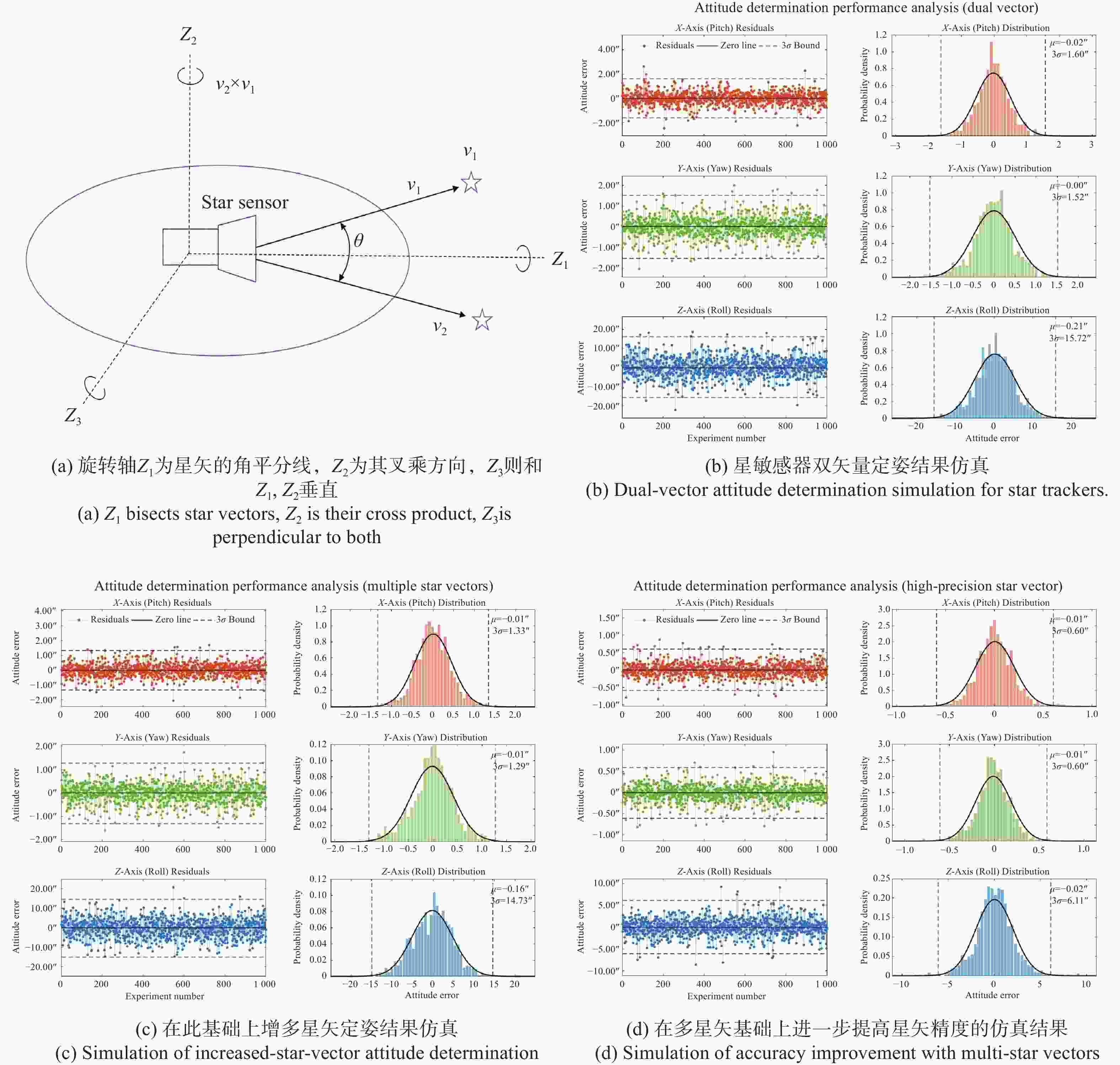
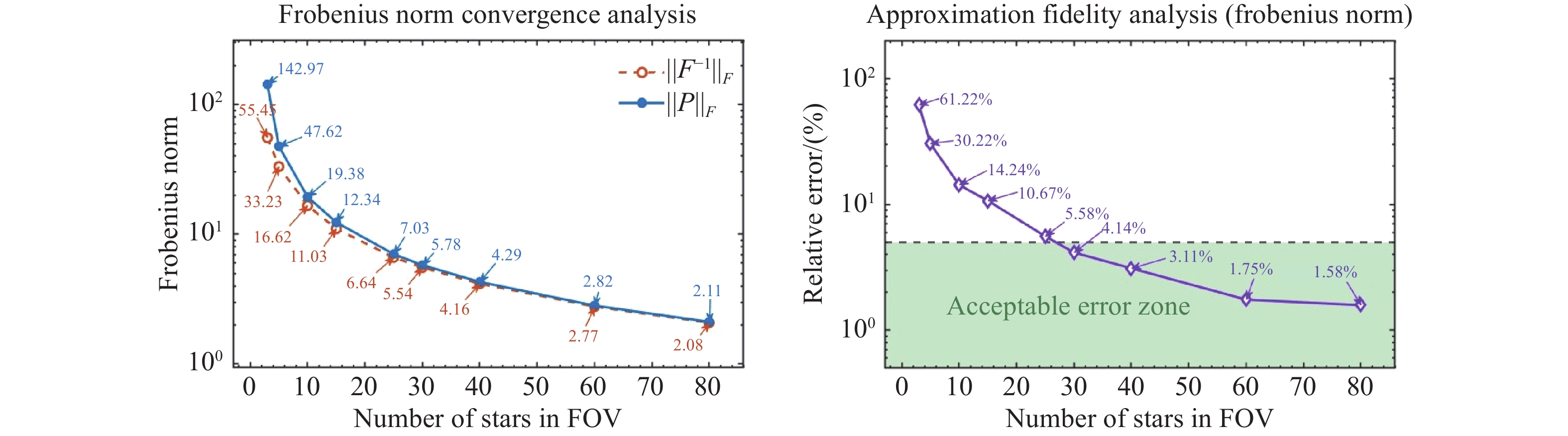
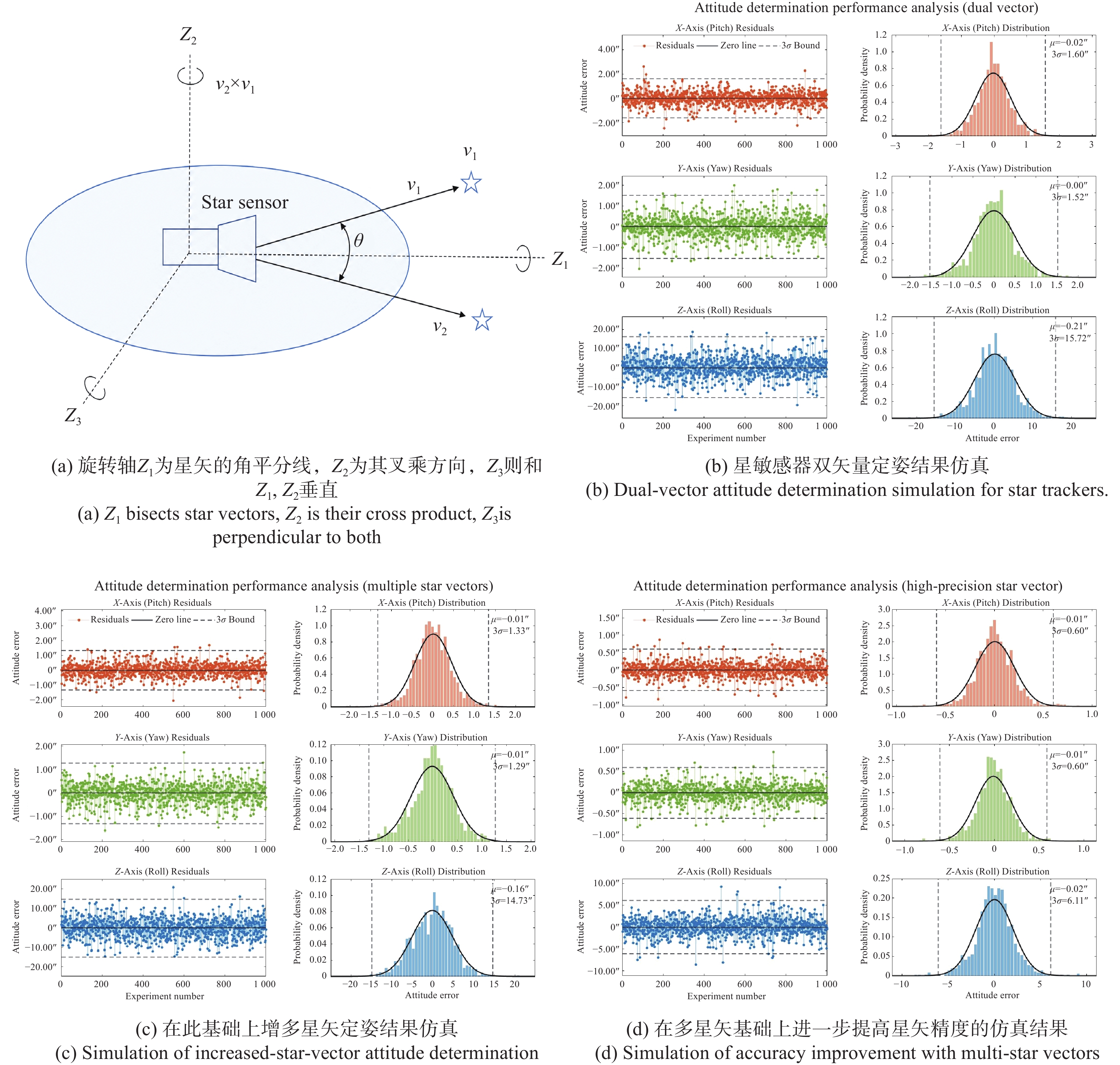
图 1 星敏感器矢量定姿缺陷的仿真
Figure 1. Simulation of defects in star tracker vector attitude determination.
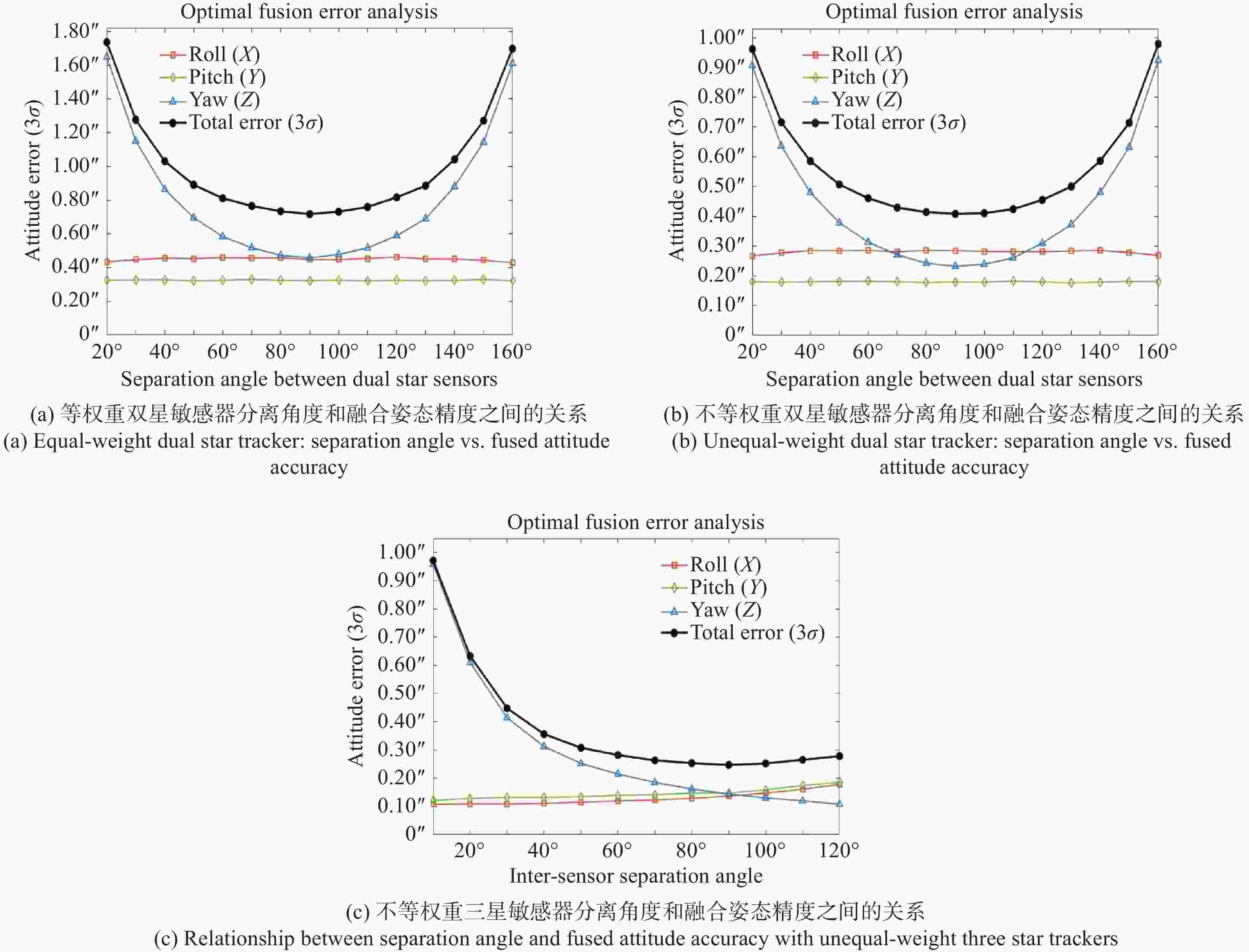
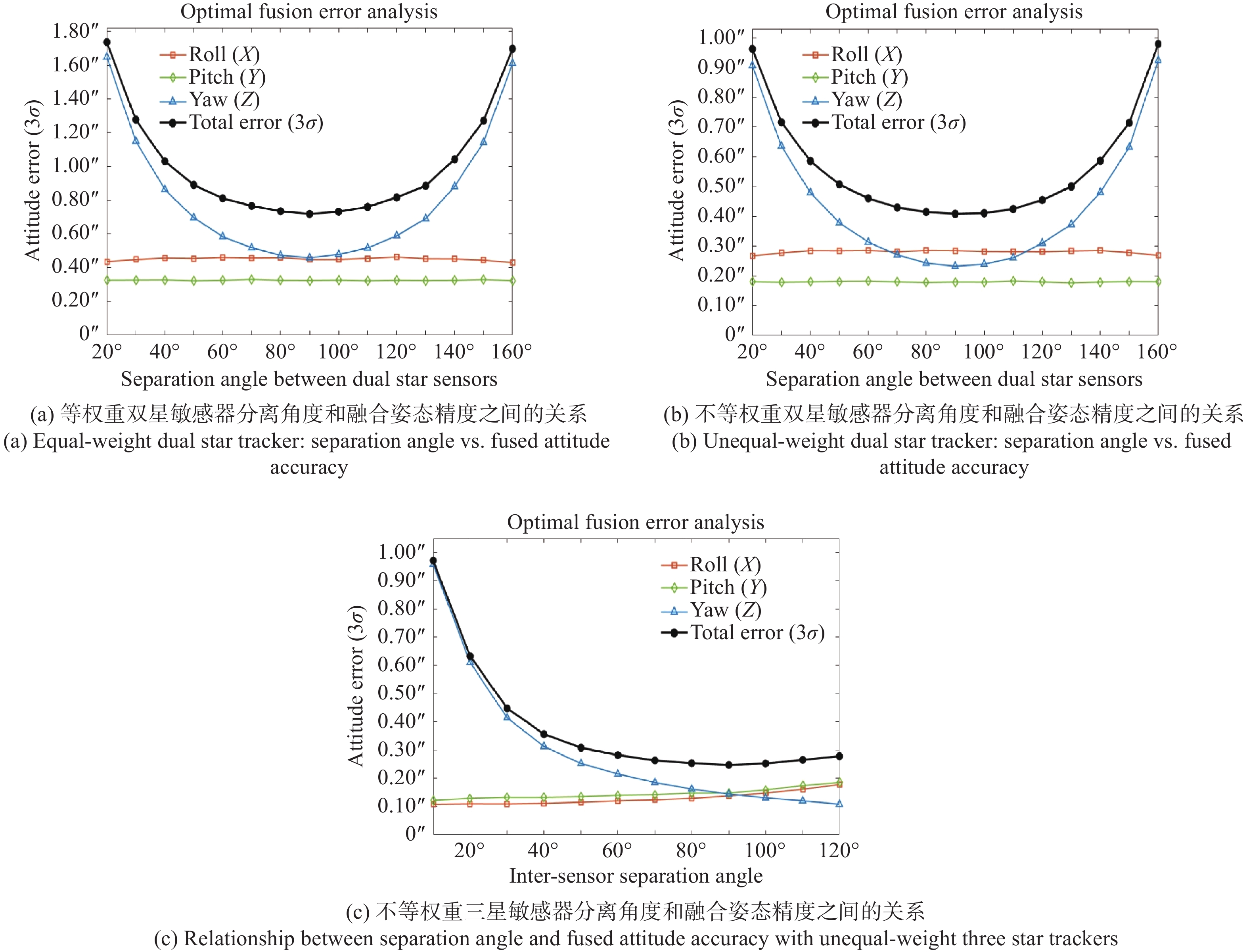
图 3 分离角度和构型优化之间的关系
Figure 3. Relationship between separation angle and configuration optimization.
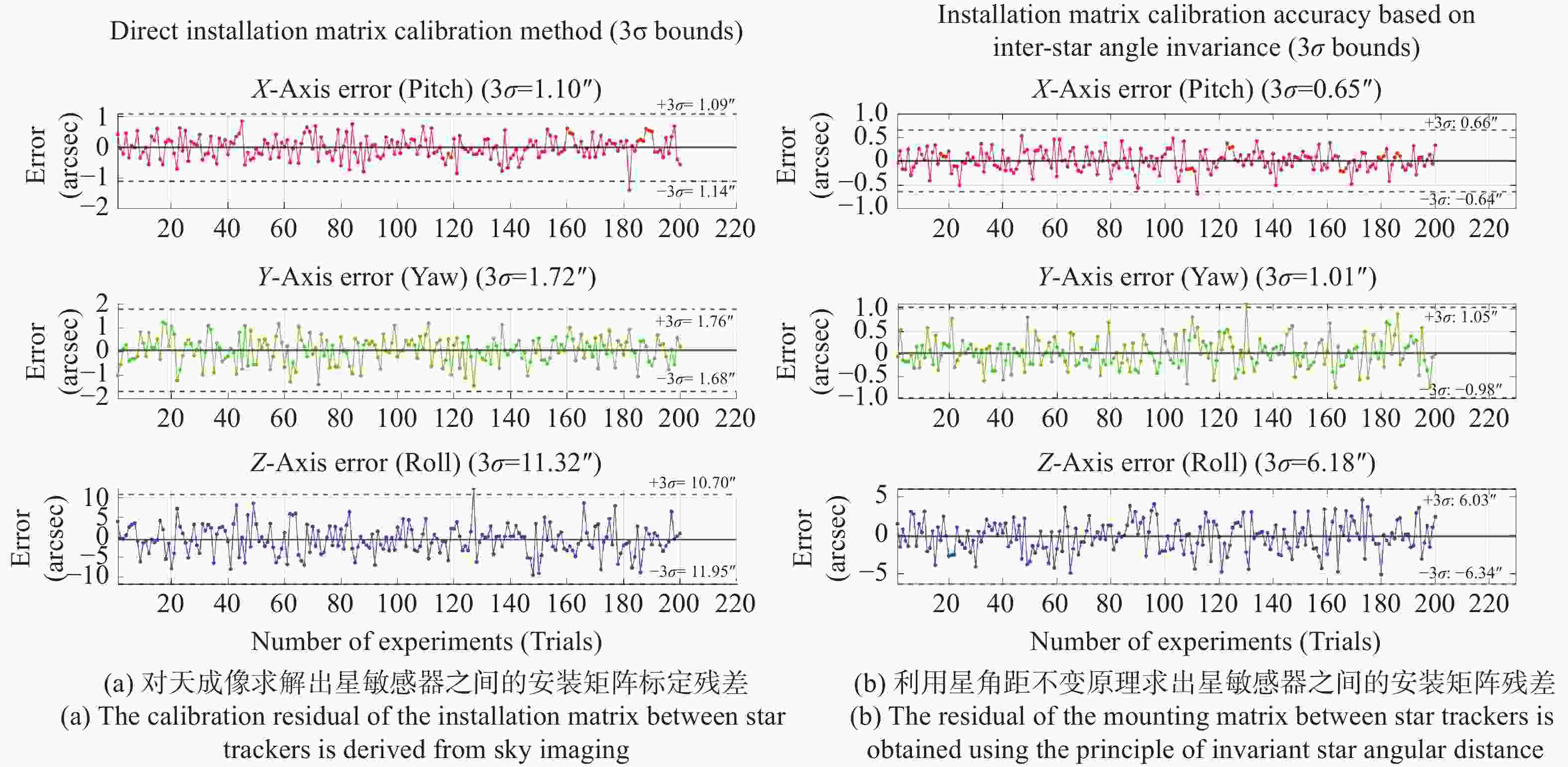
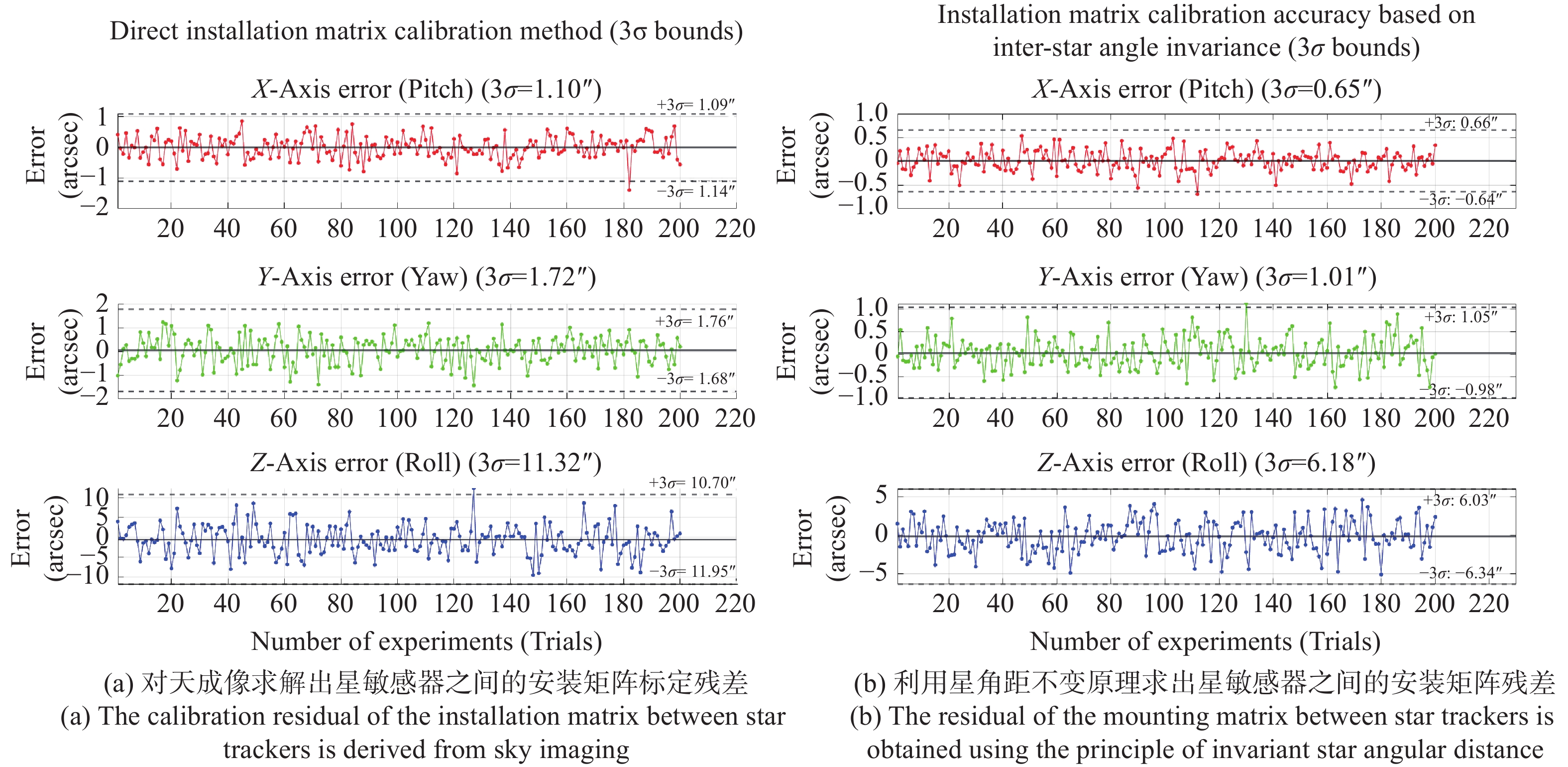
图 4 基于不同办法解算原理的星敏感器安装矩阵标定残差
Figure 4. Calibration residual of the star tracker mounting matrix based on different solution principles.
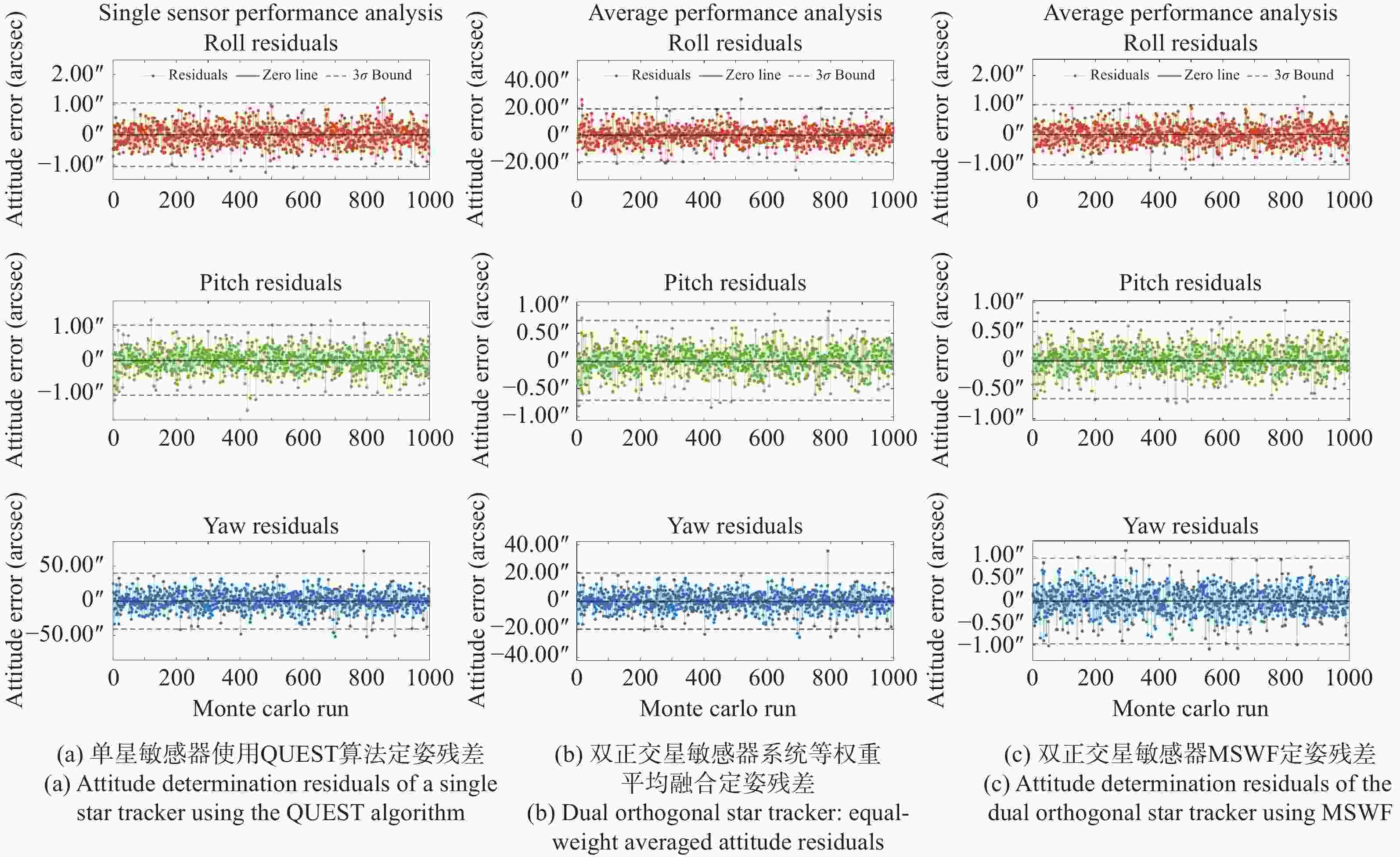
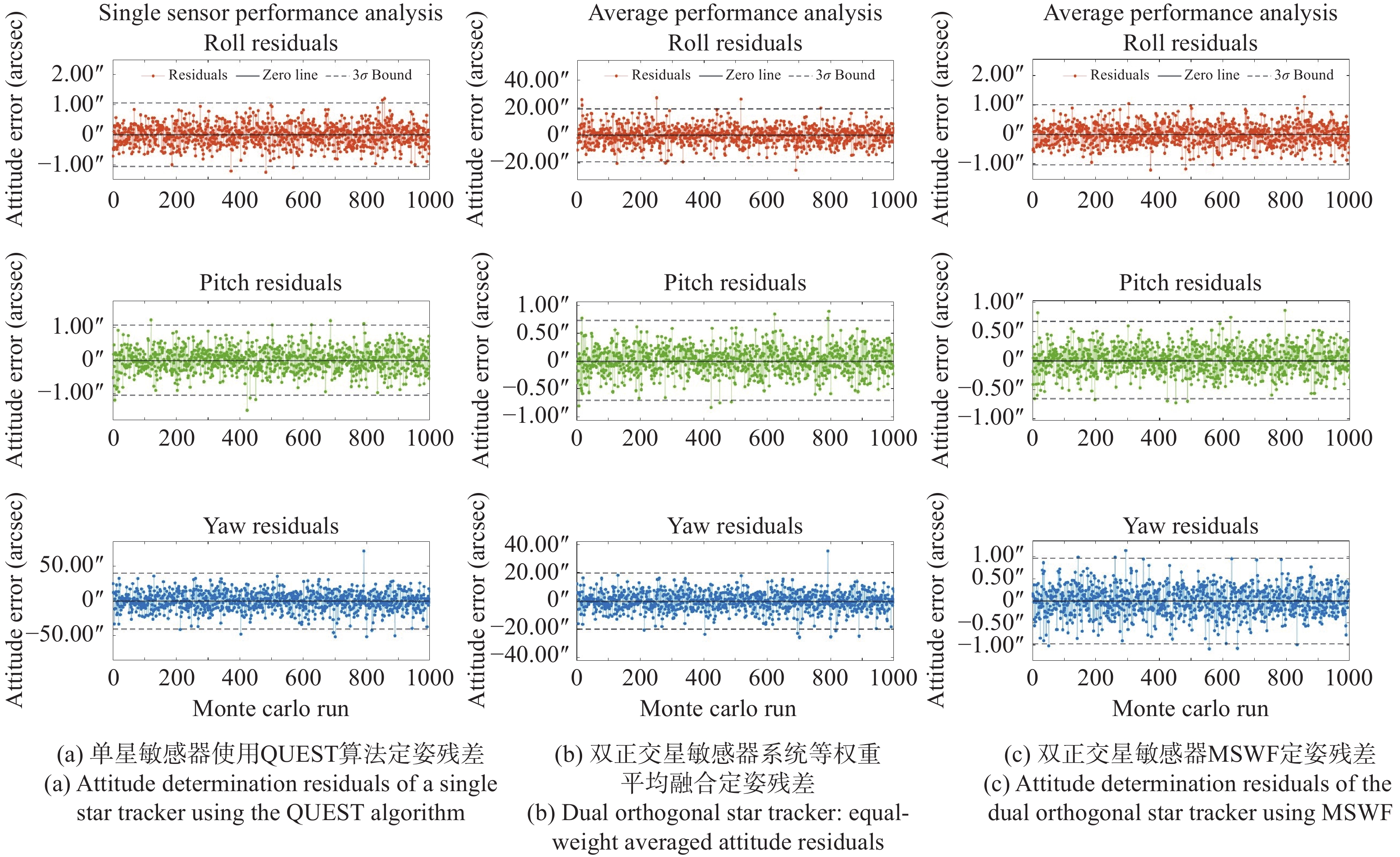
图 6 不同姿态解算方案的定姿精度对比与误差分布特性分析
Figure 6. Attitude accuracy comparison and error distribution analysis across different solution schemes.
表 1 三次蒙特卡洛仿真的星敏感器参数对比
Table 1. Comparison of star tracker parameters from three Monte Carlo simulations.
仿真参数 仅双矢量 增多星矢 提高星矢精度 焦距 75 mm 75 mm 150 mm 像元尺寸 5 μm 5 μm 5 μm 视场 15° 15° 15° 定姿矢量数量 2 5 2 星点提取误差(RMS) 0.1 pixel 0.1 pixel 0.05 pixel  下载: 导出CSV
表 2 不同仿真方案下的星敏感器光学参数与权重配置对比
Table 2. Comparison of optical parameters and weight configurations of star trackers under different simulation schemes.
仿真方案 星敏感器 焦距/mm 视场角/deg 质心误差/pixel 像元尺寸/μm 权重/% 情况一:
等权重双正交Sensor 1 75.00 15 × 15 0.10 5 × 5 50.00 Sensor 2 75.00 15 × 15 0.10 5 × 5 50.00 情况二:
不等权重双正交Sensor 1 75.00 15 × 15 0.10 5 × 5 35.92 Sensor 2 100.00 15 × 15 0.08 5 × 5 64.08 情况三:
不等权重三正交Sensor 1 75.00 15 × 15 0.10 5 × 5 25.12 Sensor 2 50.00 20 × 20 0.15 5 × 5 5.01 Sensor 3 100.00 10 × 10 0.08 5 × 5 69.87
下载: 导出CSV
表 3 不同融合定姿方案性能对比
Table 3. Performance comparison of different fusion attitude determination schemes.
定姿方案 X (3σ) Y (3σ) Z (3σ) Total (3σ) 精度提升 单星敏感器 0.245″ 0.246″ 8.309″ 8.317″ — 平均融合 4.166″ 0.169″ 4.164″ 5.892″ 29.2% MSWF 0.251″ 0.159″ 0.239″ 0.381″ 95.4%
下载: 导出CSV
表 4 稀疏星场及随机丢星工况下不同定姿方案的性能对比
Table 4. Performance comparison of attitude determination schemes under sparse star fields and random star loss.
(a). 单星敏感器 $ {P}_{loss} $ Stars X(3σ) Y(3σ) Z(3σ) Total 0.00 4 11.918″ 0.377″ 11.910″ 16.853″ 6 7.868″ 0.266″ 7.861″ 11.125″ 8 6.119″ 0.214″ 6.115″ 8.653″ 0.04 4 12.250″ 0.395″ 12.268″ 17.342″ 6 7.906″ 0.264″ 7.908″ 11.185″ 8 6.183″ 0.215″ 6.177″ 8.743″ 0.08 4 12.085″ 0.381″ 12.103″ 17.108″ 6 7.943″ 0.264″ 7.940″ 11.234″ 8 6.310″ 0.217″ 6.306″ 8.923″ (b). 双星跟踪器(MSWF) $ {P}_{loss} $ Stars X(3σ) Y(3σ) Z(3σ) Total 0.00 4 0.307″ 0.197″ 0.301″ 0.473″ 6 0.232″ 0.156″ 0.236″ 0.366″ 8 0.196″ 0.133″ 0.196″ 0.308″ 0.04 4 0.303″ 0.196″ 0.304″ 0.472″ 6 0.232″ 0.155″ 0.232″ 0.363″ 8 0.199″ 0.134″ 0.196″ 0.310″ 0.08 4 0.301″ 0.199″ 0.302″ 0.470″ 6 0.231″ 0.157″ 0.231″ 0.362″ 8 0.197″ 0.134″ 0.196″ 0.308″
下载: 导出CSV
表 5 星敏感器仿真主要参数
Table 5. Main parameters for star tracker simulation.
参数名称 数值 参数名称 数值 焦距 375 mm 质心误差 0.1 pixel 视场角 5° 角速度 0.1–1.5°/s 最大探测星等 11 曝光时间 50 ms 像元尺寸 8 μm 去模糊因子 0.7 PSF 标准差 1.5 pixel 信噪比 SNR 10
下载: 导出CSV
表 6 不同角速度下MSWF与单星姿态解算残差对比
Table 6. Comparison of attitude determination residuals between MSWF and single-star methods at different angular velocities.
(a). MSWF三轴残差 角速度 (°/s) X(3σ) Y(3σ) Z(3σ) Total(3σ) 0.1 0.202″ 0.144″ 0.203″ 0.321″ 0.2 0.255″ 0.182″ 0.259″ 0.407″ 0.5 0.469″ 0.341″ 0.463″ 0.742″ 1.0 0.870″ 0.620″ 0.844″ 1.361″ 1.5 1.254″ 0.886″ 1.271″ 1.993″ (b). 单星三轴姿态残差 角速度 (°/s) X(3σ) Y(3σ) Z(3σ) Total(3σ) 0.1 0.202″ 0.205″ 6.798″ 6.804″ 0.2 0.256″ 0.250″ 7.884″ 7.892″ 0.5 0.471″ 0.475″ 15.635″ 15.649″ 1.0 0.874″ 0.847″ 27.712″ 27.738″ 1.5 1.254″ 1.266″ 43.278″ 43.315″
下载: 导出CSV
表 7 不同工作探头数下MSWF的定姿精度对比
Table 7. Comparison of attitude determination accuracy of MSWF under different numbers of active heads.
工作星敏数 X(3σ) Y(3σ) Z(3σ) Total(3σ) star number 4 0.191″ 0.190″ 0.189″ 0.330″ 528.51 3 0.231″ 0.209″ 0.234″ 0.390″ 396.85 2 0.310″ 0.220″ 0.351″ 0.517″ 262.77 1 0.312″ 0.311″ 3.392″ 3.420″ 132.99
下载: 导出CSV
表 8 不同安装误差及工作探头数的姿态定姿精度对比分析
Table 8. Comparative analysis of attitude accuracy versus installation errors and active head count.
(a). 2个星敏感器工作(MSWF) 评价指标 0 0.1 0.5 1.0 2.0 5.0 X(3σ) 0.070″ 0.128″ 0.516″ 1.029″ 1.974″ 5.113″ Y(3σ) 0.051″ 0.091″ 0.354″ 0.726″ 1.435″ 3.654″ Z(3σ) 0.073″ 0.125″ 0.506″ 0.992″ 1.979″ 5.023″ Total(3σ) 0.113″ 0.201″ 0.804″ 1.603″ 3.142″ 8.045″ (b). 单星敏感器工作 评价指标 0 0.1 0.5 1.0 2.0 5.0 X(3σ) 0.072″ 0.129″ 0.518″ 1.030″ 1.974″ 5.116″ Y(3σ) 0.075″ 0.129″ 0.513″ 0.979″ 1.964″ 4.931″ Z(3σ) 2.486″ 2.524″ 2.512″ 2.658″ 3.101″ 5.543″ Total(3σ) 2.488″ 2.531″ 2.615″ 3.014″ 4.168″ 9.013″
下载: 导出CSV
-
[1] MEKKY T, HABIB A. Spacecraft attitude and orbit determination from the cost and reliability viewpoint: a review[J]. ASRIC Journal on Natural Sciences, 2022, 1: 14-35. [2] 朱辉. 多视场星敏感器鲁棒星识别与高精度姿态确定方法研究[D]. 北京: 清华大学, 2018.ZHU H. Robust star identification and high accuracy attitude determination method for multiple field-of-view star sensor[D]. Beijing: Tsinghua University, 2018. (in Chinese) (查阅网上资料, 未找到本条文献信息, 请确认). [3] 梁斌, 朱海龙, 张涛, 等. 星敏感器技术研究现状及发展趋势[J]. 中国光学, 2016, 9(1): 16-29. doi: 10.3788/CO.20160901.0016LIANG B, ZHU H L, ZHANG T, et al. Research status and development tendency of star tracker technique[J]. Chinese Optics, 2016, 9(1): 16-29. (in Chinese). doi: 10.3788/CO.20160901.0016 [4] 朱俊青, 沙巍, 方超, 等. 星敏镜头参数化建模辅助设计[J]. 中国光学, 2021, 14(3): 615-624. doi: 10.37188/CO.2021-0029ZHU J Q, SHA W, FANG CH, et al. Parametric modeling aided design for star sensor lens[J]. Chinese Optics, 2021, 14(3): 615-624. doi: 10.37188/CO.2021-0029 [5] 张淑芬, 姜珊, 董磊, 等. 基于衍射光栅的高精度干涉星敏感器的理论分析[J]. 中国光学, 2021, 14(6): 1368-1377. doi: 10.37188/CO.2021-0051ZHANG SH F, JIANG SH, DONG L, et al. High accuracy interferometric star tracker based on diffraction grating[J]. Chinese Optics, 2021, 14(6): 1368-1377. doi: 10.37188/CO.2021-0051 [6] 阮宇翔, 董磊. 干涉星敏感器测角精度影响因素的研究[J]. 中国光学, 2023, 16(6): 1433-1441. doi: 10.37188/CO.2022-0232RUAN Y X, DONG L. Influencing factors of angle measurement accuracy of an interferometer star tracker[J]. Chinese Optics, 2023, 16(6): 1433-1441. doi: 10.37188/CO.2022-0232 [7] 张博研, 孔德柱, 刘金国, 等. 卷帘快门式CMOS探测器的星图像移补偿[J]. 中国光学, 2020, 13(6): 1276-1284. doi: 10.37188/CO.2020-0089ZHANG B Y, KONG D ZH, LIU J G, et al. Compensation of star image motion for a CMOS image sensor with a rolling shutter[J]. Chinese Optics, 2020, 13(6): 1276-1284. doi: 10.37188/CO.2020-0089 [8] 许洪刚, 韩冰, 李曼丽, 等. 高精度大视场多星模拟器设计与验证[J]. 中国光学, 2020, 13(6): 1343-1351. doi: 10.37188/CO.2020-0024XU H G, HAN B, LI M L, et al. Design and verification of high-precision multi-star simulator with a wide field of view[J]. Chinese Optics, 2020, 13(6): 1343-1351. doi: 10.37188/CO.2020-0024 [9] ARIMURA FIALHO M A. Evaluation of centroiding algorithms for an autonomous star tracker[J]. The European Physical Journal Special Topics, 2026, 234(25): 7877-7883. doi: 10.1140/epjs/s11734-025-01917-0 [10] JUNKINS J L, WHITE III C C, TURNER J D. Star pattern recognition for real time attitude determination[J]. The Journal of the Astronautical Sciences, 1977, 25(3): 251-270. [11] LIEBE C C. Pattern recognition of star constellations for spacecraft applications[J]. IEEE Aerospace and Electronic Systems Magazine, 1993, 8(1): 31-39. doi: 10.1109/62.145117 [12] MORTARI D, SAMAAN M A, BRUCCOLERI C, et al. The pyramid star identification technique[J]. Navigation, 2004, 51(3): 171-183. doi: 10.1002/j.2161-4296.2004.tb00349.x [13] ZHAO H R, LEMBECK M F, ZHUANG A, et al. Real-time convolutional-neural-network-based star detection and centroiding method for CubeSat star tracker[J]. IEEE Transactions on Aerospace and Electronic Systems, 2025, 61(4): 8172-8184. doi: 10.1109/TAES.2025.3542744 [14] HEPBURN-DICKINS F, JONES M W, EDWARDS M, et al. SIGNN – star identification using graph neural networks[C]. 2025 IEEE/CVF Winter Conference on Applications of Computer Vision (WACV), IEEE, 2025: 9063-9072. [15] SHUSTER M D, OH S D. Three-axis attitude determination from vector observations[J]. Journal of Guidance and Control, 1981, 4(1): 70-77. doi: 10.2514/3.19717 [16] MORTARI D. ESOQ: a closed-form solution to the Wahba problem[J]. The Journal of the Astronautical Sciences, 1997, 45(2): 195-204. doi: 10.1007/BF03546376 [17] KLEMA V, LAUB A. The singular value decomposition: its computation and some applications[J]. IEEE Transactions on Automatic Control, 1980, 25(2): 164-176. doi: 10.1109/TAC.1980.1102314 [18] GREWAL M S, ANDREWS A P. Applications of Kalman filtering in aerospace 1960 to the present [historical perspectives][J]. IEEE Control Systems Magazine, 2010, 30(3): 69-78. doi: 10.1109/MCS.2010.936465 [19] SUN T, XING F, YOU ZH, et al. Deep coupling of star tracker and MEMS-gyro data under highly dynamic and long exposure conditions[J]. Measurement Science and Technology, 2014, 25(8): 085003. doi: 10.1088/0957-0233/25/8/085003 [20] LI J, WEI X G, ZHANG G J. An extended Kalman filter-based attitude tracking algorithm for star sensors[J]. Sensors, 2017, 17(8): 1921. doi: 10.3390/s17081921 [21] MAO X Y, DU X J, FANG H. Precise attitude determination strategy for spacecraft based on information fusion of attitude sensors: gyros/GPS/star-sensor[J]. International Journal of Aeronautical and Space Sciences, 2013, 14(1): 91-98. doi: 10.5139/IJASS.2013.14.1.91 [22] YI J H, MA Y B, LONG H F, et al. Tightly coupled visual–inertial fusion for attitude estimation of spacecraft[J]. Remote Sensing, 2024, 16(16): 3063. doi: 10.3390/rs16163063 [23] MA L H, DAI D K, NI Y M. How to improve the attitude accuracy of the star sensor under dynamic conditions: a review[J]. Acta Astronautica, 2025, 233: 42-54. doi: 10.1016/j.actaastro.2025.03.043 [24] BLARRE L, OUAKNINE J, ODDOS-MARCEL L, et al. High accuracy SODERN star trackers: recent improvements proposed on SED36 and HYDRA star trackers[C]. AIAA Guidance, Navigation, and Control Conference and Exhibit, AIAA, 2006: 6046. [25] GELIN B, CHALTÉ C, MAJEWSKI L, et al. Multiple heads management and validation in HYDRA star tracker[C]. 33rd Annual AAS Guidance and Control Conference, American Astronautical Society, 2010. (查阅网上资料, 未找到本条文献论文集名信息, 请确认). [26] RANDALL C R, SPEED J F, BLARRE L. Design and development of the Ball Aerospace flexible space camera FSC-701[C]. 2009 IEEE Aerospace Conference, IEEE, 2009: 1-7. [27] JORGENSEN J L, DENVER T, BETTO M, et al. MicroASC a miniature star tracker[C]. Proceedings of the 5th International ESA Conference on Guidance, Navigation and Control Systems, European Space Agency, 2002: ESA SP-516. (查阅网上资料, 未找到本条文献论文集名和出版者信息, 请确认). [28] MORTARI D, ROMOLI A. StarNav III: a three fields of view star tracker[C]. Proceedings, IEEE Aerospace Conference, IEEE, 2002, 1-47. [29] 熊亚舟, 王勇, 陈慧燕. 基于星图融合的多探头星敏感器姿态确定精度[J]. 中国惯性技术学报, 2016, 24(5): 612-618.XIONG Y ZH, WANG Y, CHEN H Y. Attitude determination accuracy of multi-head star tracker based on star-image fusion[J]. Journal of Chinese Inertial Technology, 2016, 24(5): 612-618. (in Chinese). [30] YANG J S, JIANG J, LI J, et al. Uncertainty estimation and multi-FOV data fusion for star sensors based on directional statistics[J]. IEEE Transactions on Instrumentation and Measurement, 2024, 73: 1000115. doi: 10.1109/tim.2023.3341142 [31] 王真, 魏新国, 张广军. 多视场星敏感器结构布局优化[J]. 红外与激光工程, 2011, 40(12): 2469-2473. doi: 10.3969/j.issn.1007-2276.2011.12.030WANG ZH, WEI X G, ZHANG G J. Structure optimization for multi-FOV star sensors[J]. Infrared and Laser Engineering, 2011, 40(12): 2469-2473. (in Chinese). doi: 10.3969/j.issn.1007-2276.2011.12.030 [32] SHUSTER M D. Maximum likelihood estimation of spacecraft attitude[J]. The Journal of the Astronautical Sciences, 1989, 37: 79-88. [33] KAMMER D C. Sensor placement for on-orbit modal identification and correlation of large space structures[C]. 1990 American Control Conference, IEEE, 1990: 2984-2990. [34] JOSHI S, BOYD S. Sensor selection via convex optimization[J]. IEEE Transactions on Signal Processing, 2009, 57(2): 451-462. doi: 10.1109/TSP.2008.2007095 [35] 李健, 张广军, 魏新国. 多视场星敏感器数学模型与精度分析[J]. 红外与激光工程, 2015, 44(4): 1223-1228. doi: 10.3969/j.issn.1007-2276.2015.04.020LI J, ZHANG G J, WEI X G. Modeling and accuracy analysis for multiple heads star tracker[J]. Infrared and Laser Engineering, 2015, 44(4): 1223-1228. (in Chinese). doi: 10.3969/j.issn.1007-2276.2015.04.020 [36] WANG Y L, WANG M, ZHU Y. On-orbit calibration of installation parameter of multiple star sensors system for optical remote sensing satellite with ground control points[J]. Remote Sensing, 2020, 12(7): 1055. doi: 10.3390/rs12071055 [37] PITTELKAU M E. Kalman filtering for spacecraft system alignment calibration[J]. Journal of Guidance, Control, and Dynamics, 2001, 24(6): 1187-1195. doi: 10.2514/2.4834 [38] 岳阳阳. 双CCD星敏感器标定方法研究[D]. 长沙: 国防科学技术大学研究生院, 2015.YUE Y Y. Calibration method of double-CCD star sensor[D]. Changsha: Graduate School of National University of Defense Technology, 2015. (in Chinese). [39] 曹丹, 陈震, 王新龙, 等. 分视场星相机双光学通道图像数据识别方法[C]. 2014: 342-346. (查阅网上资料, 未找到本条文献信息, 请确认).CAO D, CHEN ZH, WANG X L, et al. A method for identifying image data coming from two optical channels in a split field of view star camera[C]. 2014: 342-346. (in Chinese). [40] CHEN J, ZHU L W, YANG T, et al. Design method of an off-axis reflective aperture-divided optical system[J]. Applied Optics, 2025, 64(26): 7692-7702. doi: 10.1364/AO.567366 [41] WEI X G, TAN W, LI J, et al. Exposure time optimization for highly dynamic star trackers[J]. Sensors, 2014, 14(3): 4914-4931. doi: 10.3390/s140304914 [42] LUO ZH W, GUO Q, FENG J, et al. Centroid algorithm for high-dynamic star sensor based on key point detection deep learning algorithms[J]. Optics Express, 2025, 33(8): 17203-17232. doi: 10.1364/OE.542489 -

 下载:
下载:

计量
- 文章访问数: 90
- HTML全文浏览量: 39
- PDF下载量: 5
- 被引次数: 0
