


Layer-by-layer adaptive stripping of coupling noise in gravitational reference sensors using CNN-BiLSTM
-
摘要:
以LISA、太极计划和天琴计划为代表的空间探测计划面临的核心挑战之一是如何处理测试质量块复杂的噪声背景。引力参考传感器(GRS)的噪声包含布朗噪声、温度场耦合、磁场噪声、静电场噪声、驱动电压不稳定性及难以解释的1/
f 超额噪声等多种物理起源。本文提出一种“物理机理→噪声分类→双向时序建模→自适应剔除”的完整算法链条:基于LISA Pathfinder任务实测数据校准的物理噪声模型将出气效应等最新结果定量嵌入噪声合成管道;卷积神经网络(CNN)与双向长短期记忆网络(BiLSTM)在物理分类引导下互补捕获局部瞬态模式与双向长程依赖(链条第二环);按物理类别依次执行自适应谱减法实现噪声的逐层物理剥离(链条第三环)。仿真结果表明,在输入信噪比为10.2 dB的条件下,该算法链条对注入信号的恢复保真度达0.97(归一化相关系数),优于传统匹配滤波及纯CNN或纯BiLSTM基线方法。本研究可为空间引力波探测中的噪声建模、数据管道设计提供有价值的参考。-
关键词:
- 引力参考传感器 /
- 卷积神经网络 /
- 双向长短期记忆网络 /
- 噪声分离 /
- LISA Pathfinder
Abstract:This study addresses the difficulty of interpreting and separating multi-source coupling noise in gravitational reference sensors (GRSs) for spaceborne gravitational-wave detection. A unified acceleration-noise spectrum model is established for Brownian noise, thermal-field coupling, magnetic noise, electrostatic noise, drive-voltage noise, and residual low-frequency noise, with key parameters calibrated against LISA Pathfinder measurements. CNN layers are used to extract local transient features, BiLSTM layers are used to capture long-range temporal dependence, and adaptive spectral subtraction is then applied sequentially by physical noise category. At an input SNR of 10.2 dB, the proposed method achieves a recovery fidelity of
0.9694 and a waveform overlap of0.9695 , outperforming matched filtering, pure CNN, and pure BiLSTM baselines. Across an SNR range from −15 dB to +25 dB, the method shows a slower performance degradation in the negative-SNR regime. Combining physics-guided noise classification with CNN-BiLSTM temporal modeling improves signal recovery under complex GRS noise backgrounds and provides a useful reference for noise budgeting, simulation pipelines, and onboard denoising algorithms in spaceborne gravitational-wave missions. -
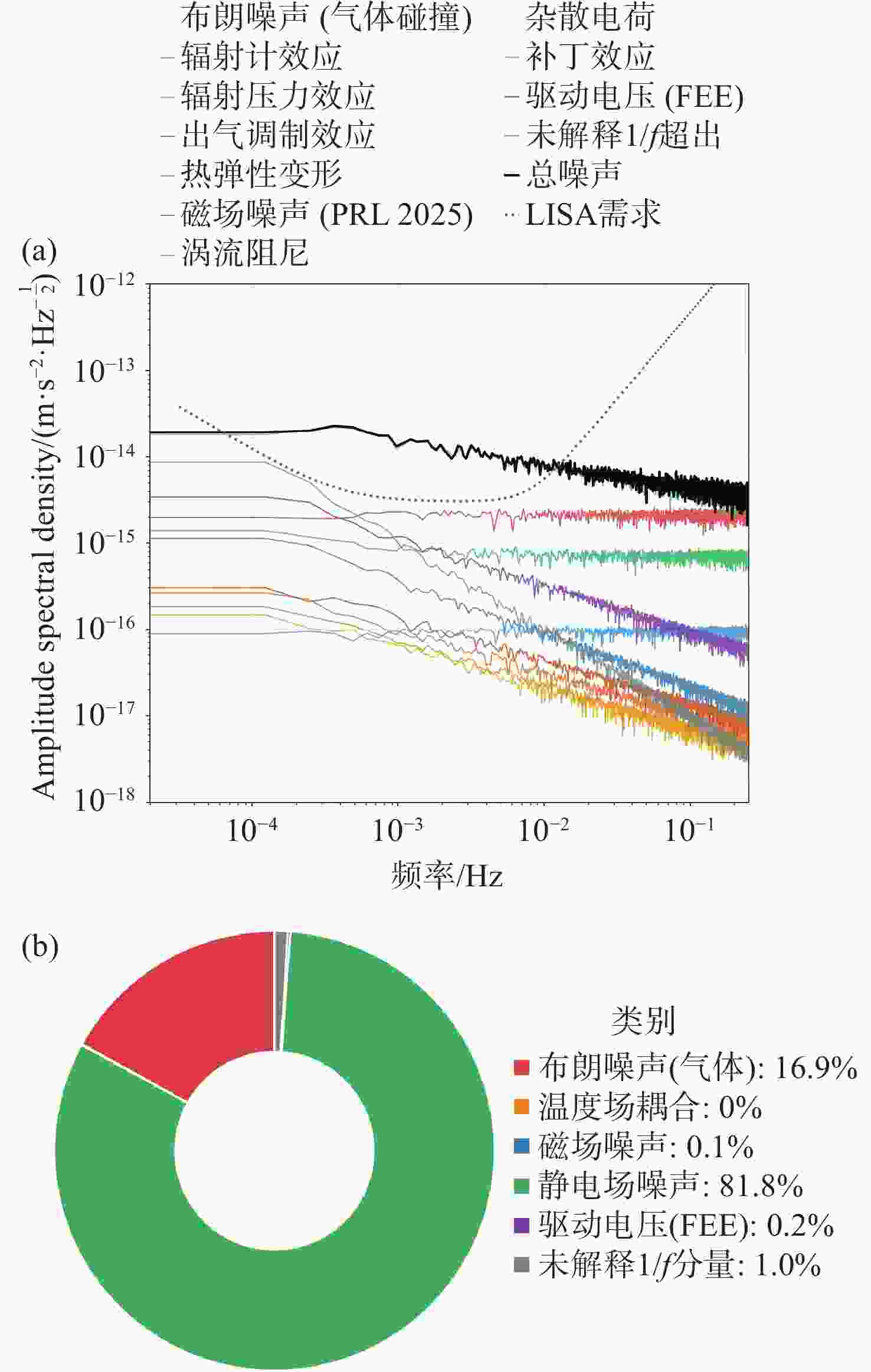
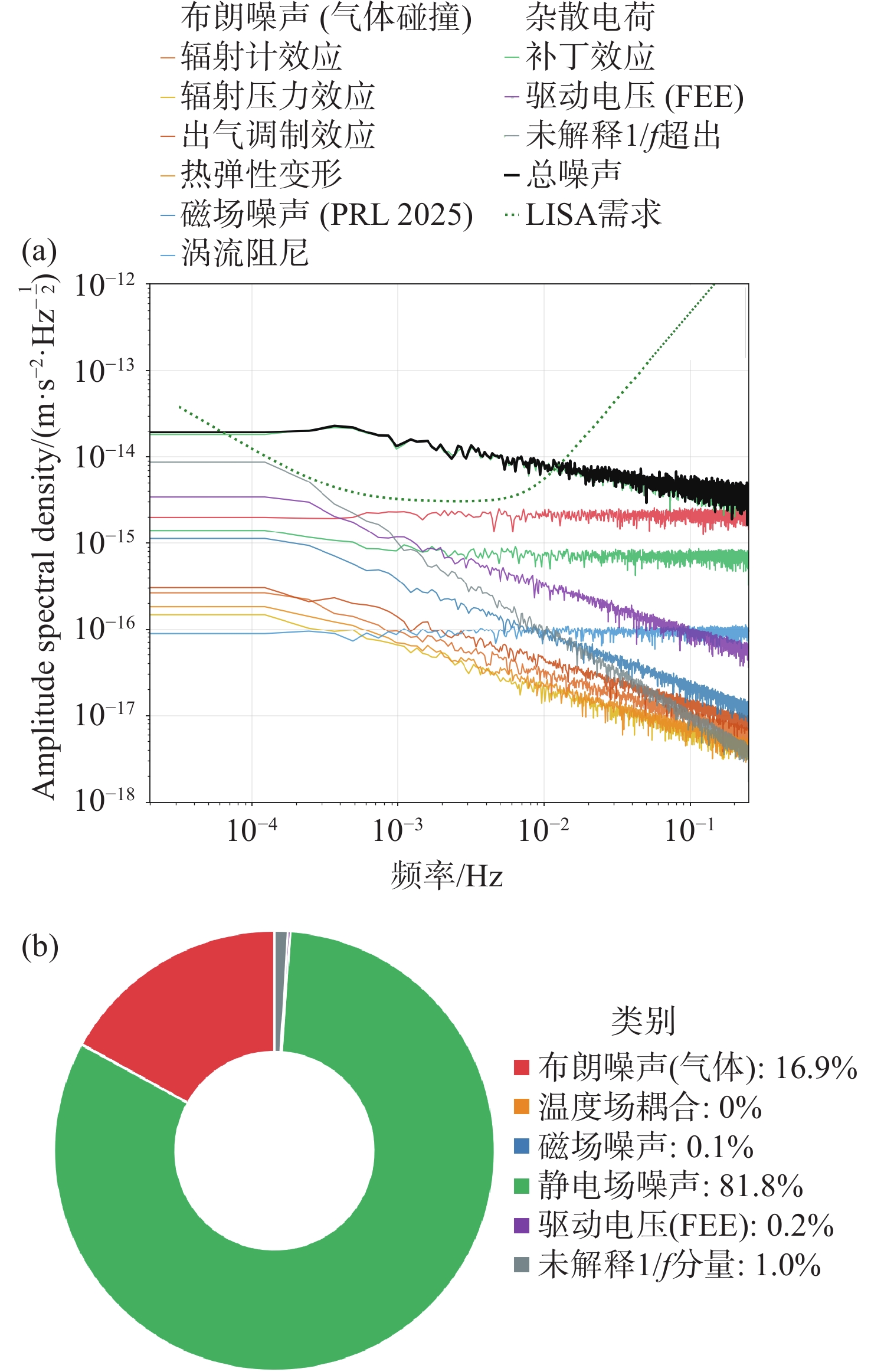
图 1 GRS 环境耦合噪声分类体系与功率分布。(a) 噪声分量的振幅谱密度对比,黑色粗线为总噪声,绿色虚线为 LISA 需求曲线;(b) 按 6 个物理类别统计的噪声功率占比。
Figure 1. Classification and power distribution of environmental coupling noise in the GRS. (a) Amplitude spectral density of each component, with the total noise shown by the thick black curve and the LISA requirement by the green dashed curve; (b) noise power fractions of the six physical noise categories
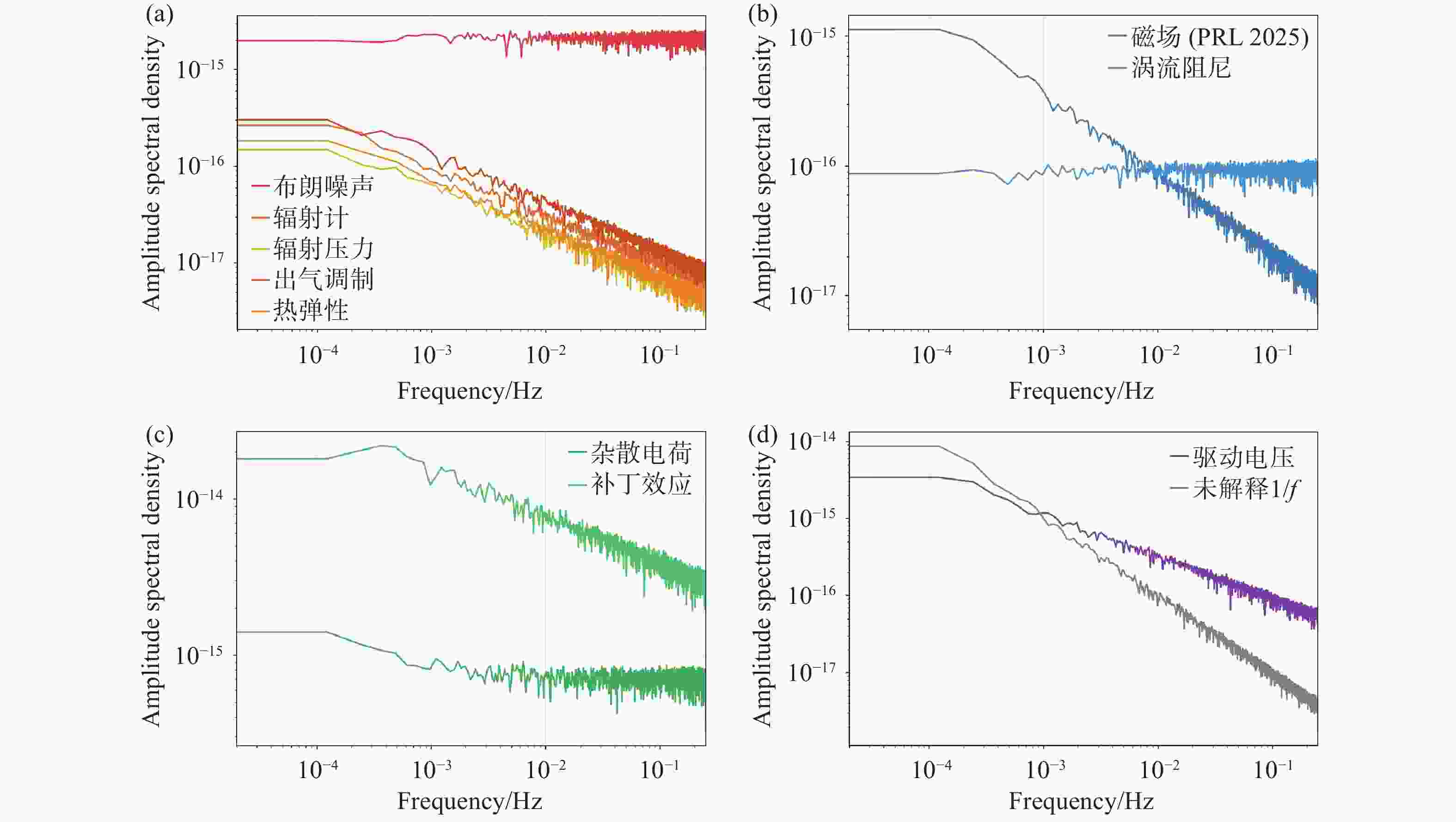
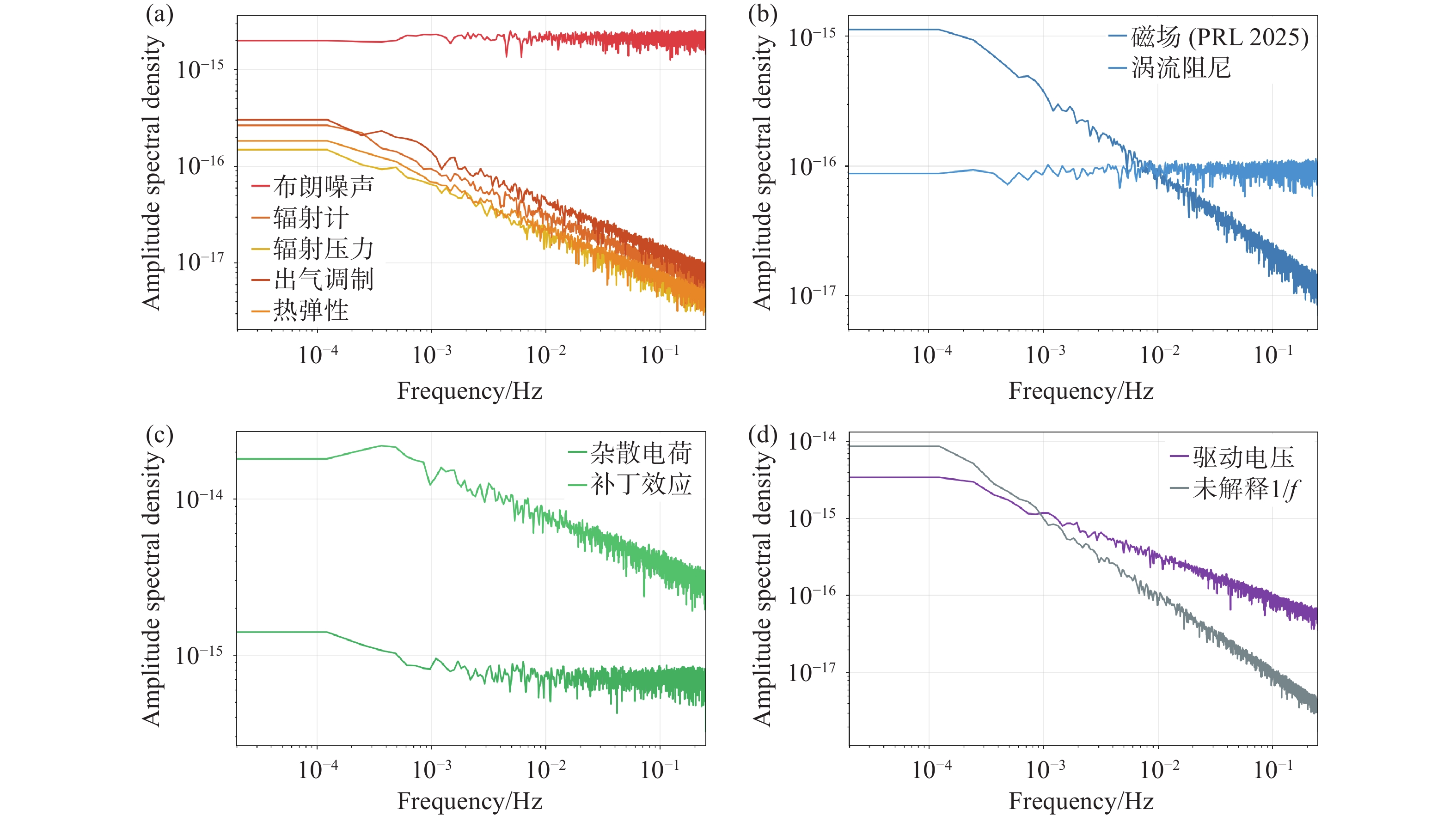
图 2 各物理类别噪声振幅谱密度分面板对比。(a) 温度场耦合噪声;(b) 磁场噪声;(c) 静电场噪声;(d) 驱动电压 FEE 与未解释1/f分量。
Figure 2. Amplitude spectral density of each physical noise category. (a) Thermal-field coupling noise; (b) magnetic noise; (c) electrostatic noise; (d) drive-voltage FEE noise and the unexplained 1/f component
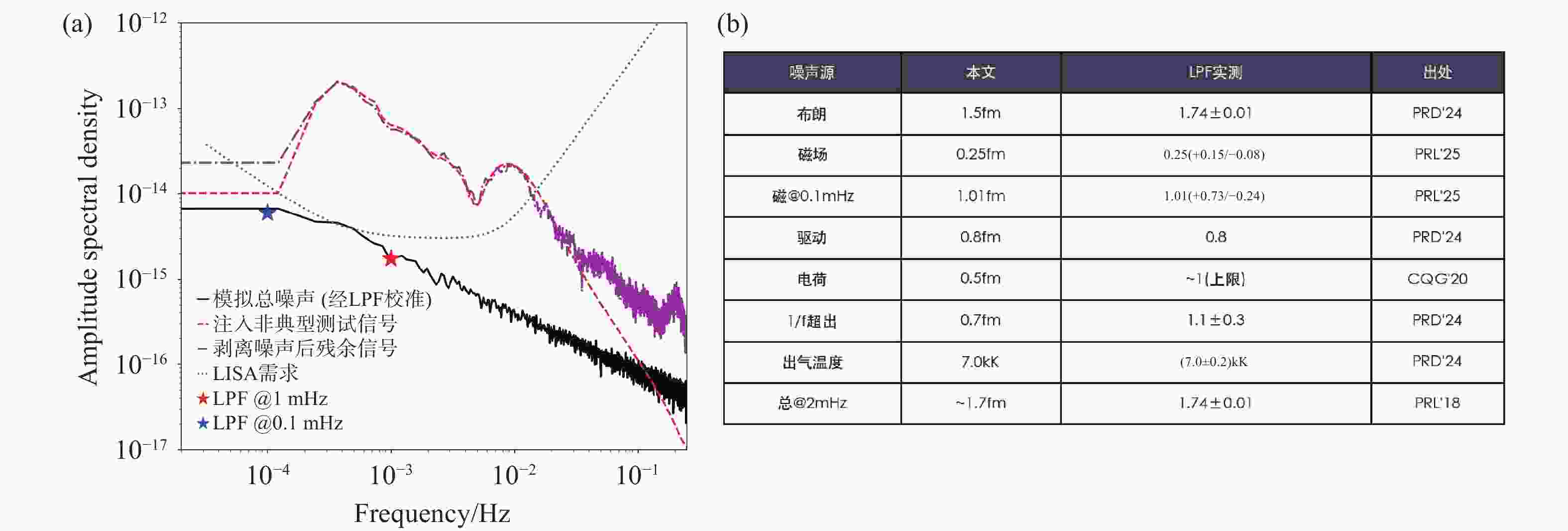
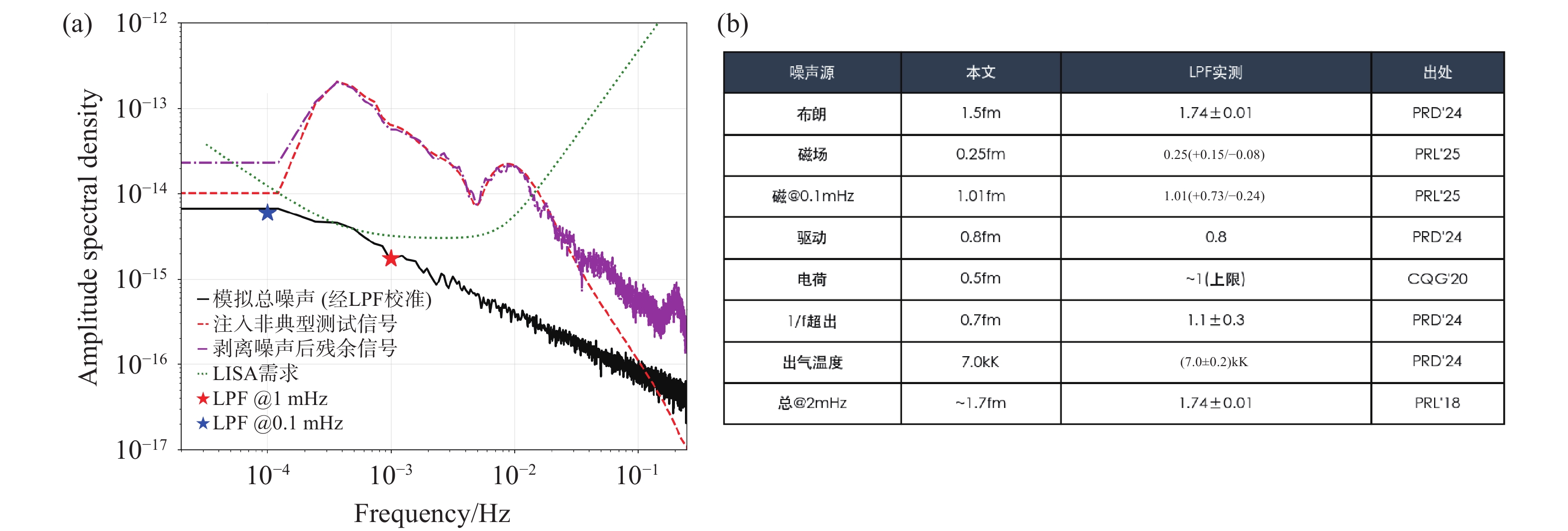
图 3 噪声预算与 LISA Pathfinder 实测数据的定量校准对比。(a) 模拟总噪声曲线与 LPF 实测点对比;(b) 本文模型参数与 LPF 实测结果的对比表
Figure 3. Quantitative calibration of the noise budget against LISA Pathfinder measurements. (a)Comparison of simulated total noise with LPF measurement points; (b) comparison of the model parameters used in this study with LPF measurement results
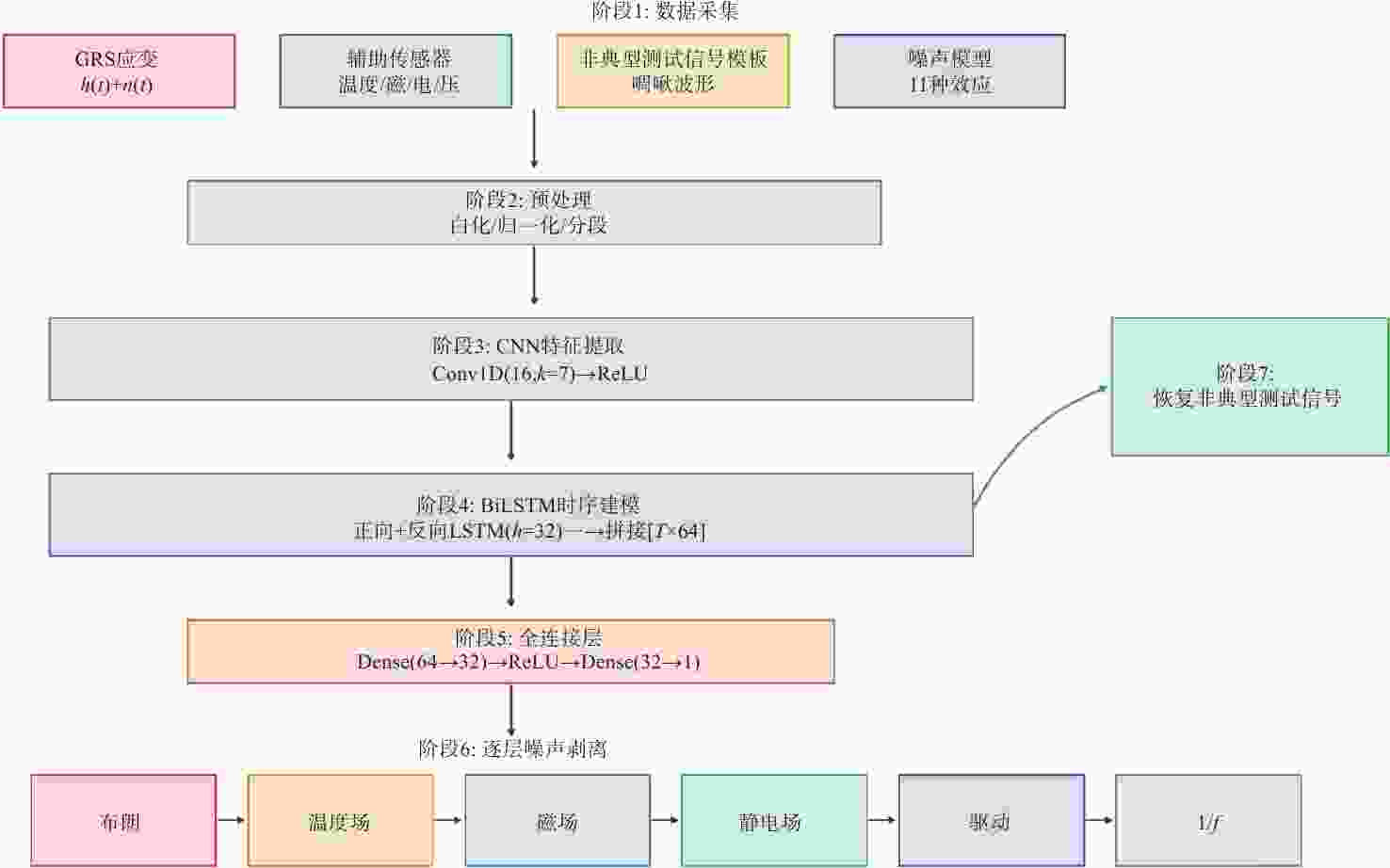
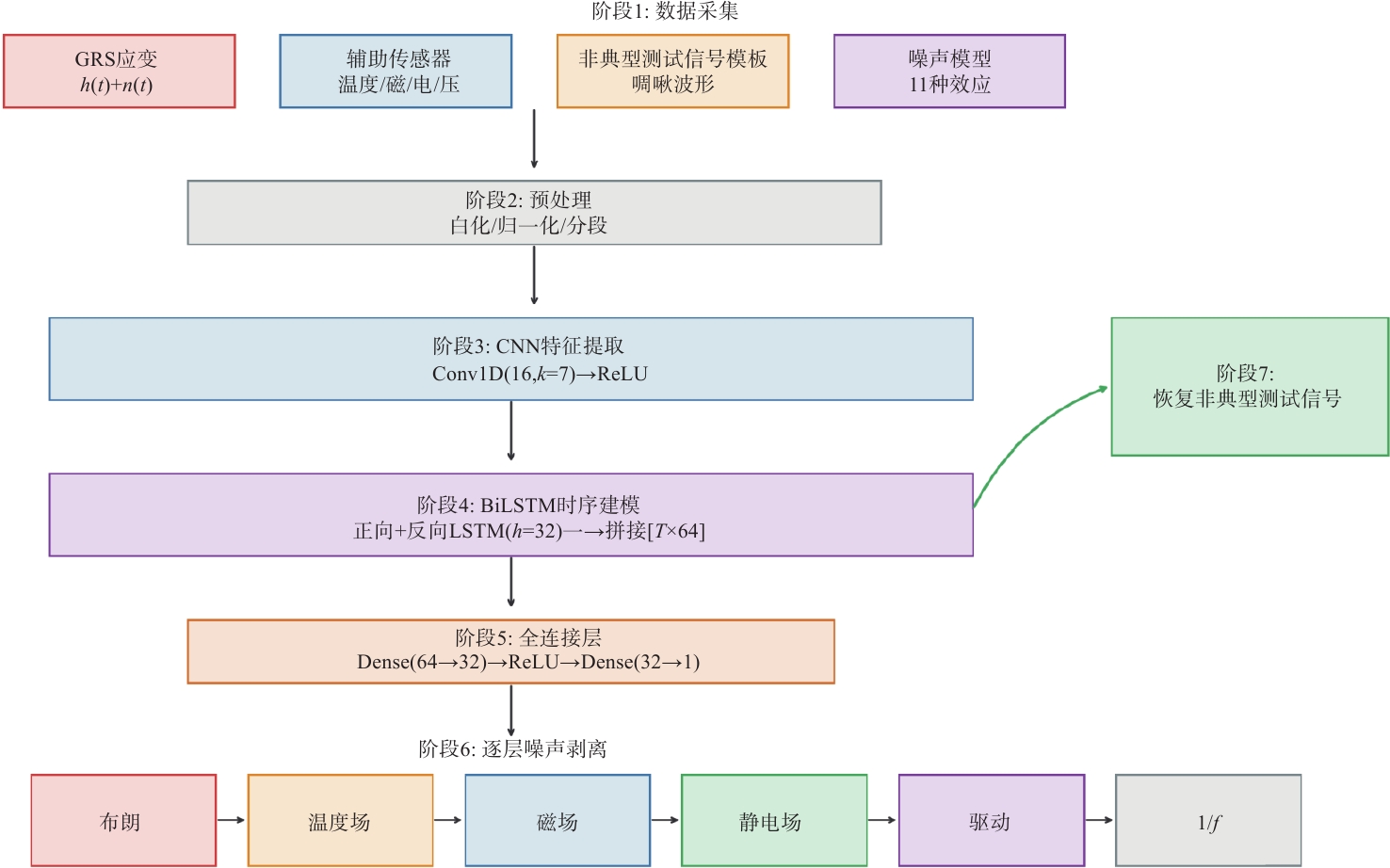
图 4 CNN-BiLSTM 逐层噪声剥离技术路线流程图
Figure 4. Flow chart of layer-by-layer noise stripping with CNN-BiLSTM
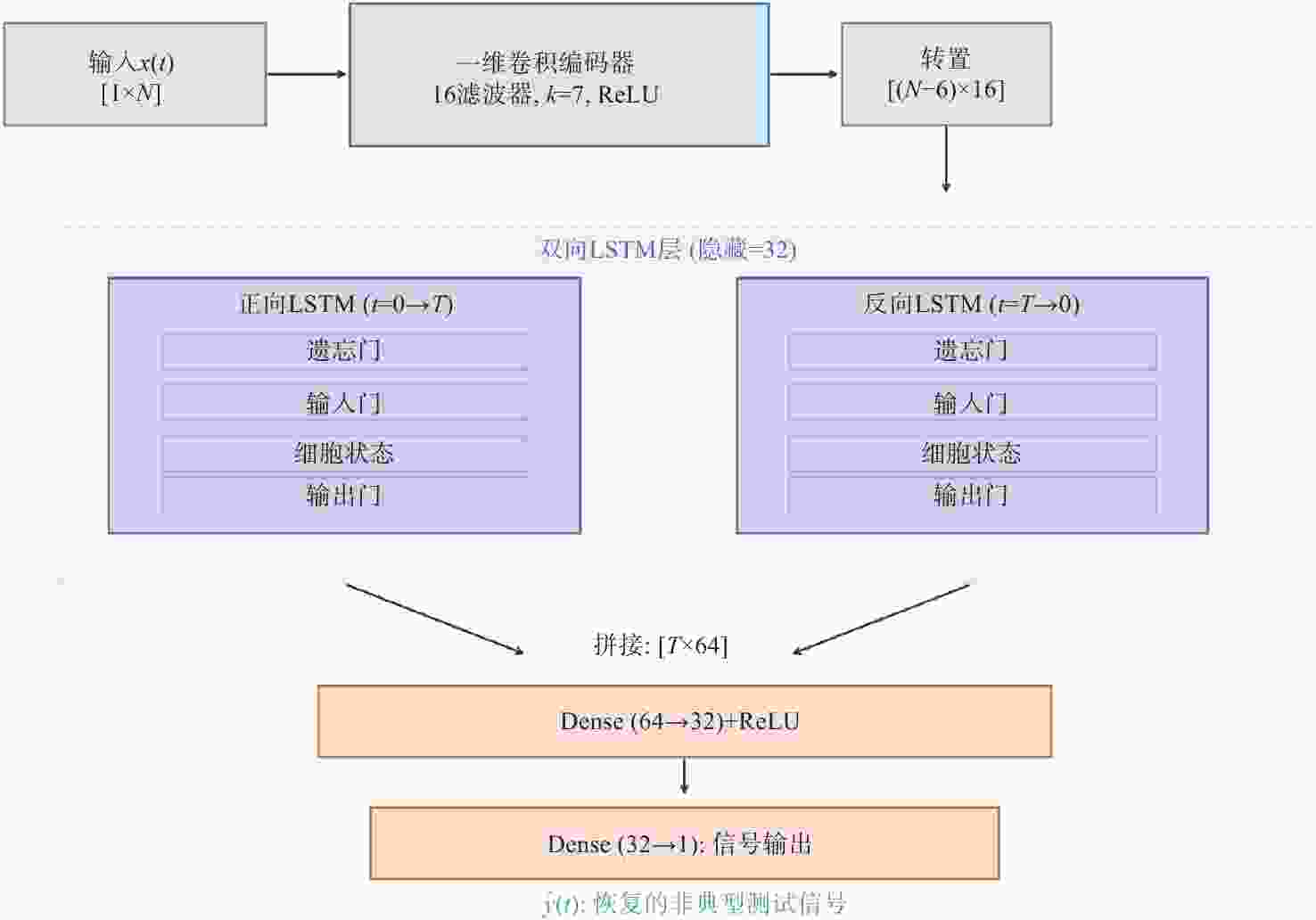
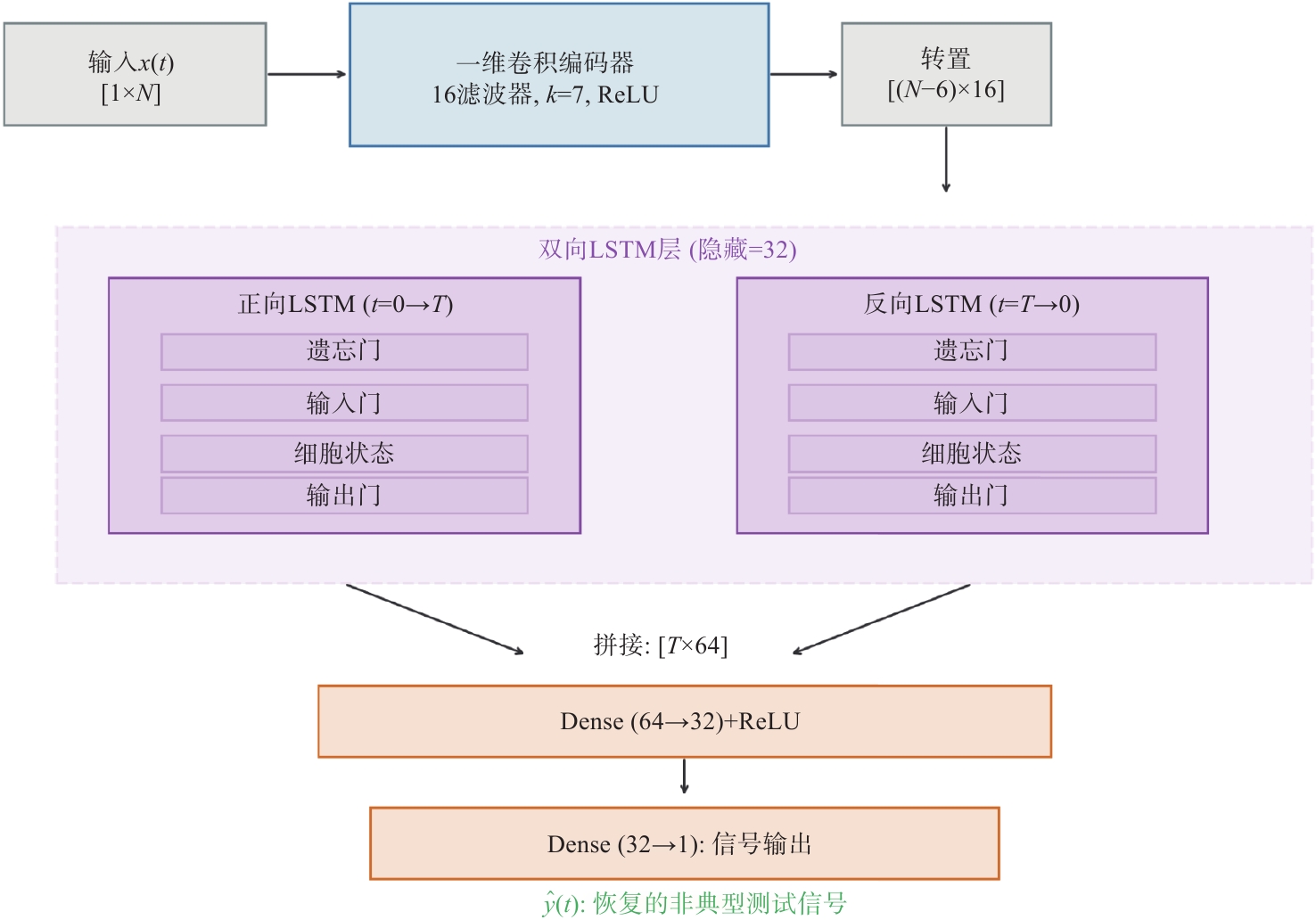
图 5 CNN-BiLSTM 降噪自编码器架构详图。一维卷积编码器含 16 个卷积核大小为 7的滤波器;BiLSTM 单向隐藏维度为 32;全连接层输出单维恢复信号
Figure 5. Architecture of the CNN-BiLSTM denoising autoencoder. The 1D convolutional encoder uses 16 filters with a kernel size of 7; the BiLSTM has a one-directional hidden size of 32; the fully connected layer outputs a one-dimensional recovered signal
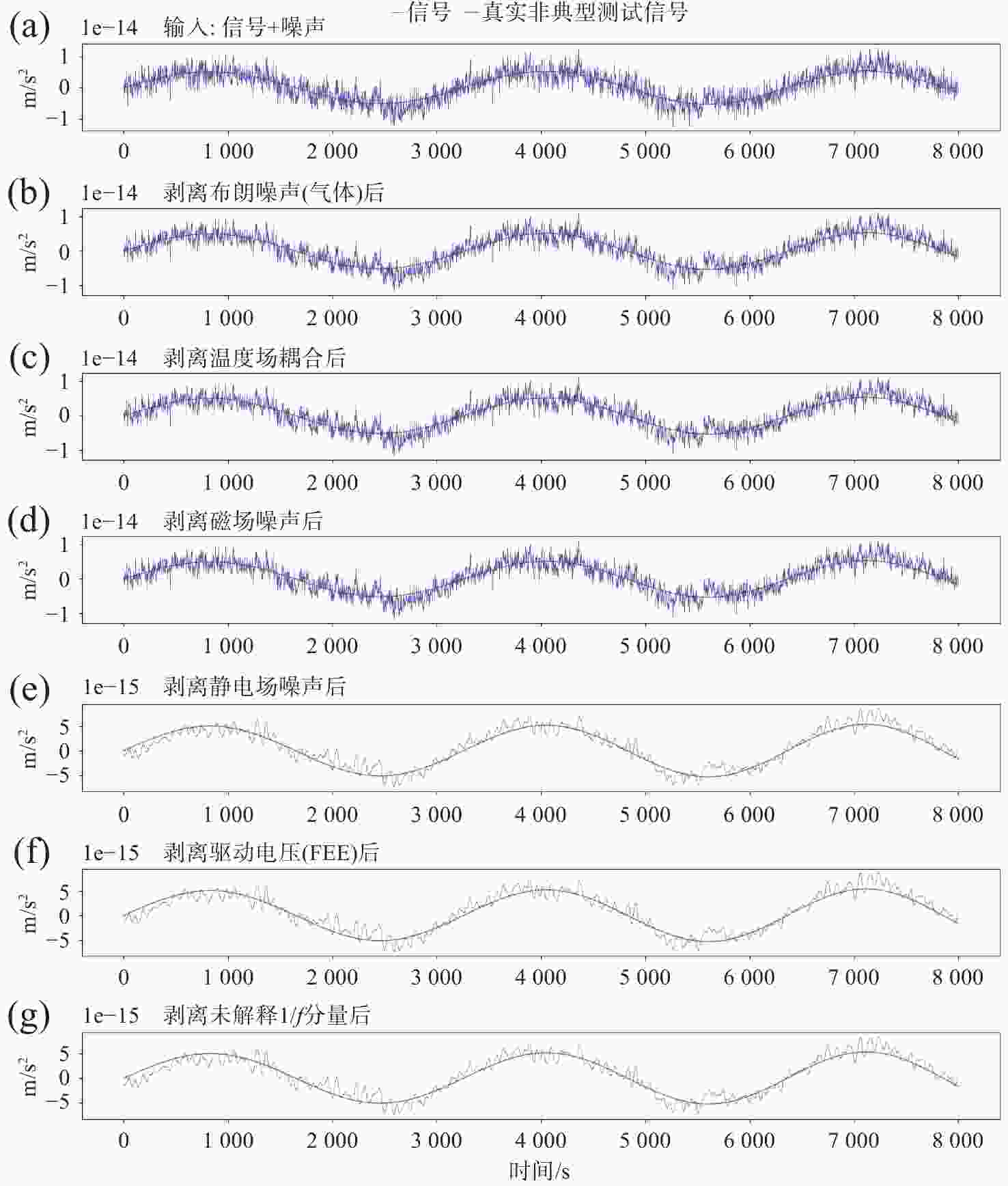
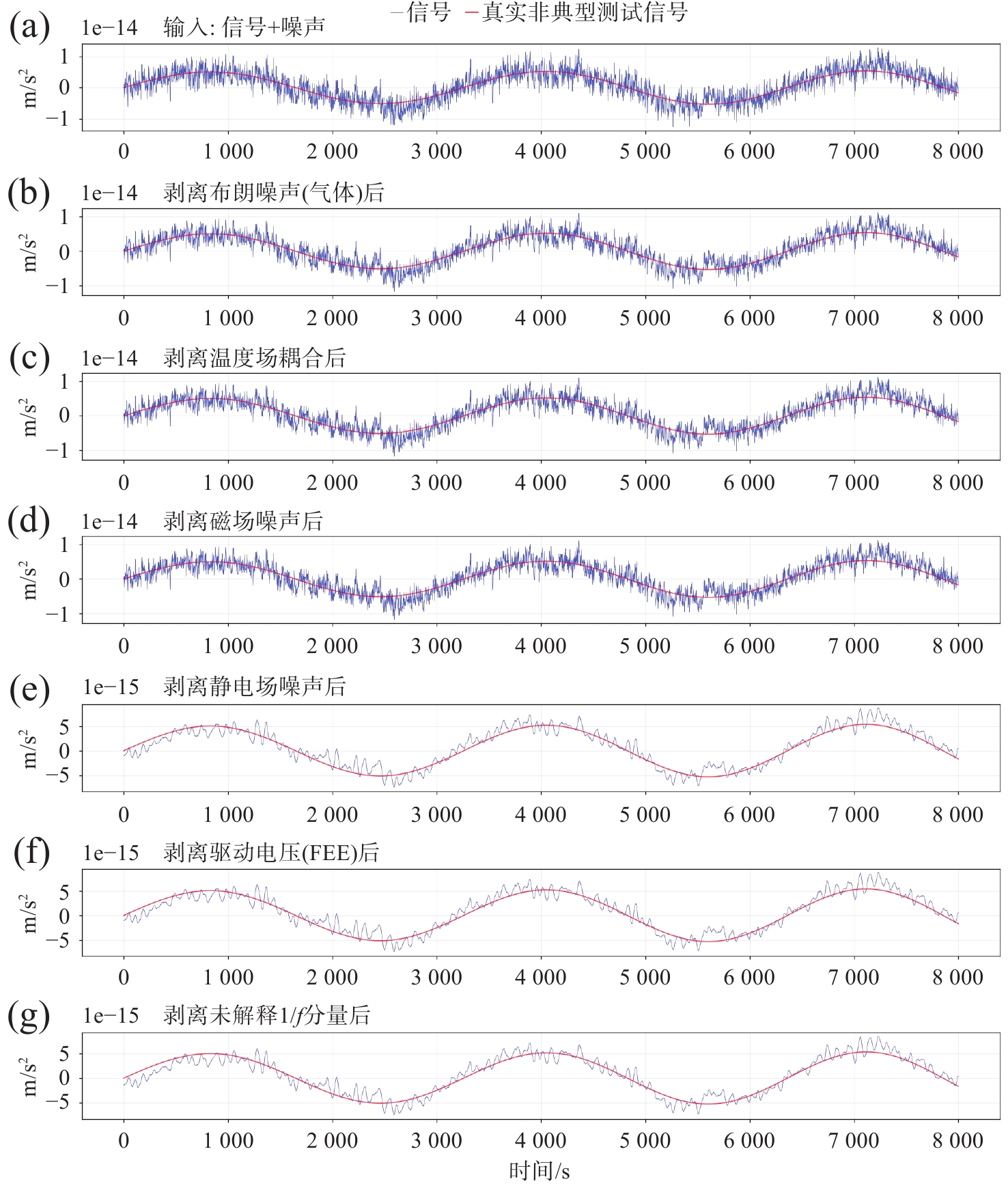
图 6 6 类别逐层噪声剥离的时域演化过程。蓝色曲线为当前剥离阶段的信号,红色曲线为真实非典型测试信号波形参照。
Figure 6. Time-domain evolution of six-category layer-by-layer noise stripping. The blue curve denotes the signal at the current stripping stage, and the red curve denotes the true atypical test signal
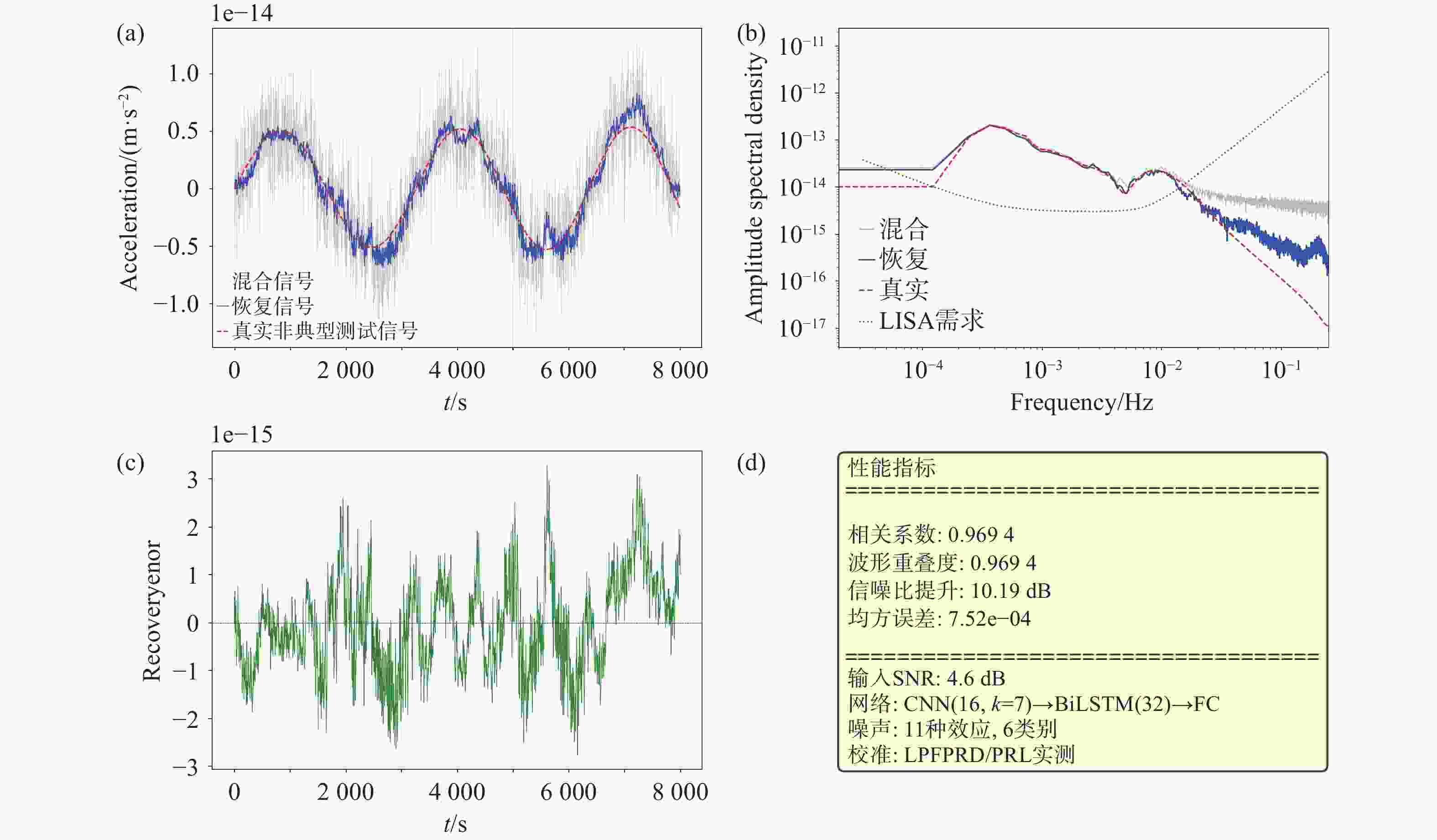
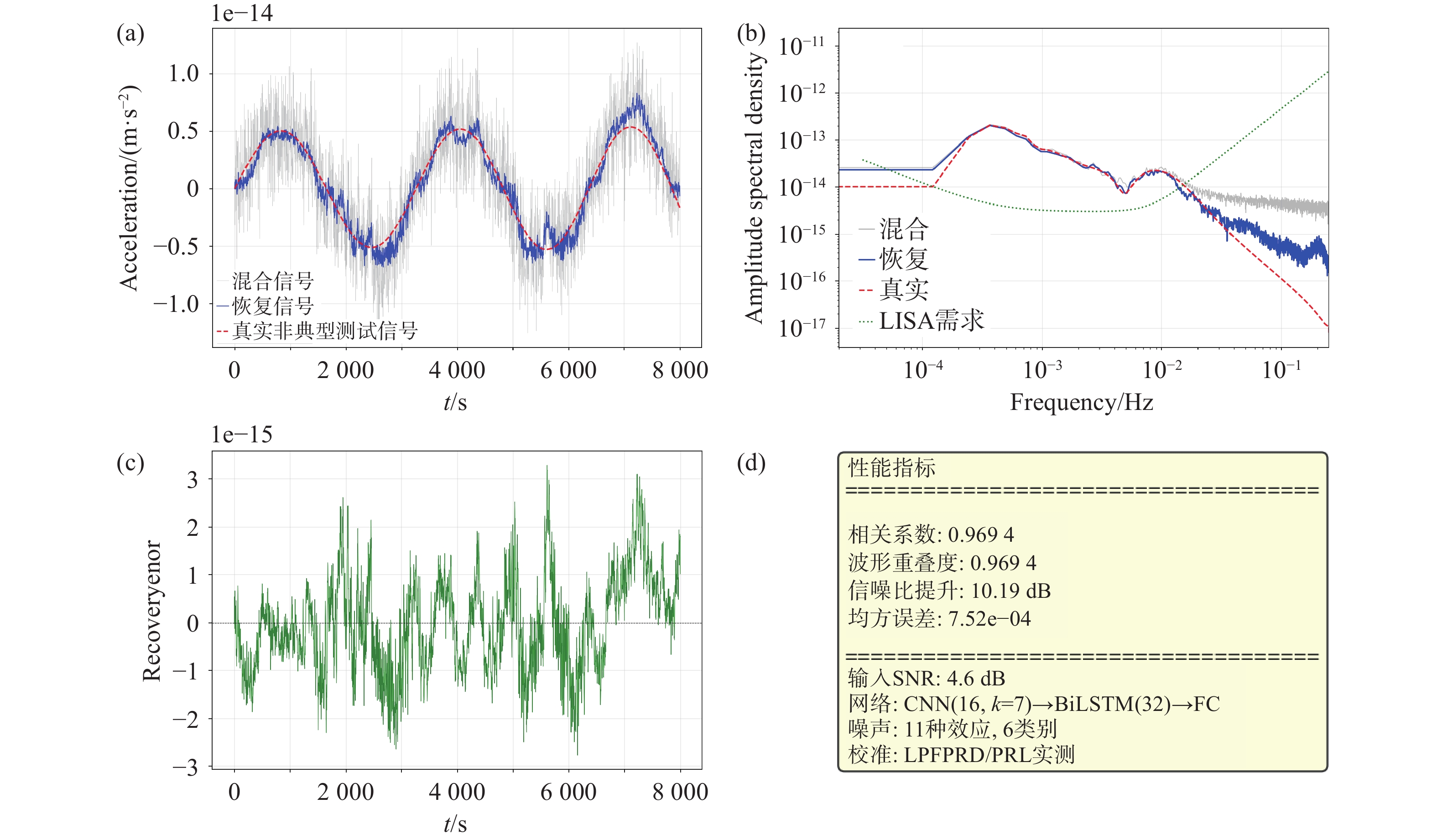
图 7 基于 CNN-BiLSTM 逐层噪声剥离的注入非典型测试信号恢复结果。(a) 混合信号、恢复信号与真实注入信号的时域波形;(b) 三者的加速度振幅谱密度及 LISA 需求曲线;(c) 恢复信号相对于真实注入信号的误差时间序列;(d) 恢复性能指标及仿真设置
Figure 7. Recovery of an injected atypical test signal using CNN-BiLSTM-based layer-by-layer noise stripping. (a) Time-domain waveforms of the mixed, recovered, and true injected signals; (b) their acceleration amplitude spectral densities and the LISA requirement curve; (c) recovery-error time series relative to the true injected signal; (d) recovery performance metrics and simulation settings
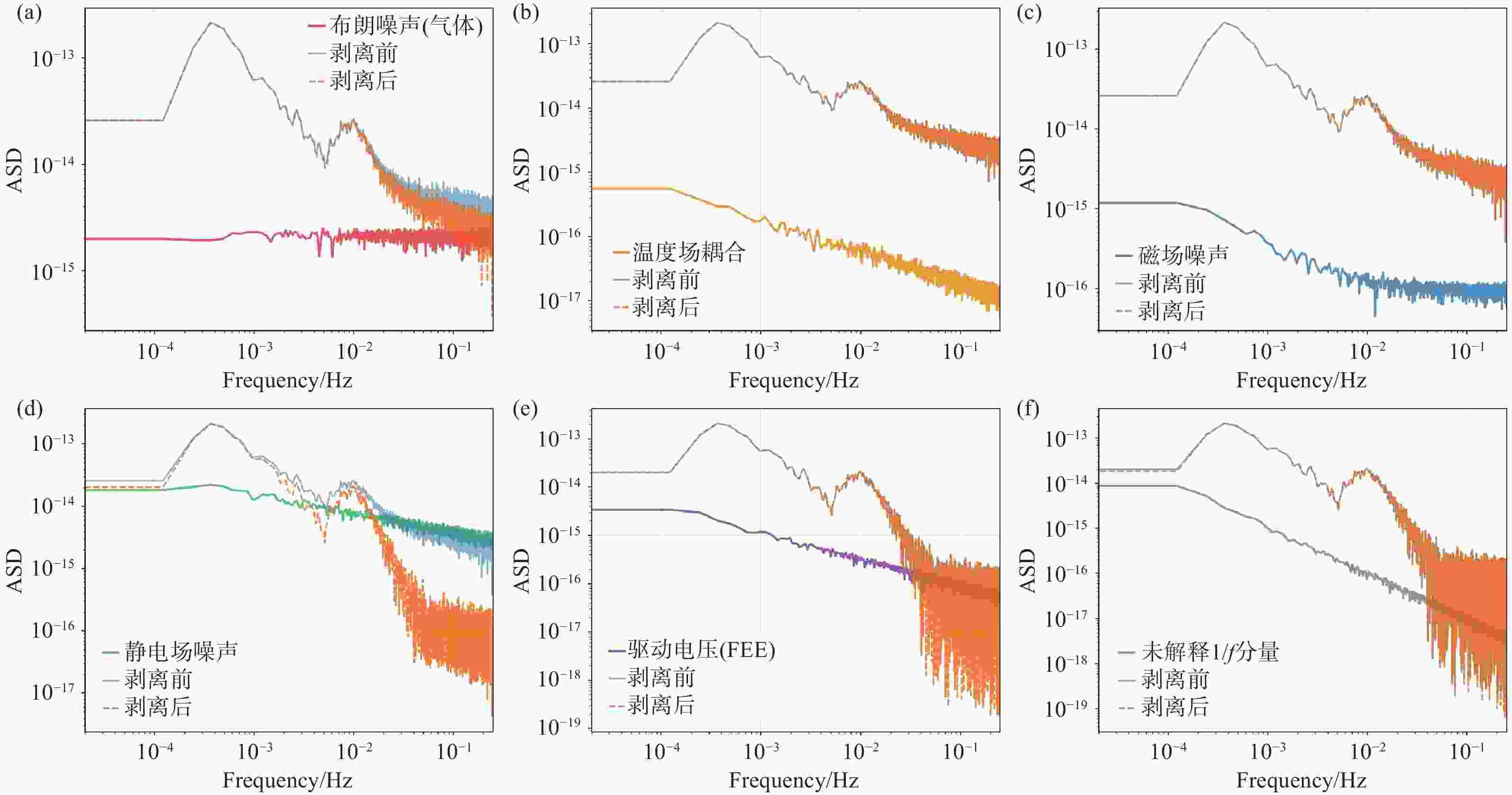
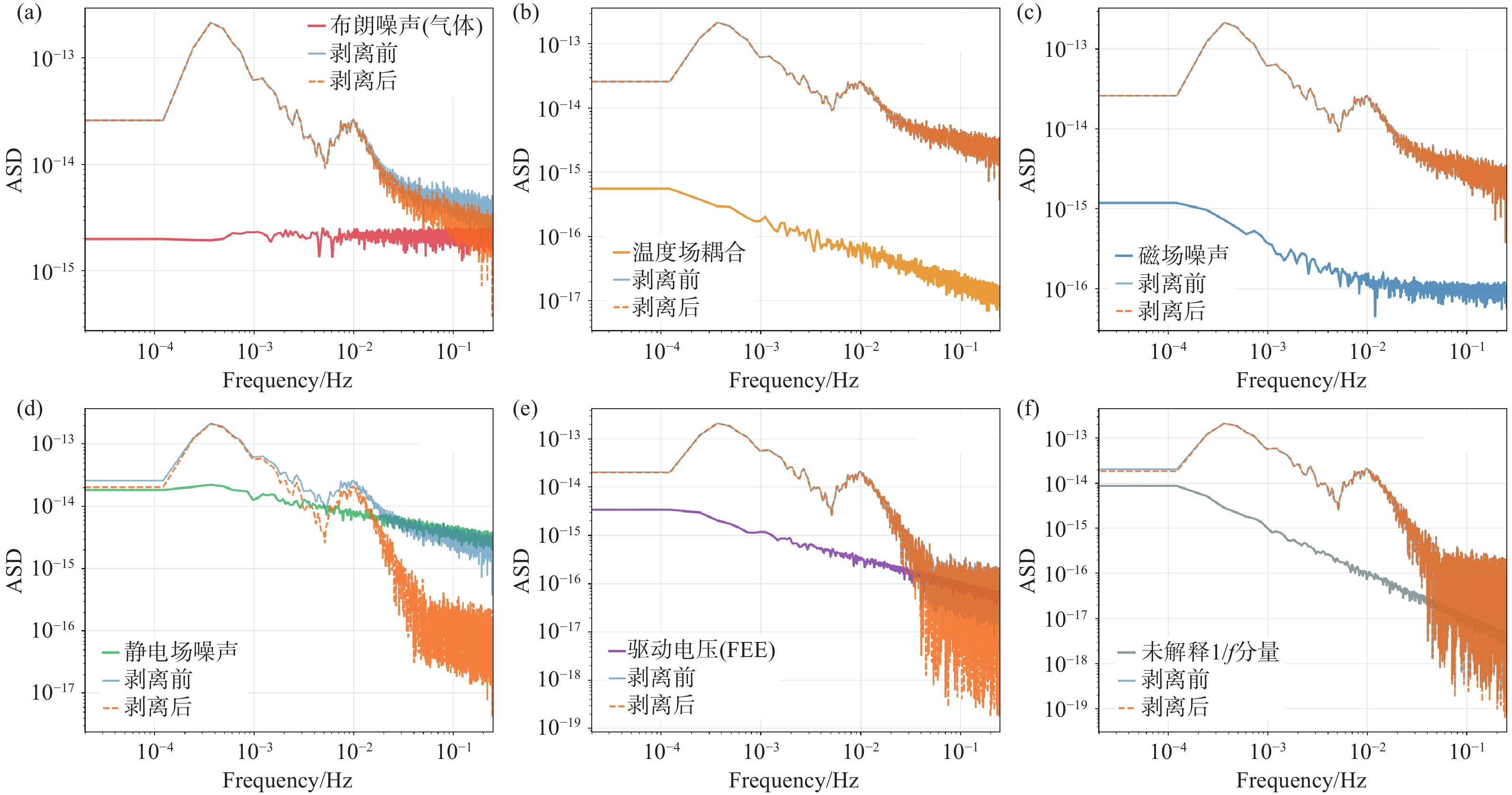
图 8 6 个物理类别噪声剥离前后的频域振幅谱对比。每幅子图包含该类别噪声自身的振幅谱(彩色)、剥离前信号谱(黑色)和剥离后信号谱(蓝色虚线)。
Figure 8. Comparison of frequency-domain amplitude spectra before and after stripping for the six physical noise categories. Each panel shows the spectrum of the target noise category (colored), the pre-stripping signal spectrum (black), and the post-stripping signal spectrum (blue dashed line)
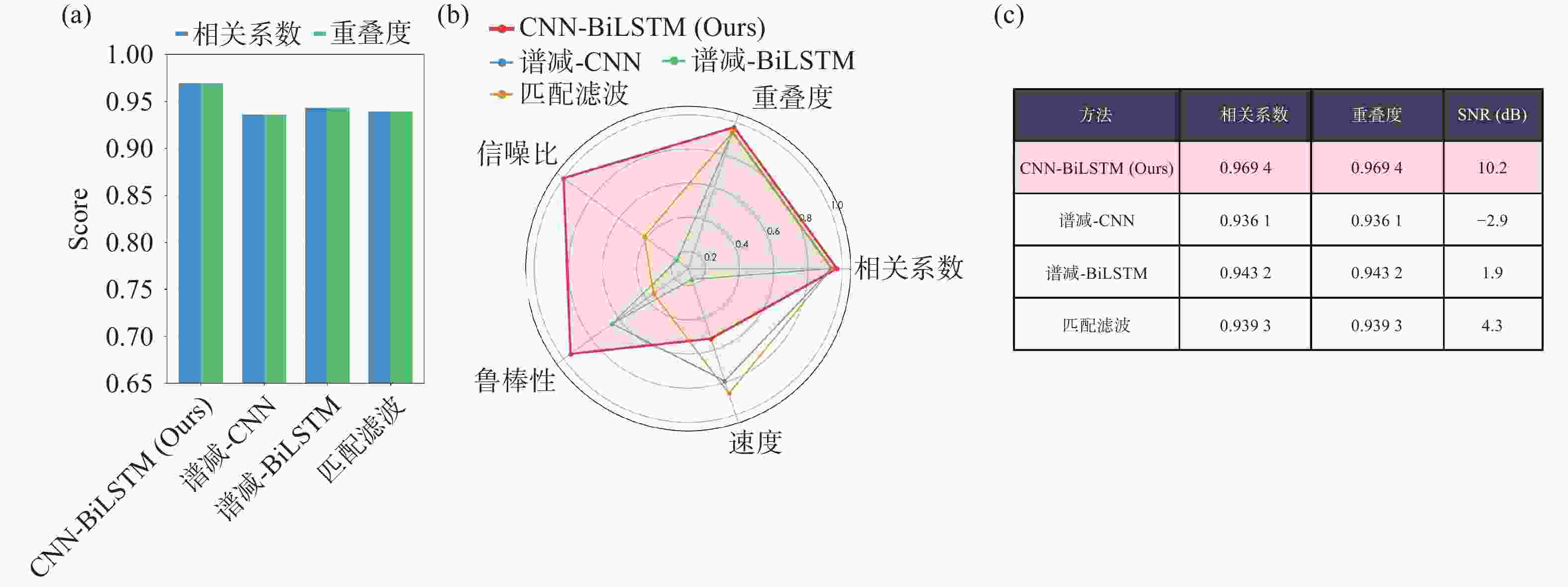
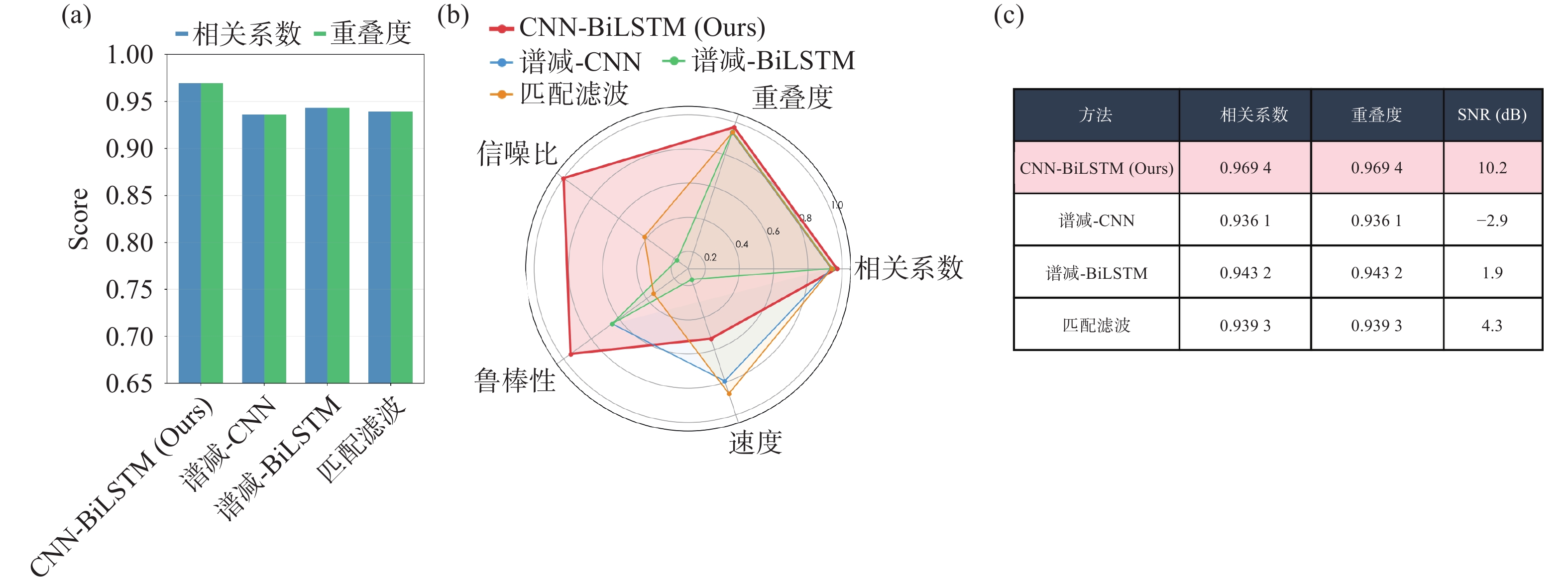
图 9 CNN-BiLSTM 与 3 种基线方法的横向对比。(a) 注入信号恢复保真度与重叠度柱状图;(b) 五维雷达图;(c) 定量对比表
Figure 9. Comparison between CNN-BiLSTM and three baseline methods. (a) Recovery fidelity and waveform overlap; (b) five-dimensional radar chart; (c) quantitative comparison table
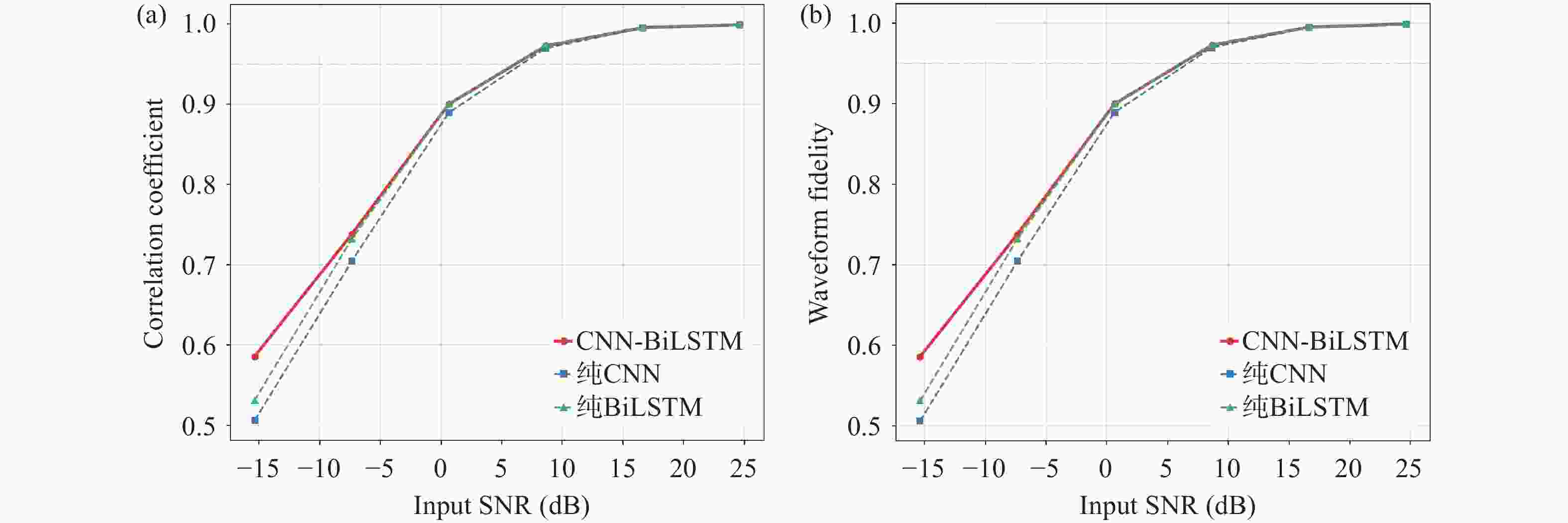
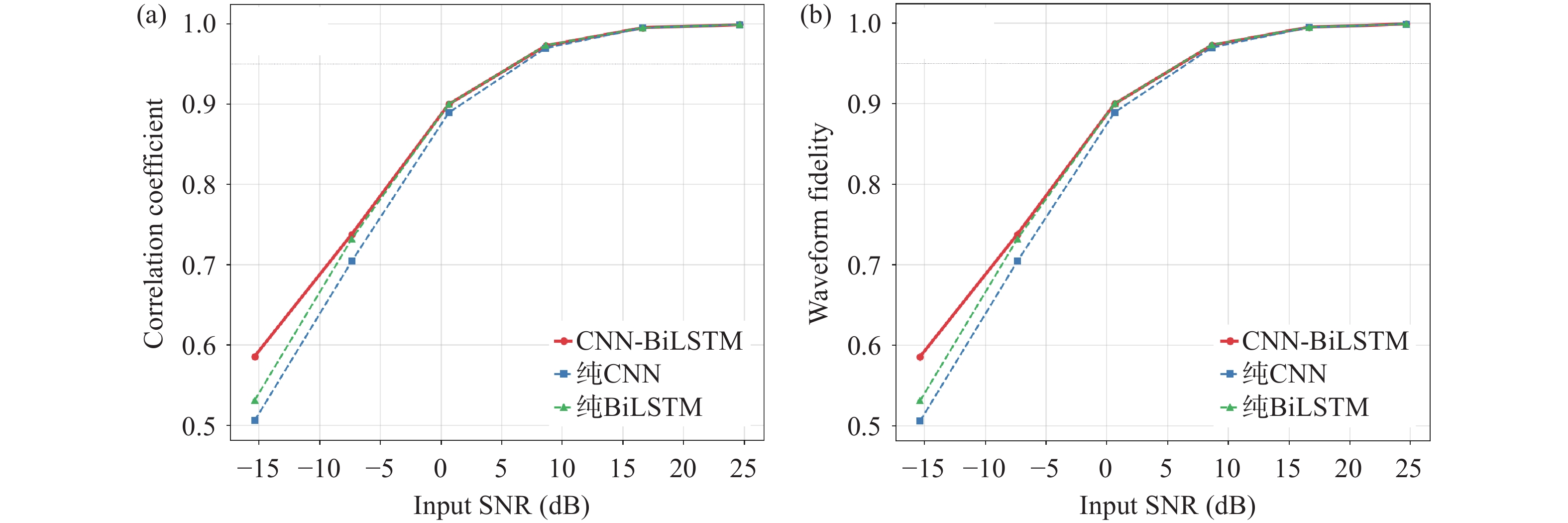
图 10 不同输入信噪比下4种方法的性能鲁棒性。(a) 恢复保真度随输入 SNR 的变化;(b) 重叠度随输入 SNR 的变化
Figure 10. Robustness of four methods under different input SNRs. (a) Recovery fidelity varies with input SNR; (b) waveform overlap varies with input SNR
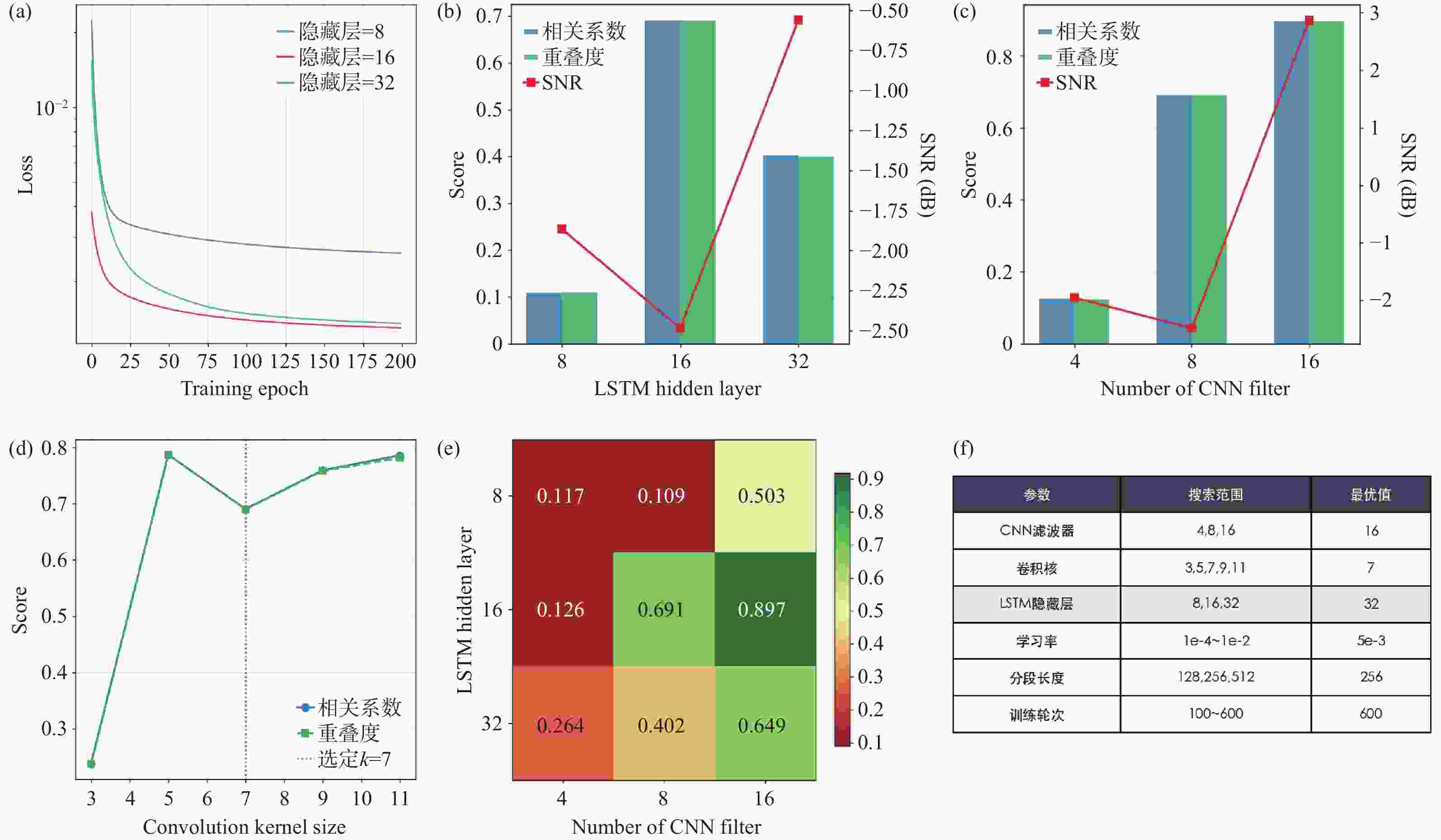
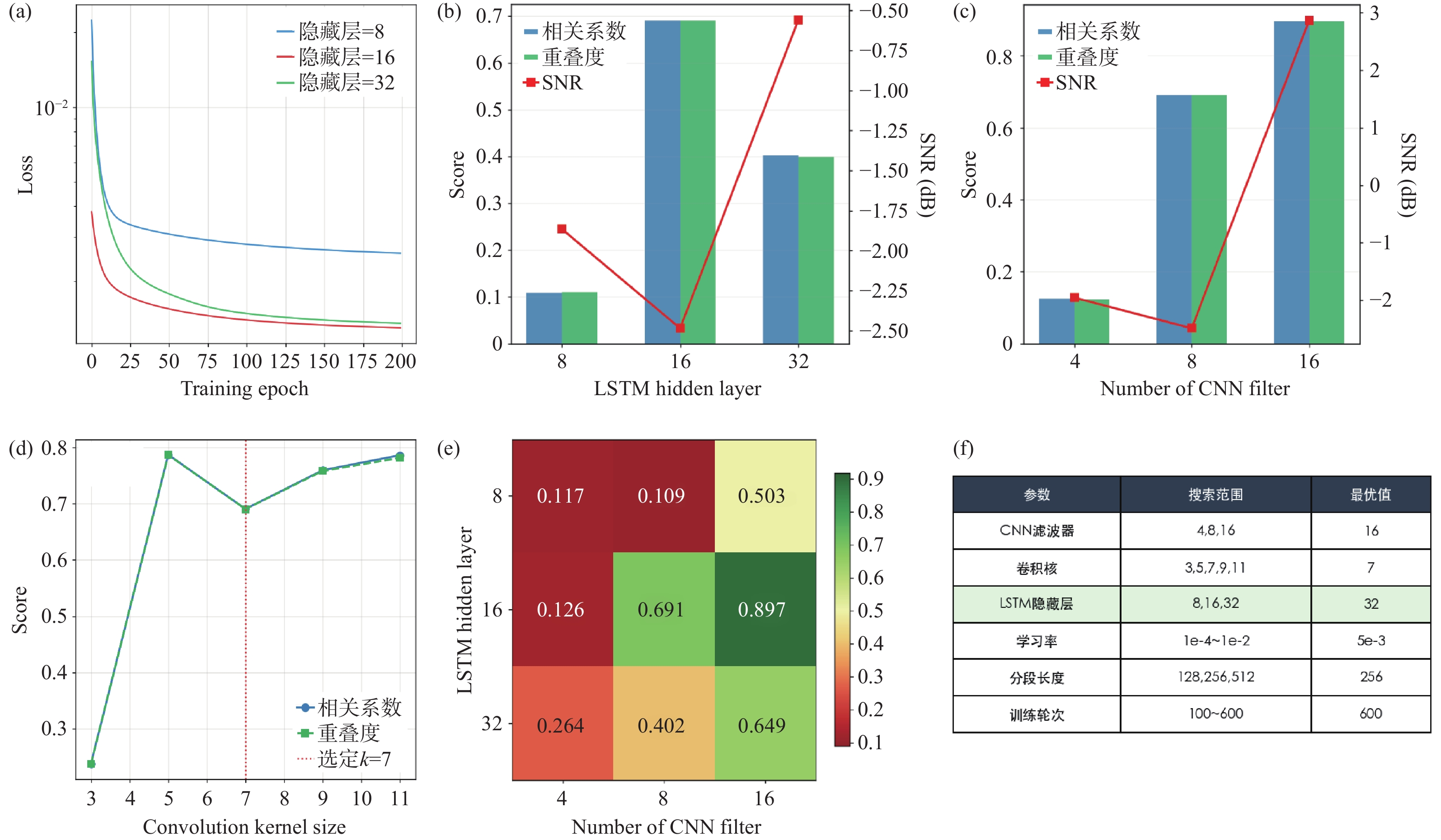
图 11 网络超参数敏感性实验。(a) 训练损失收敛曲线;(b) LSTM 隐藏层维度及(c) CNN 滤波器数量的性能影响;(d) 卷积核大小扫描;(e) 交叉热力图;(f) 超参数搜索汇总
Figure 11. Hyperparameter sensitivity of the network. (a) training-loss convergence; (b)(c) effects of LSTM hidden size and CNN filter number; (d) kernel-size scan; (e) cross heat map; (f) summary of the hyperparameter search
-
[1] ABBOTT B P, ABBOTT R, ABBOTT T D, et al. Observation of gravitational waves from a binary black hole merger[J]. Physical Review Letters, 2016, 116(6): 061102. doi: 10.1103/PhysRevLett.116.061102 [2] ABBOTT B P, ABBOTT R, ABBOTT T D, et al. GW170817: observation of gravitational waves from a binary neutron star inspiral[J]. Physical Review Letters, 2017, 119(16): 161101. doi: 10.1103/PhysRevLett.119.161101 [3] AMARO-SEOANE P, AUDLEY H, BABAK S, et al. Laser interferometer space antenna[J]. arXiv preprint arXiv:1702.00786, 2017. [4] HU W R, WU Y L. The Taiji Program in Space for gravitational wave physics and the nature of gravity[J]. National Science Review, 2017, 4(5): 685-686. doi: 10.1093/nsr/nwx116 [5] LIU H SH, WANG J, TAO W, et al. Recent development of the laser interferometer for Taiji space gravitational wave detection[J]. Research, 2026, 9: 1252. doi: 10.34133/research.1252 [6] LUO J, CHEN L SH, DUAN H Z, et al. TianQin: a space-borne gravitational wave detector[J]. Classical and Quantum Gravity, 2016, 33(3): 035010. doi: 10.1088/0264-9381/33/3/035010 [7] 王智, 马军, 李静秋. 空间引力波探测计划-LISA系统设计要点[J]. 中国光学, 2015, 8(6): 980-987. doi: 10.3788/CO.20150806.0980WANG ZH, MA J, LI J Q. Space-based gravitational wave detection mission: design highlights of LISA system[J]. Chinese Optics, 2015, 8(6): 980-987. (in Chinese). doi: 10.3788/CO.20150806.0980 [8] 邓剑峰, 蔡志鸣, 陈琨, 等. 无拖曳控制技术研究及在我国空间引力波探测中的应用[J]. 中国光学, 2019, 12(3): 503-514. doi: 10.3788/CO.20191203.0503DENG J F, CAI ZH M, CHEN K, et al. Drag-free control and its application in China's space gravitational wave detection[J]. Chinese Optics, 2019, 12(3): 503-514. doi: 10.3788/CO.20191203.0503 [9] 刘河山, 高瑞弘, 罗子人, 等. 空间引力波探测中的绝对距离测量及通信技术[J]. 中国光学, 2019, 12(3): 486-492. doi: 10.3788/CO.20191203.0486LIU H SH, GAO R H, LUO Z R, et al. Laser ranging and data communication for space gravitational wave detection[J]. Chinese Optics, 2019, 12(3): 486-492. doi: 10.3788/CO.20191203.0486 [10] 王登峰, 姚鑫, 焦仲科, 等. 面向天基引力波探测的时间延迟干涉技术[J]. 中国光学, 2021, 14(2): 275-288. doi: 10.37188/CO.2020-0098WANG D F, YAO X, JIAO ZH K, et al. Time-delay interferometry for space-based gravitational wave detection[J]. Chinese Optics, 2021, 14(2): 275-288. doi: 10.37188/CO.2020-0098 [11] 叶磊巧, 杜明辉, 徐鹏, 等. 空间引力波探测“太极计划”星间姿态-光程耦合噪声迭代拟合与高精度抑制方法[J]. 中国光学(中英文), 2025, 18(3): 583-595. doi: 10.37188/CO.2025-0042YE L Q, DU M H, XU P, et al. Iterative estimation and precision suppression of inter-spacecraft tilt-to-length coupling noise for the Taiji space gravitational wave detection mission[J]. Chinese Optics, 2025, 18(3): 583-595. doi: 10.37188/CO.2025-0042 [12] ARMANO M, AUDLEY H, AUGER G, et al. Sub-Femto-g free fall for space-based gravitational wave observatories: LISA Pathfinder results[J]. Physical Review Letters, 2016, 116(23): 231101. doi: 10.1103/PhysRevLett.116.231101 [13] ARMANO M, AUDLEY H, BAIRD J, et al. Beyond the required LISA free-fall performance: new LISA Pathfinder results down to 20 μ Hz[J]. Physical Review Letters, 2018, 120(6): 061101. doi: 10.1103/PhysRevLett.120.061101 [14] DOLESI R, BORTOLUZZI D, BOSETTI P, et al. Gravitational sensor for LISA and its technology demonstration mission[J]. Classical and Quantum Gravity, 2003, 20(10): S99-S108. doi: 10.1088/0264-9381/20/10/312 [15] WEBER W J, BORTOLUZZI D, CAVALLERI A, et al. Position sensors for flight testing of LISA drag-free control[J]. Proceedings of SPIE, 2003, 4856: 31-42. doi: 10.1117/12.458564 [16] LECUN Y, BOTTOU L, BENGIO Y, et al. Gradient-based learning applied to document recognition[J]. Proceedings of the IEEE, 1998, 86(11): 2278-2324. doi: 10.1109/5.726791 [17] KRIZHEVSKY A, SUTSKEVER I, HINTON G E. ImageNet classification with deep convolutional neural networks[J]. Communications of the ACM, 2017, 60(6): 84-90. doi: 10.1145/3065386 [18] GOODFELLOW I, BENGIO Y, COURVILLE A. Deep Learning[M]. Cambridge: MIT Press, 2016. [19] GEORGE D, HUERTA E A. Deep learning for real-time gravitational wave detection and parameter estimation: results with Advanced LIGO data[J]. Physics Letters B, 2018, 778: 64-70. doi: 10.1016/j.physletb.2017.12.053 [20] GABBARD H, WILLIAMS M, HAYES F, et al. Matching matched filtering with deep networks for gravitational-wave astronomy[J]. Physical Review Letters, 2018, 120(14): 141103. doi: 10.1103/PhysRevLett.120.141103 [21] CHATTERJEE C, WEN L Q, VINSEN K, et al. Using deep learning to localize gravitational wave sources[J]. Physical Review D, 2019, 100(10): 103025. doi: 10.1103/PhysRevD.100.103025 [22] HUERTA E A, ALLEN G, ANDREONI I, et al. Enabling real-time multi-messenger astrophysics discoveries with deep learning[J]. Nature Reviews Physics, 2019, 1(10): 600-608. doi: 10.1038/s42254-019-0097-4 [23] CUOCO E, POWELL J, CAVAGLIÀ M, et al. Enhancing gravitational-wave science with machine learning[J]. Machine Learning: Science and Technology, 2020, 2(1): 011002. doi: 10.1088/2632-2153/abb93a [24] ZEVIN M, COUGHLIN S, BAHAADINI S, et al. Gravity Spy: integrating advanced LIGO detector characterization, machine learning, and citizen science[J]. Classical and Quantum Gravity, 2017, 34(6): 064003. doi: 10.1088/1361-6382/aa5cea [25] CHATTERJEE C, WEN L Q, DIAKOGIANNIS F, et al. Extraction of binary black hole gravitational wave signals from detector data using deep learning[J]. Physical Review D, 2021, 104(6): 064046. doi: 10.1103/PhysRevD.104.064046 [26] ZACKAY B, VENUMADHAV T, ROULET J, et al. Detecting gravitational waves in data with non-gaussian noise, arXiv e-prints[J]. arXiv preprint arXiv:1908.05644, 2019. [27] RAZZANO M, CUOCO E. Image-based deep learning for classification of noise transients in gravitational wave detectors[J]. Classical and Quantum Gravity, 2018, 35(9): 095016. doi: 10.1088/1361-6382/aab793 [28] COLGAN R E, CORLEY K R, LAU Y, et al. Efficient gravitational-wave glitch identification from environmental data through machine learning[J]. Physical Review D, 2020, 101(10): 102003. doi: 10.1103/PhysRevD.101.102003 [29] REN ZH X, ZHAO T Y, CAO ZH J, et al. Taiji data challenge for exploring gravitational wave universe[J]. Frontiers of Physics, 2023, 18(6): 64302. doi: 10.1007/s11467-023-1318-y [30] LI E K, WANG H, CHEN H Y, et al. GWSpace: a multi-mission science data simulator for space-based gravitational wave detection[J]. Classical and Quantum Gravity, 2025, 42(16): 165005. doi: 10.1088/1361-6382/adf409 [31] ARMANO M, AUDLEY H, BAIRD J, et al. In-depth analysis of LISA Pathfinder performance results: time evolution, noise projection, physical models, and implications for LISA[J]. Physical Review D, 2024, 110(4): 042004. doi: 10.1103/PhysRevD.110.042004 [32] ARMANO M, AUDLEY H, BAIRD J, et al. Magnetic-induced force noise in LISA Pathfinder free-falling test masses[J]. Physical Review Letters, 2025, 134(7): 071401. doi: 10.1103/PhysRevLett.134.071401 [33] HOCHREITER S, SCHMIDHUBER J. Long short-term memory[J]. Neural Computation, 1997, 9(8): 1735-1780. doi: 10.1162/neco.1997.9.8.1735 [34] SCHUSTER M, PALIWAL K K. Bidirectional recurrent neural networks[J]. IEEE Transactions on Signal Processing, 1997, 45(11): 2673-2681. doi: 10.1109/78.650093 [35] SAINATH T N, VINYALS O, SENIOR A, et al. Convolutional, long short-term memory, fully connected deep neural networks[C]. 2015 IEEE International Conference on Acoustics, Speech and Signal Processing (ICASSP), IEEE, 2015: 4580-4584. https://doi.org/10.1109/ICASSP.2015.7178838. [36] CHEN W, SHI K. Multi-scale attention convolutional neural network for time series classification[J]. Neural Networks, 2021, 136: 126-140. doi: 10.1016/j.neunet.2021.01.001 [37] BOLL S F. Suppression of acoustic noise in speech using spectral subtraction[J]. IEEE Transactions on Acoustics, Speech, and Signal Processing, 1979, 27(2): 113-120. doi: 10.1109/TASSP.1979.1163209 [38] EPHRAIM Y, MALAH D. Speech enhancement using a minimum-mean square error short-time spectral amplitude estimator[J]. IEEE Transactions on Acoustics, Speech, and Signal Processing, 1984, 32(6): 1109-1121. doi: 10.1109/TASSP.1984.1164453 [39] GONG Y G, LUO J, WANG B. Concepts and status of Chinese space gravitational wave detection projects[J]. Nature Astronomy, 2021, 5(9): 881-889. doi: 10.1038/s41550-021-01480-3 -

 下载:
下载:

计量
- 文章访问数: 176
- HTML全文浏览量: 92
- PDF下载量: 6
- 被引次数: 0
