


Analysis and Decoupling of Phasemeter Noise Based on a Physics-Informed Residual Network
-
摘要:
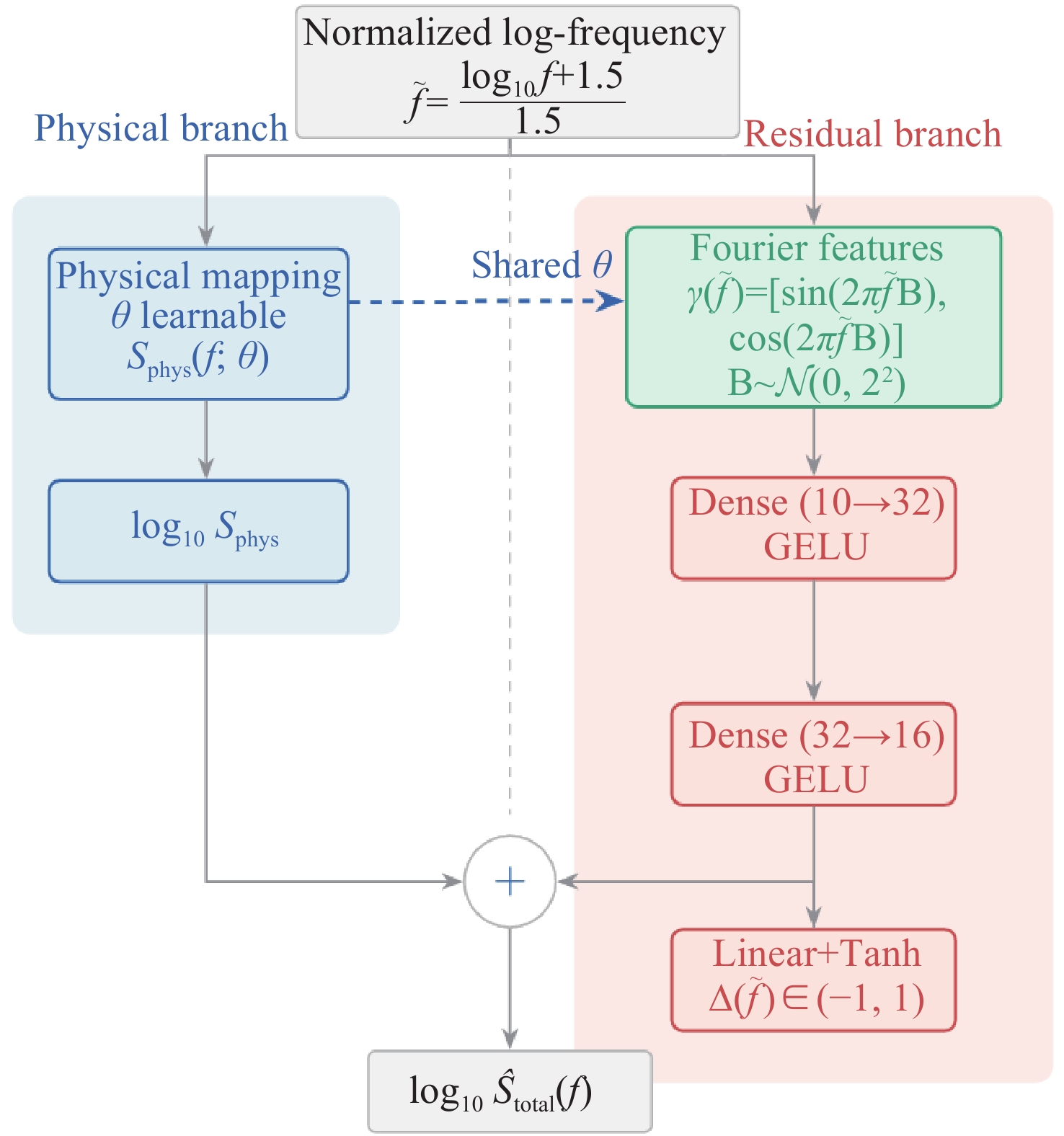
高精度相位计是空间激光干涉测量与引力波探测系统的核心载荷,其低频相位噪声水平直接制约测量灵敏度极限。针对纯解析物理模型难以表征硬件非线性扰动、纯数据驱动深度网络易产生频谱偏倚且缺乏物理可解释性的问题,本文提出一种傅里叶特征增强的物理约束残差网络(Physics-Informed Residual Network with Fourier Features,PIResNet-FF)。该网络采用双支路协同架构,以嵌入确定性噪声演化方程的物理支路作为全局基准,并利用傅里叶特征增强的残差支路补偿局部频谱畸变,通过两阶段优化实现物理参数与残差网络的协同学习。实验结果表明,PIResNet-FF对振幅谱密度的平均绝对百分比误差为3.52%,优于经典物理模型、标准物理信息神经网络和纯数据驱动网络。进一步采用多载波控制变量实验,利用时钟抖动与等效白噪声不同的载波频率响应增加参数估计中的独立物理约束,从而改善两类平坦噪声在单载波条件下的结构可辨识性。不同参考时钟条件下,模型得到的时钟相关等效参数呈现与参考时钟稳定度变化一致的响应方向,为时钟相关噪声分量的辨识提供了补充实验支持。该方法可为高精度相位计噪声谱建模、条件等效参数提取和噪声分析提供参考。
-
关键词:
- 空间引力波探测 /
- 相位计 /
- 噪声分析 /
- 物理信息残差神经网络
Abstract:High-precision phasemeters are core payloads in space laser interferometry and gravitational-wave detection systems, and their low-frequency phase-noise performance directly limits the achievable measurement sensitivity. To address the limited capability of purely analytical physical models in describing hardware-induced nonlinear disturbances, as well as the spectral bias and lack of physical interpretability of purely data-driven deep networks, this study proposes a Physics-Informed Residual Network with Fourier Features (PIResNet-FF). The proposed network adopts a dual-branch architecture, in which a physics branch embedding deterministic noise equations provides the global spectral baseline, while a Fourier-feature-enhanced residual branch compensates for local spectral distortions. A two-stage optimization strategy is employed to jointly learn the physical parameters and residual corrections. Experimental results show that PIResNet-FF achieves a mean absolute percentage error of 3.52% in amplitude spectral density modeling, outperforming the classical physical model, a standard physics-informed neural network, and a purely data-driven network. Multi-carrier control experiments are further introduced to exploit the different carrier-frequency responses of clock-jitter noise and equivalent white noise, thereby providing additional independent physical constraints for parameter estimation and improving the structural identifiability of the two flat-noise components under single-carrier conditions. Under different reference-clock conditions, the clock-related equivalent parameter estimated by the model exhibits a response consistent with the relative change in reference-clock stability, providing supplementary experimental support for the identification of the clock-related noise component. The proposed method provides a useful approach for noise-spectrum modeling, conditional equivalent parameter estimation, and noise analysis of high-precision phasemeters.
-
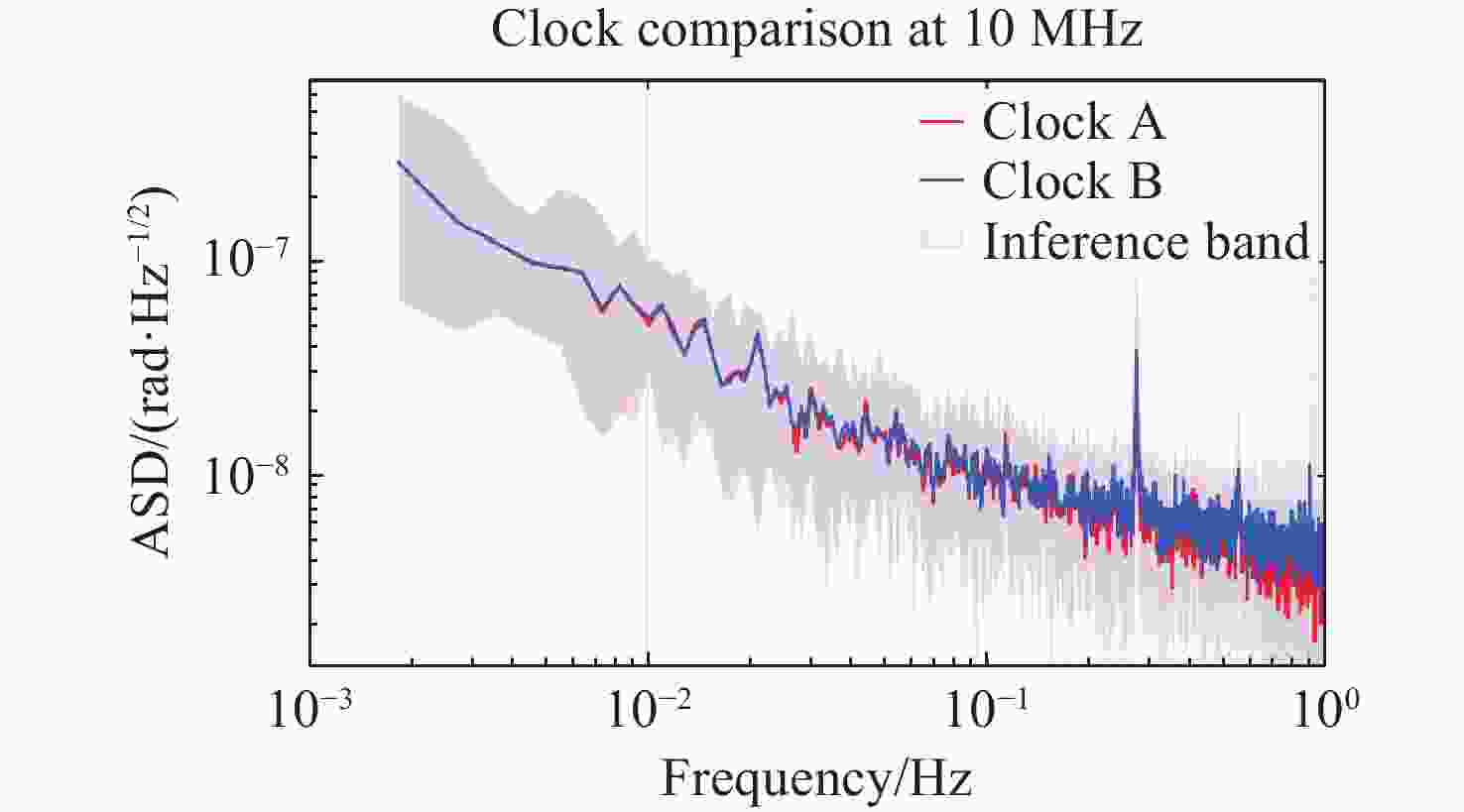
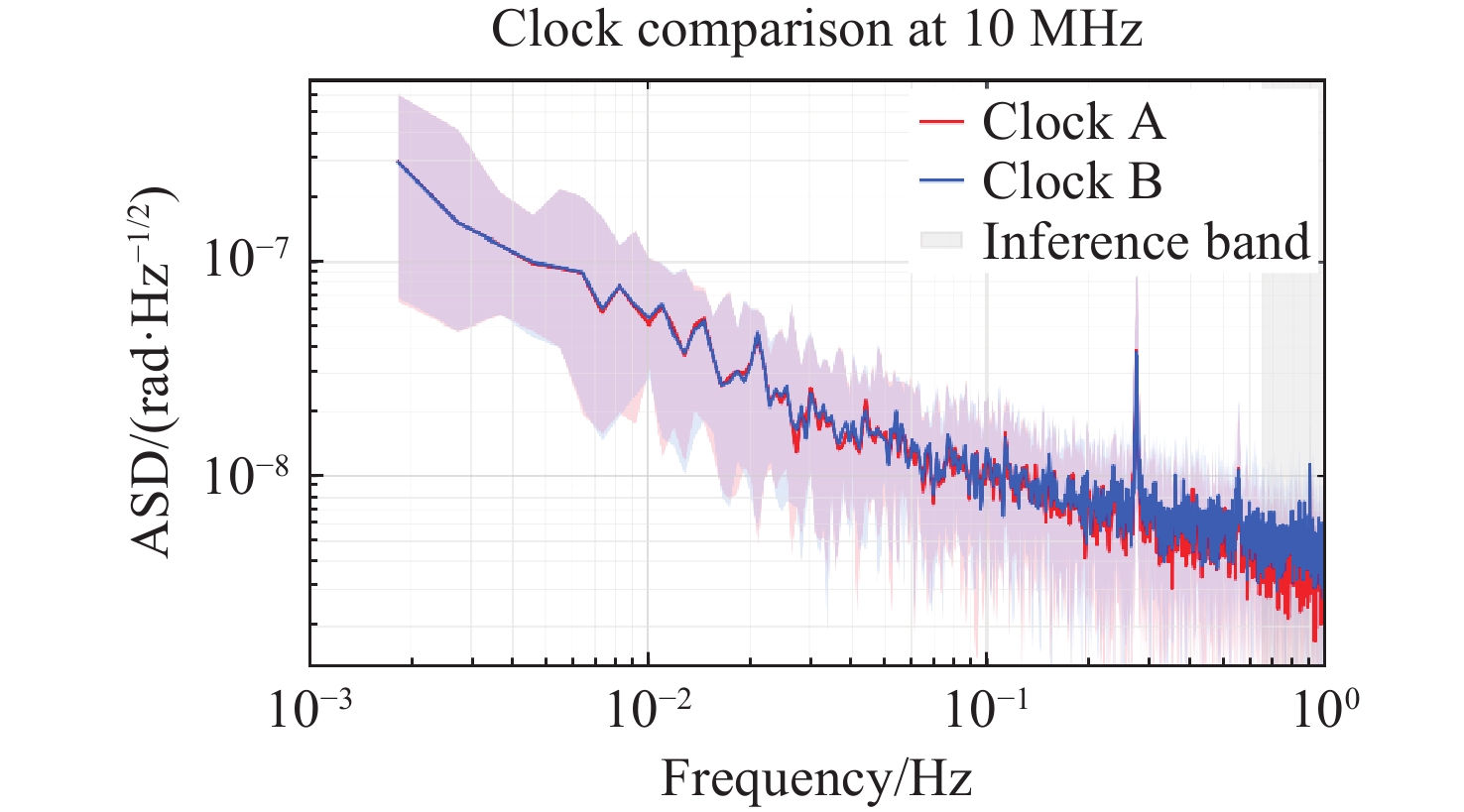
图 8 10 MHz载波下两种参考时钟的相位噪声谱对比
Figure 8. Comparison of phase-noise spectra for two reference clocks at a 10 MHz carrier frequency
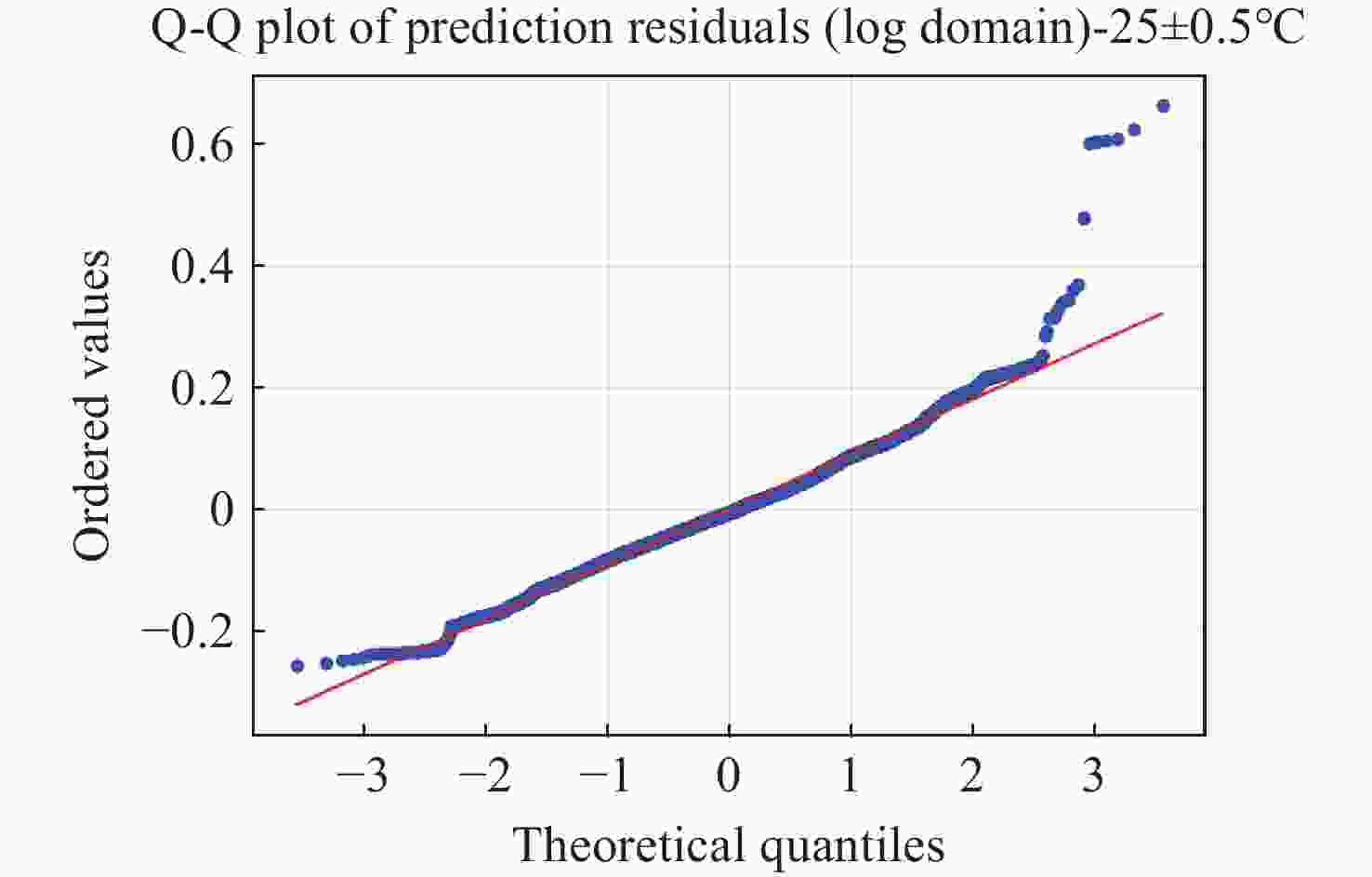
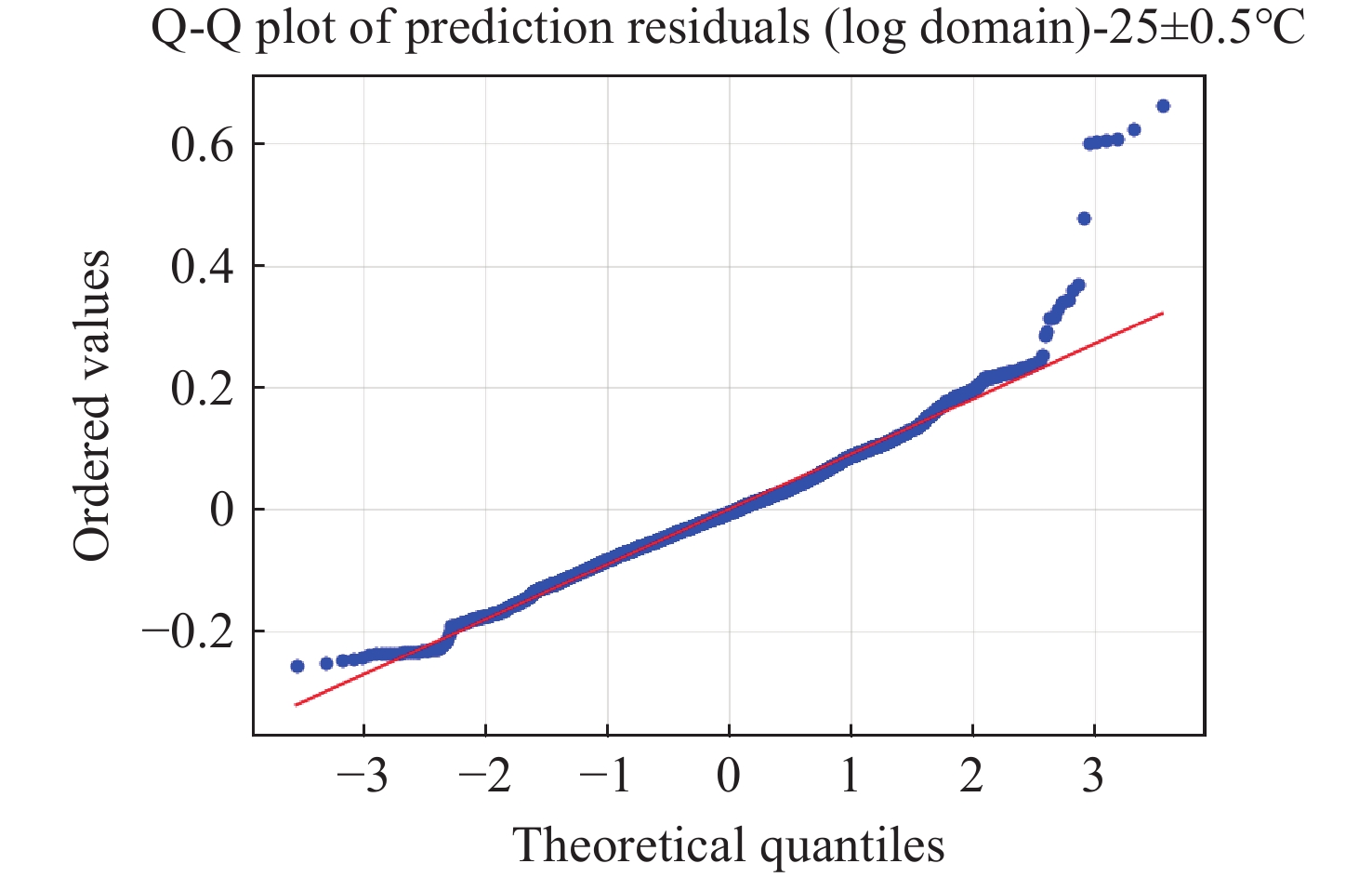
图 10 对数域残差Q-Q图
Figure 10. Q–Q plot of the prediction residuals in the logarithmic domain
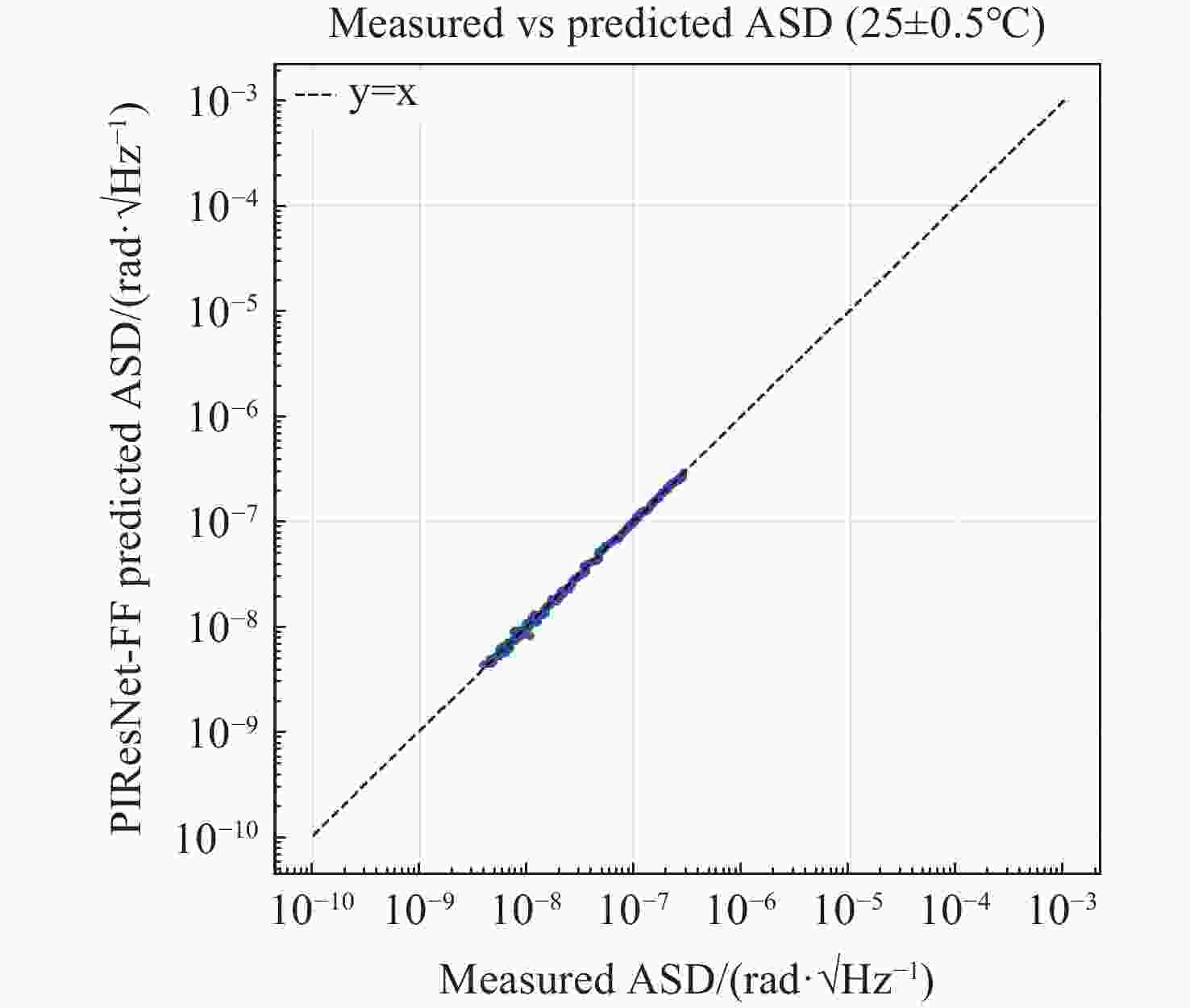
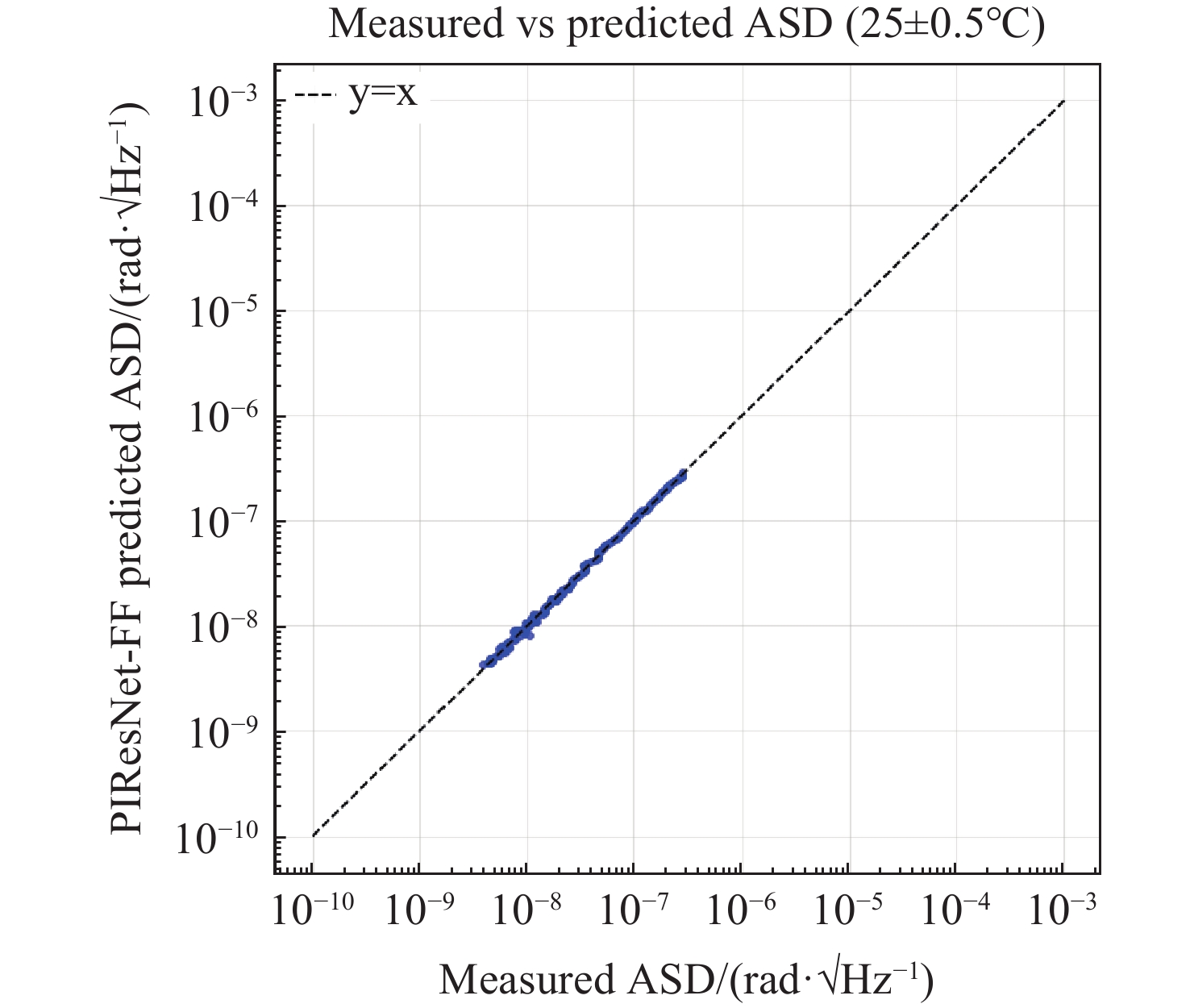
图 11 中位数与预测值ASD点图
Figure 11. Scatter plot comparing the measured median ASD and predictions
表 1 测试数据工况汇总
Table 1. Summary of test data conditions
Parameter Value ADC sampling frequency/MHz 80 Output sampling rate/Hz 60 Acquisition duration/s 1800 External reference clock frequency/MHz 20 Ambient temperature/°C 25 ± 0.5 Carrier frequency/MHz 2, 6, 10, 14, 20  下载: 导出CSV
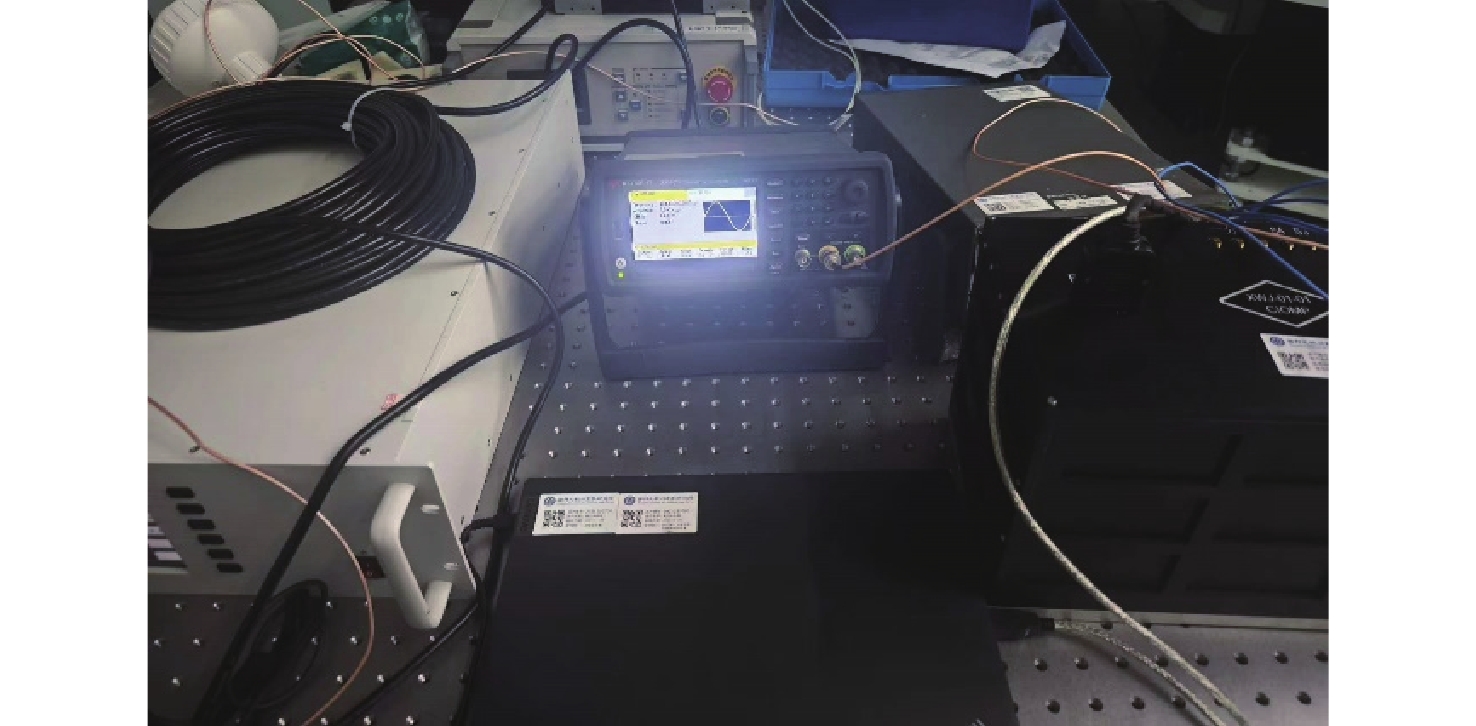
表 2 数据采集设备型号
Table 2. Data acquisition equipment models
Equipment Manufacturer Model Temperature measurement YOWEXA Platinum resistance thermometer Signal generator KEYSIGHT 33500B External clock source Xi'an Hongtai Time-Frequency Rubidium atomic clock DC power KEITHLEY 2231A-30-3
下载: 导出CSV
表 3 模型频谱重构精度对比
Table 3. Comparison of spectral reconstruction accuracy
Model MAPE Classical physical model 22.66% Data-driven network 6.35% Standard PINN 9.40% PIResNet-FF 3.52%
下载: 导出CSV
表 4 单载波条件下的条件等效参数估计及统计重复性
Table 4. Conditional equivalent parameter estimates and statistical repeatability under the single-carrier condition
Parameter Physical meaning Single-carrier
estimate95% confidence
intervalOptimization search
bounds$ {\tau }_{\rm{jit}}/({\mathrm{s}}/\sqrt{{\mathrm{Hz}}}) $ ADC equivalent differential clock jitter 4.01×10⁻¹⁷ [3.98, 4.05]×10-17 10-17-10-15 $ {A}_{\rm{white}}/({\mathrm{rad}}/\sqrt{{\mathrm{Hz}}}) $ Equivalent white-noise component 2.88×10⁻⁹ [2.85, 2.89]×10−9 10−9-10−8 $ {A}_{1/f}/({\rm{rad}}\cdot {{\mathrm{Hz}}}^{\alpha }/\sqrt{{\mathrm{Hz}}}) $ Equivalent coefficient of \(1/f\) noise and thermal drift 1.60×10⁻⁹ [1.53, 1.71]×10−9 5×10⁻¹⁰-3×10⁻⁹ $ \alpha $ Flicker-noise power exponent 0.806 [0.790, 0.822] 0.5-1.5
下载: 导出CSV
表 5 PIResNet-FF消融实验结果
Table 5. Ablation study results of PIResNet-FF
Model MAPE Physical MAPE Full PIResNet-FF 3.52% 11.79% Without Fourier features 12.94% 14.55% Without residual network 10.83% 10.83% Without Tanh constraint 3.89% 12.10%
下载: 导出CSV
-
[1] 罗子人, 张敏, 靳刚, 等. 中国空间引力波探测“太极计划”及“太极1号”在轨测试[J]. 深空探测学报, 2020, 7(1): 3-10. doi: 10.15982/j.issn.2095-7777.2020.20191230001LUO Z R, ZHANG M, JIN G, et al. Introduction of Chinese space-borne gravitational wave detection program “Taiji” and “Taiji-1” satellite mission[J]. Journal of Deep Space Exploration, 2020, 7(1): 3-10. (in Chinese). doi: 10.15982/j.issn.2095-7777.2020.20191230001 [2] 罗俊, 艾凌皓, 艾艳丽, 等. 天琴计划简介[J]. 中山大学学报(自然科学版), 2021, 60(1-2): 1-19. doi: 10.13471/j.cnki.acta.snus.2020.12.23.2020B154LUO J, AI L H, AI Y L, et al. A brief introduction to the TianQin project[J]. Acta Scientiarum Naturalium Universitatis Sunyatseni, 2021, 60(1-2): 1-19. (in Chinese). doi: 10.13471/j.cnki.acta.snus.2020.12.23.2020B154 [3] 高瑞弘, 刘河山, 罗子人, 等. 太极计划激光指向调控方案介绍[J]. 中国光学, 2019, 12(3): 425-431. doi: 10.3788/CO.20191203.0425GAO R H, LIU H SH, LUO Z R, et al. Introduction of laser pointing scheme in the Taiji program[J]. Chinese Optics, 2019, 12(3): 425-431. (in Chinese). doi: 10.3788/CO.20191203.0425 [4] DANZMANN K, The LISA Study Team. LISA: laser interferometer space antenna for gravitational wave measurements[J]. Classical and Quantum Gravity, 1996, 13(11A): A247-A250. doi: 10.1088/0264-9381/13/11a/033 [5] 罗子人, 白姗, 边星, 等. 空间激光干涉引力波探测[J]. 力学进展, 2013, 43(4): 415-447.LUO Z R, BAI SH, BIAN X, et al. Gravitational wave detection by space laser interferometry[J]. Advances in Mechanics, 2013, 43(4): 415-447. (in Chinese). [6] 韩爽. 空间引力波探测相位计测试系统设计与实现[D]. 长春: 中国科学院大学(中国科学院长春光学精密机械与物理研究所), 2022.HAN SH. Design and implementation of phasemeter test system for space gravitational wave detection[D]. Changchun: University of Chinese Academy of Sciences (Changchun Institute of Optics, Fine Mechanics and Physics, Chinese Academy of Sciences), 2022. (in Chinese). [7] YANG R, LIU H SH, LUO Z R. Optimization design of decimation filter for the phasemeter in the space gravitational wave detection[J]. IEEE Transactions on Instrumentation and Measurement, 2024, 73: 7006508. doi: 10.1109/tim.2024.3453345 [8] LIU H SH, WANG J, TAO W, et al. Recent development of the laser interferometer for Taiji space gravitational wave detection[J]. Research, 2026, 9: 1252. doi: 10.34133/research.1252 [9] GERBERDING O, SHEARD B, BYKOV I, et al. Phasemeter core for intersatellite laser heterodyne interferometry: modelling, simulations and experiments[J]. Classical and Quantum Gravity, 2013, 30(23): 235029. doi: 10.1088/0264-9381/30/23/235029 [10] GERBERDING O, DIEKMANN C, KULLMANN J, et al. Readout for intersatellite laser interferometry: measuring low frequency phase fluctuations of high-frequency signals with microradian precision[J]. Review of Scientific Instruments, 2015, 86(7): 074501. doi: 10.1063/1.4927071 [11] BODE C H. Noise in the LISA phasemeter[D]. Hannover: Leibniz Universität Hannover, 2024, doi: 10.15488/17997. [12] YAO W L, SUN CH Y, LIANG X D, et al. Research on ADPLL for high-precision phase measurement[J]. Symmetry, 2025, 17(9): 1487. doi: 10.3390/sym17091487 [13] CHEN H K, WANG P P, SHAO CH G. Subtracting and monitoring tilt-to-length noise under high differential wavefront sensing noise using convolutional neural networks and time delay interferometry[J]. The Astrophysical Journal, 2026, 998(2): 237. doi: 10.3847/1538-4357/ae1c46 [14] XU Y X, WANG H, DU M H, et al. Gravitational wave signal denoising and merger time prediction with a deep neural network[J]. Physical Review D, 2025, 111(6): 063037. doi: 10.1103/PhysRevD.111.063037 [15] RAISSI M, PERDIKARIS P, KARNIADAKIS G E. Physics-informed neural networks: a deep learning framework for solving forward and inverse problems involving nonlinear partial differential equations[J]. Journal of Computational Physics, 2019, 378: 686-707. doi: 10.1016/j.jcp.2018.10.045 [16] KIM K M, LEE J. Memristor noise modeling based on physics-informed neural networks: circuit simulator application[J]. Journal of the Semiconductor & Display Technology, 2025, 24(1): 25-31. [17] KIM K, LEE J. Stochastic memristor modeling framework based on physics-informed neural networks[J]. Applied Sciences, 2024, 14(20): 9484. doi: 10.3390/app14209484 [18] LEE J. Physics-informed neural network for high frequency noise performance in quasi-ballistic MOSFETs[J]. Electronics, 2021, 10(18): 2219. doi: 10.3390/electronics10182219 [19] KIM H, KANG P. naPINN: noise-adaptive physics-informed neural networks for recovering physics from corrupted measurement[EB/OL]. (2026-06-01)[2026-09-01]. https://arxiv.org/abs/2602.02547. [20] HOU B Y, BAI Y L, JING X T, et al. Fourier feature-enhanced multi-layer residual stacking network: a novel multiscale modeling approach for physics-informed neural networks[J]. Neural Networks, 2026, 195: 108247. doi: 10.1016/j.neunet.2025.108247 [21] HE K M, ZHANG X Y, REN SH Q, et al. Deep residual learning for image recognition[C]//Proceedings of the 2016 IEEE Conference on Computer Vision and Pattern Recognition, IEEE, 2016: 770-778. [22] TANCIK M, SRINIVASAN P P, MILDENHALL B, et al. Fourier features let networks learn high frequency functions in low dimensional domains[C]//Proceedings of the 34th International Conference on Neural Information Processing Systems, Curran Associates Inc., 2020: 632. [23] BASRI R, JACOBS D, KASTEN Y, et al. The convergence rate of neural networks for learned functions of different frequencies[C]//Proceedings of the 33rd International Conference on Neural Information Processing Systems, Curran Associates Inc., 2019: 428. [24] WANG S F, WANG H W, PERDIKARIS P. On the eigenvector bias of Fourier feature networks: from regression to solving multi-scale PDEs with physics-informed neural networks[J]. Computer Methods in Applied Mechanics and Engineering, 2021, 384: 113938. doi: 10.1016/j.cma.2021.113938 [25] SONG CH, WANG Y H. Simulating seismic multifrequency wavefields with the Fourier feature physics-informed neural network[J]. Geophysical Journal International, 2023, 232(3): 1503-1514. doi: 10.1093/gji/ggac399 [26] BISCHOF R, KRAUS M A. Multi-objective loss balancing for physics-informed deep learning[J]. Computer Methods in Applied Mechanics and Engineering, 2025, 439: 117914. doi: 10.1016/j.cma.2025.117914 [27] HELDMANN F, BERKHAHN S, EHRHARDT M, et al. PINN training using biobjective optimization: the trade-off between data loss and residual loss[J]. Journal of Computational Physics, 2023, 488: 112211. doi: 10.1016/j.jcp.2023.112211 [28] DAVINI D, SAMINENI B, THOMAS B, et al. Using physics-informed regularization to improve extrapolation capabilities of neural networks[C]//Fourth Workshop on Machine Learning and the Physical Sciences, 2021. (查阅网上资料, 未找到本条文献出版社信息, 请确认). [29] MCDOWELL E J, CUI X Q, YAQOOB Z, et al. A generalized noise variance analysis model and its application to the characterization of $ 1/{f} $ noise[J]. Optics Express, 2007, 15(7): 3833-3848. doi: 10.1364/oe.15.003833 -

 下载:




计量
- 文章访问数: 0
- HTML全文浏览量: 0
- PDF下载量: 0
- 被引次数: 0
