


-
摘要:
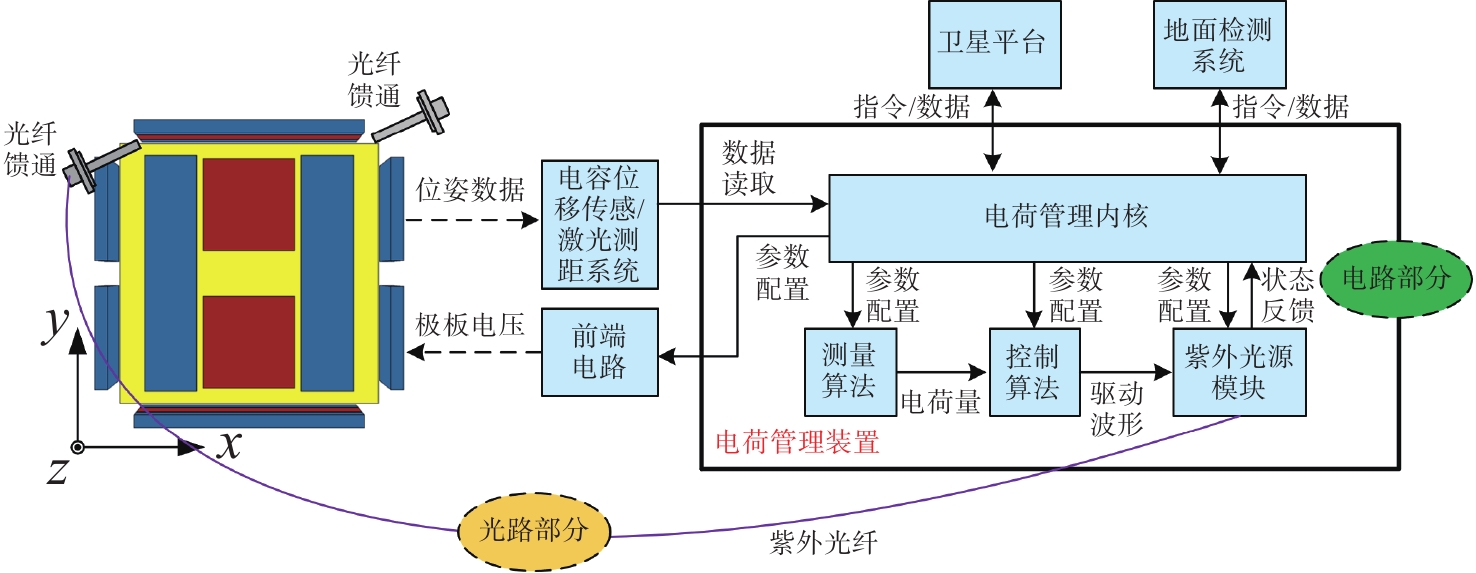
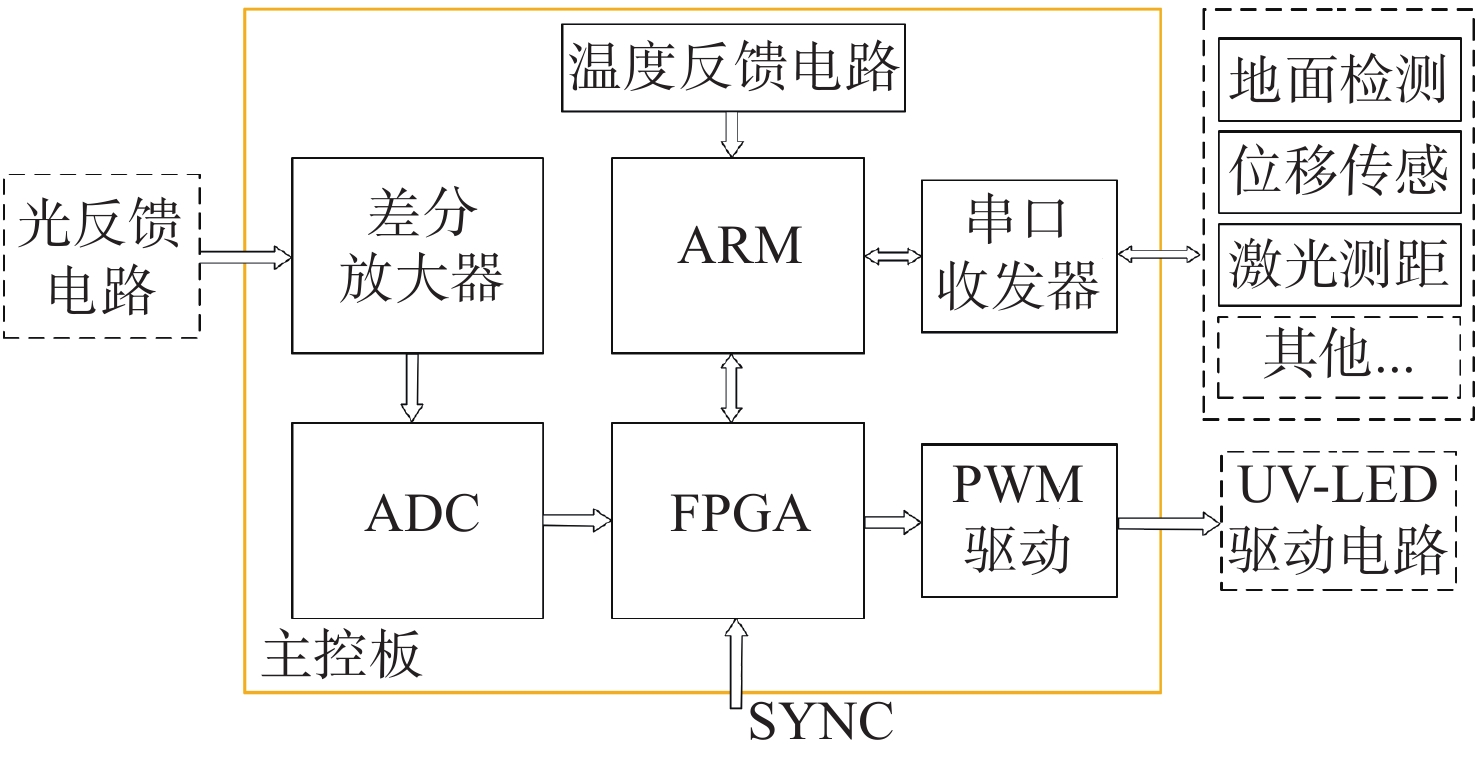
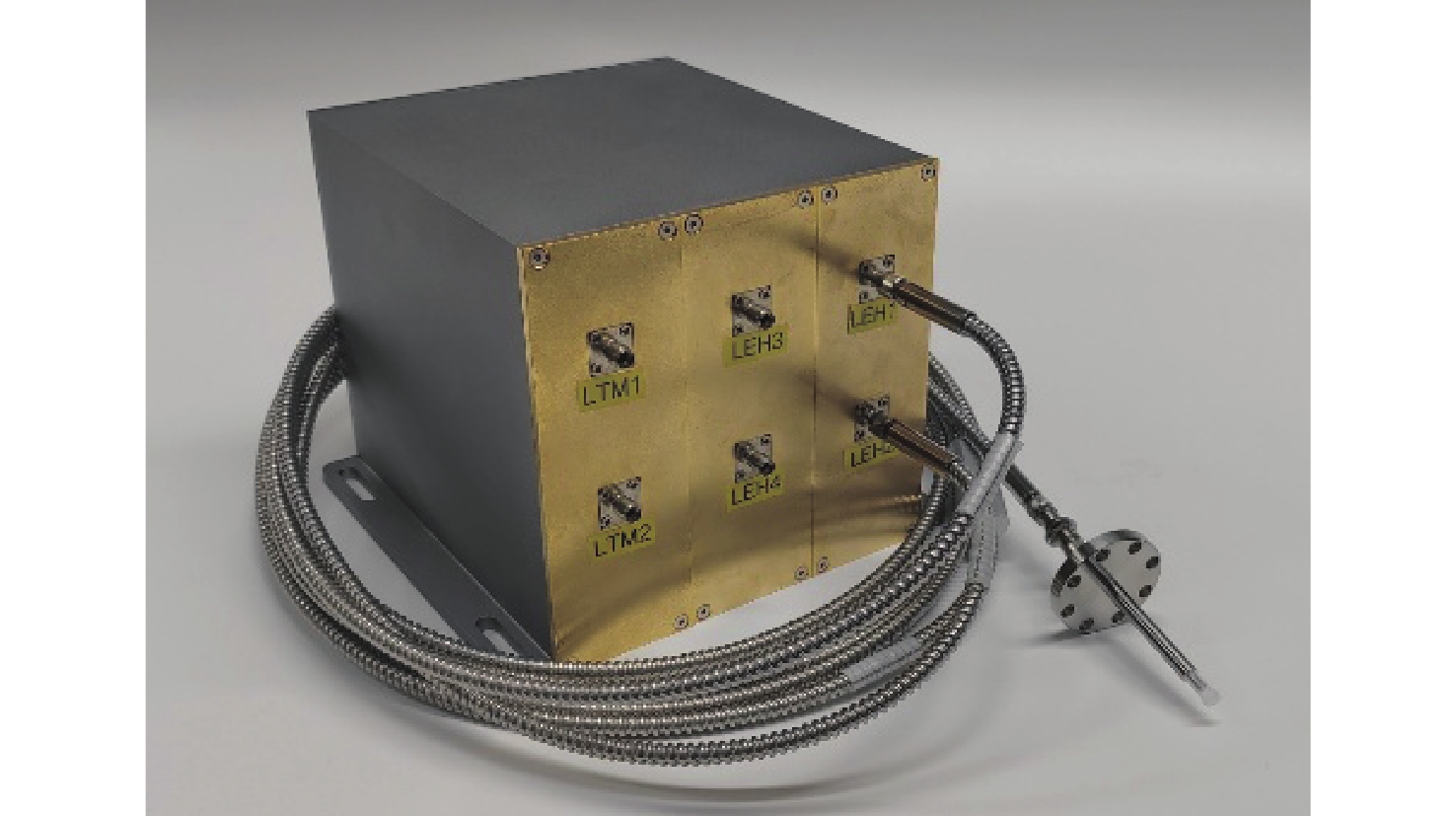
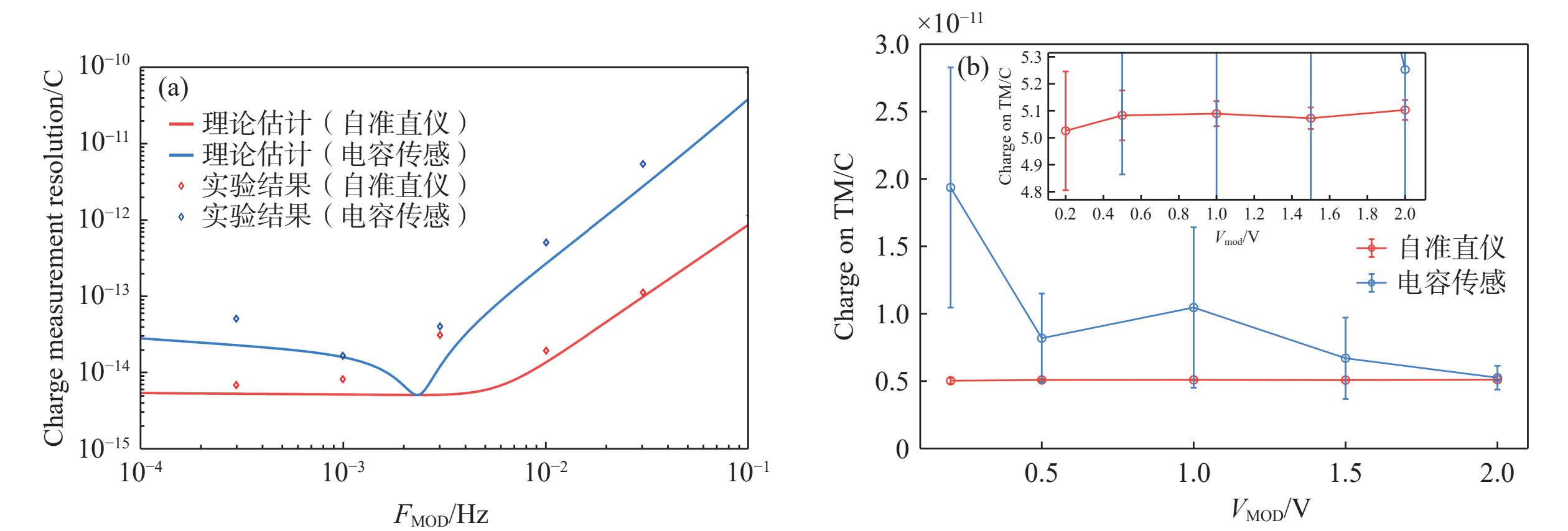
检验质量(TM)在轨存在高能粒子充电效应,从而干扰引力波探测。本文针对天琴计划的电荷管理需求,首先建立静电力模型,确定检验质量的电荷阈值上限为 2×10⁻¹³ C;然后设计基于紫外LED光源的电荷管理系统,并研制工程样机;最后构建基于精密扭摆的地面测试系统,用于评估电荷管理样机性能。实验结果表明:在2V、1 mHz的调制作用下,电荷测量的分辨率优于 2×10⁻¹⁴ C,电荷控制的分辨率约为 6×10⁻¹⁴ C,满足空间引力波探测需求。上述研究成果为天琴计划的实施提供了关键技术支持。
Abstract:The test mass (TM) in orbit is subject to the charging effect of high-energy particles, which interferes with gravitational wave detection. This paper addresses the charge management requirements of the TianQin Project. First, an electrostatic force model is established to determine the charge threshold of the TM, which is limited to less than 2×10⁻¹³ C. Then, a charge management structure using a UV LED light source is designed, and an engineering prototype is developed accordingly. Finally, a ground testing system based on a torsion pendulum is constructed to evaluate the charge management performance. Experimental results show that at 1 mHz, the resolution of charge measurement is better than 2×10⁻¹⁴ C, and the resolution of charge control is approximately 6×10⁻¹⁴ C, which meet the requirements of space gravitational wave detection. These achievements provide a solid foundation for TianQin project.
-
Key words:
- TianQin project /
- charge management system /
- charge measurement and control /
- UV LED
-
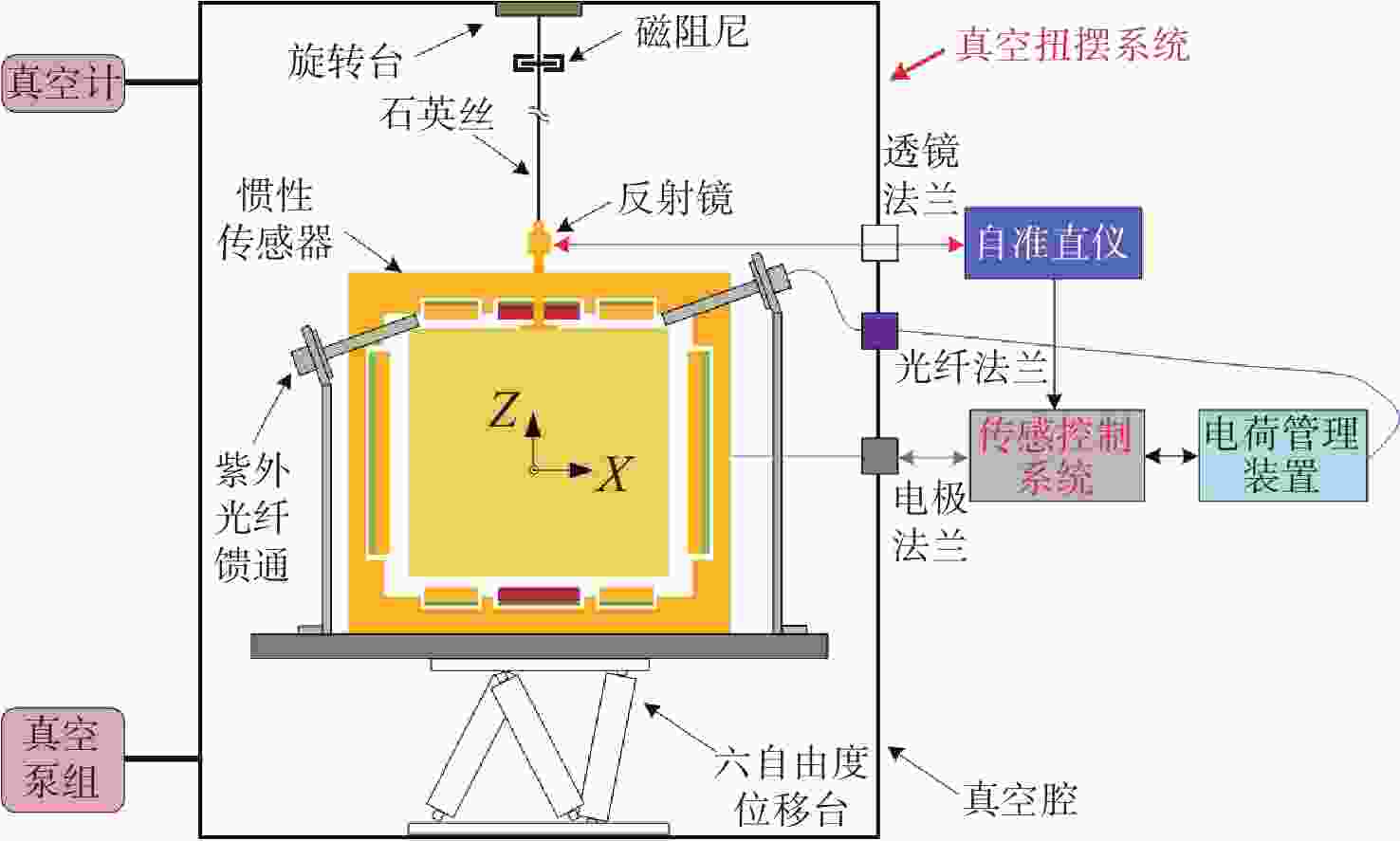
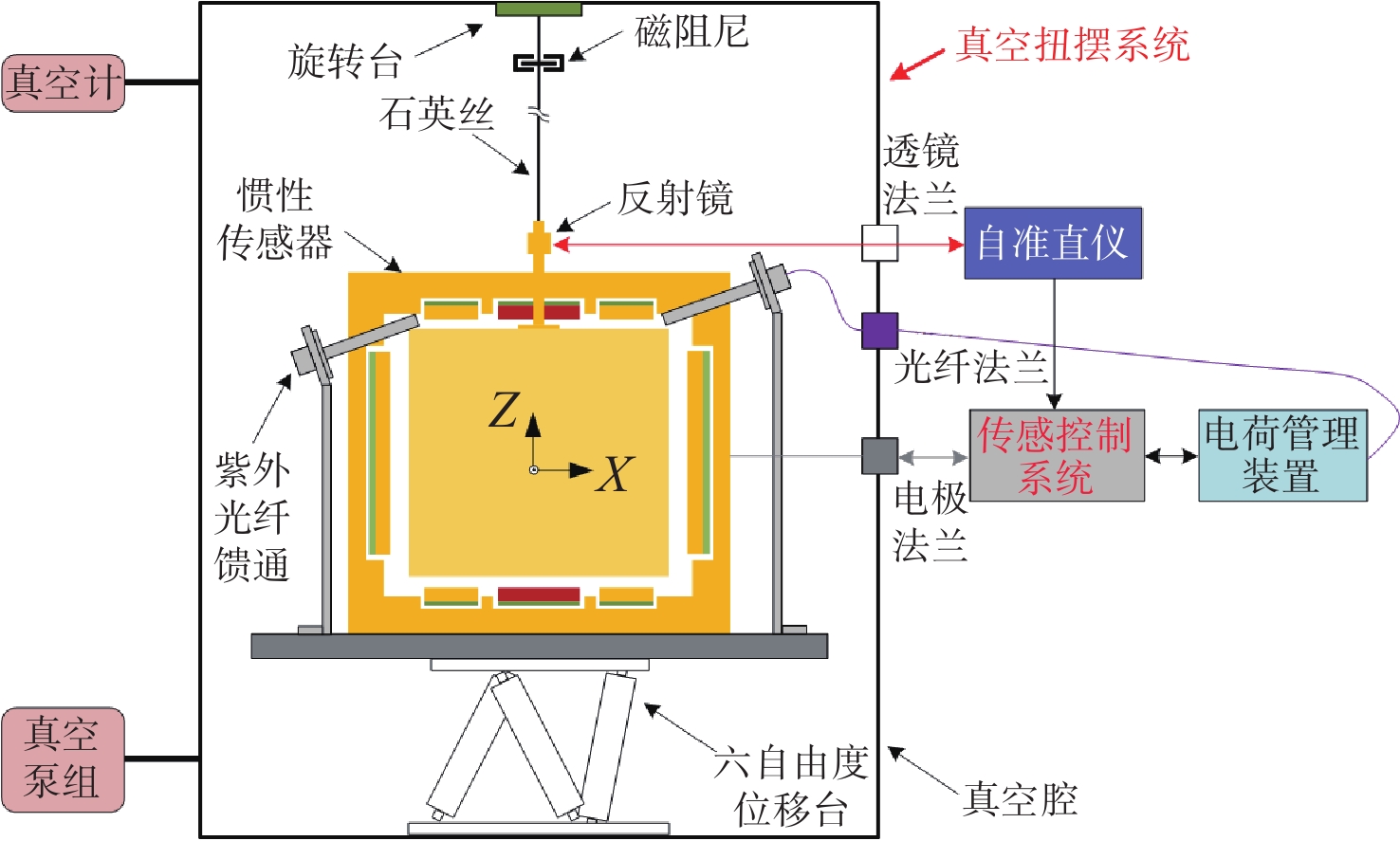
图 10 电荷管理地面测试系统示意图
Figure 10. Schematic diagram of charge management ground test system
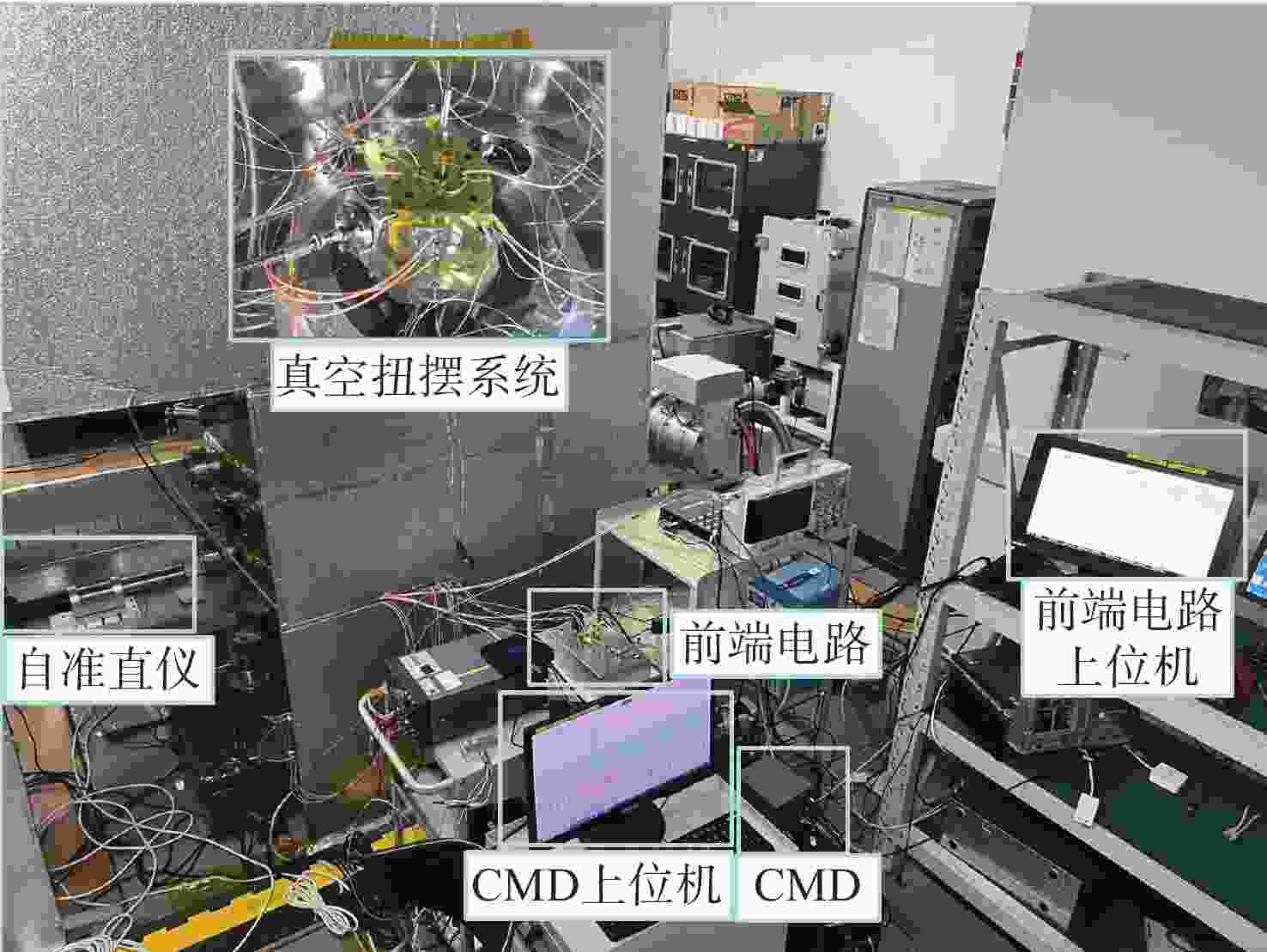
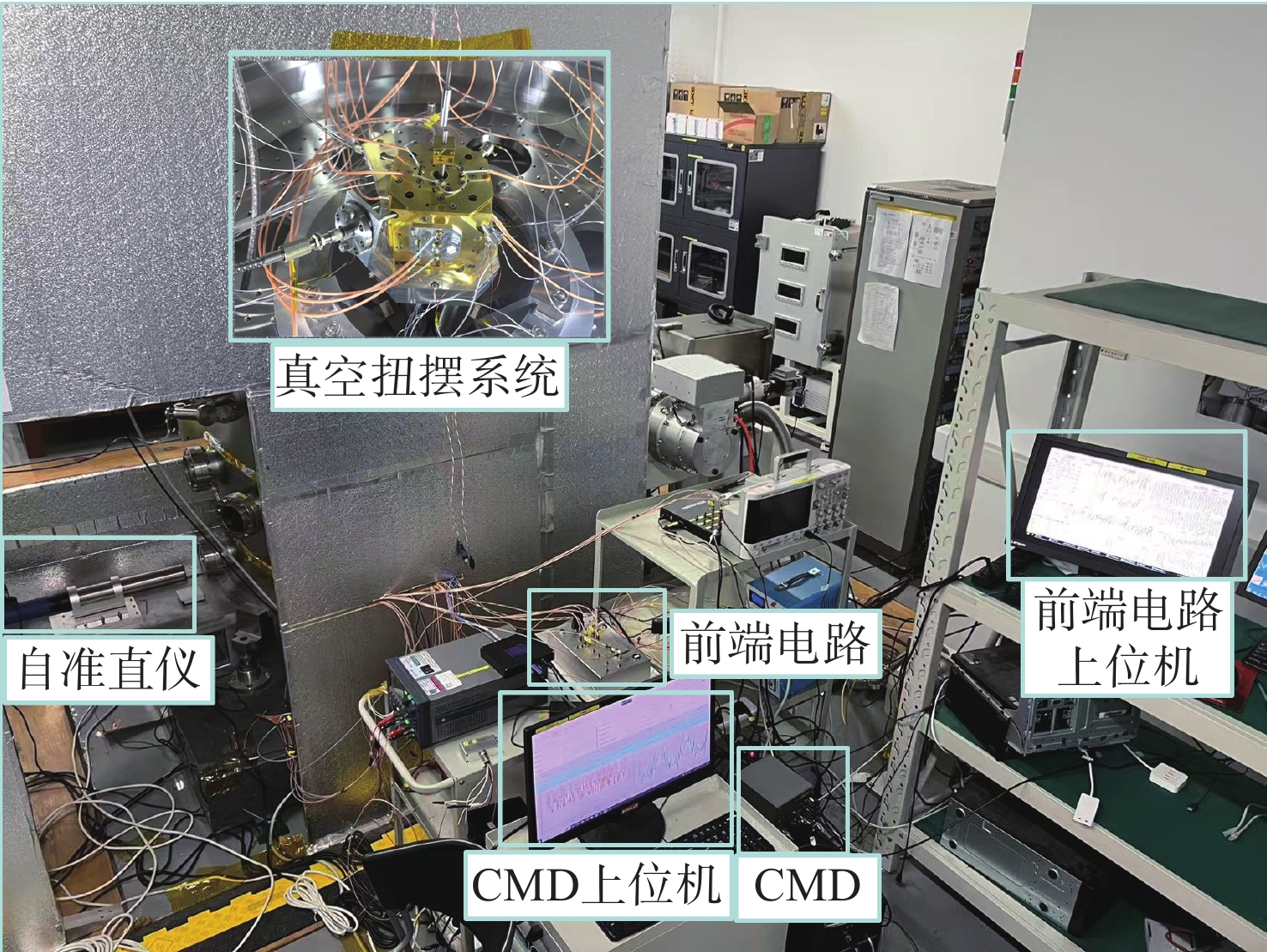
图 11 基于精密扭摆的地面测试装置
Figure 11. Ground testing device based on precision torsion pendulum
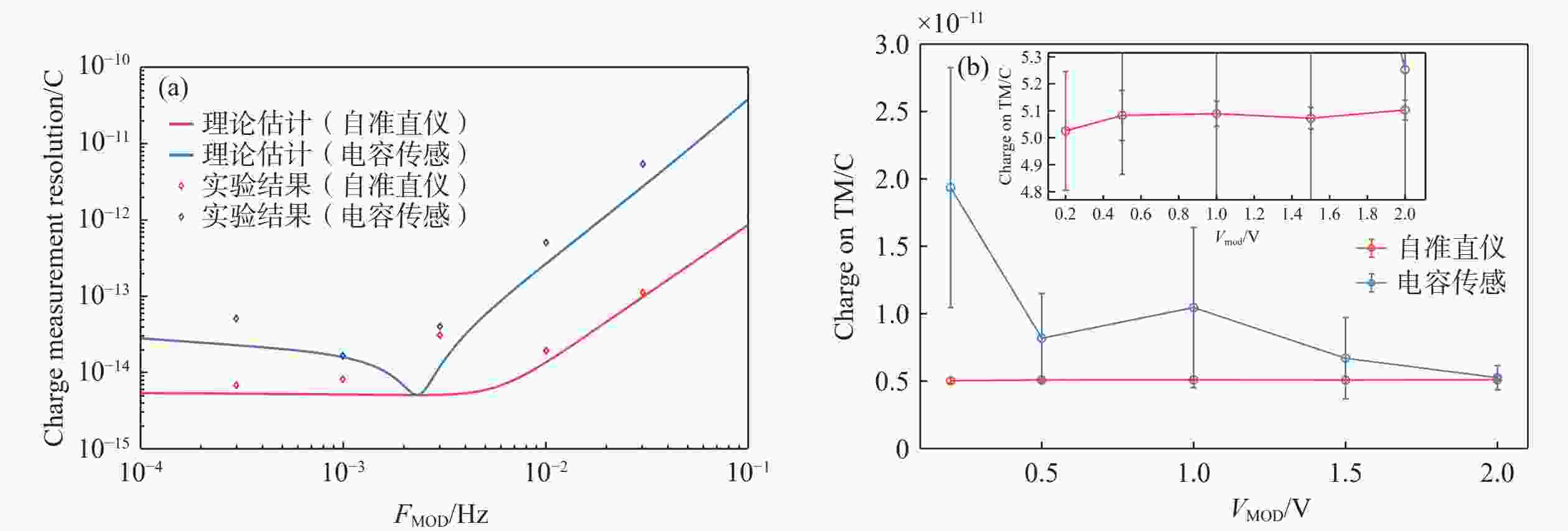
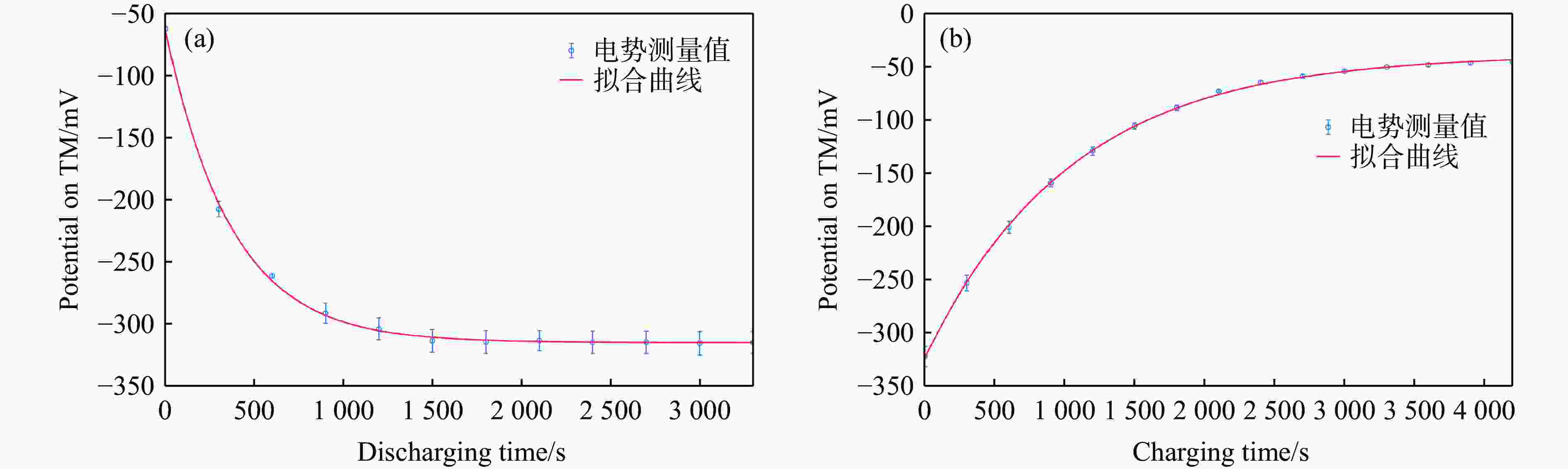
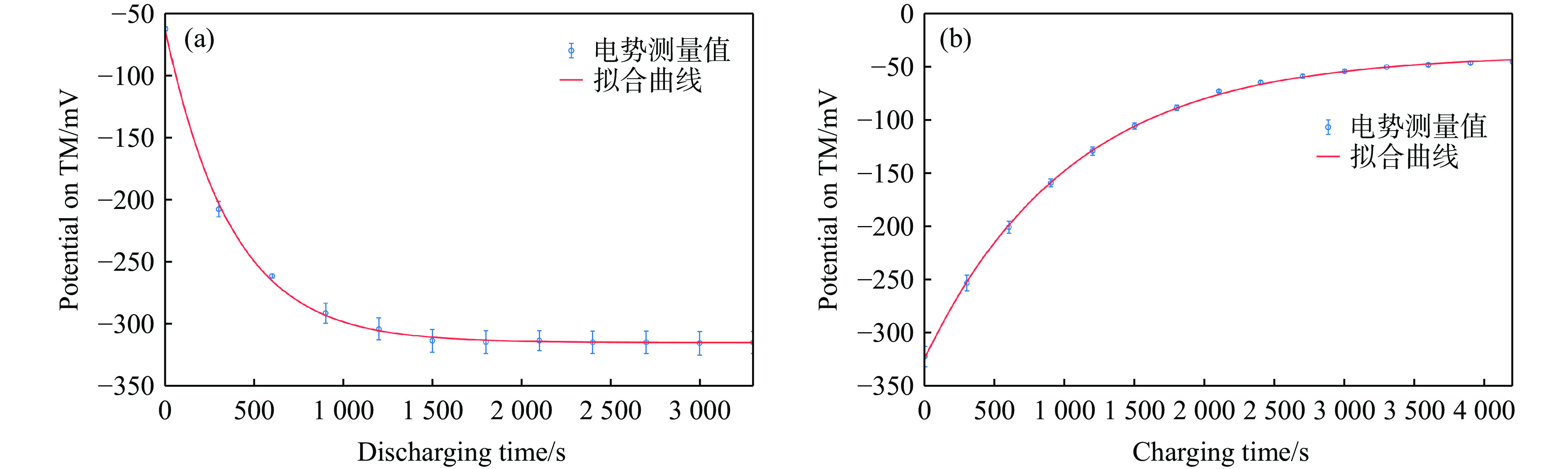
图 14 检验质量充放电曲线标定结果。(a) 目标电势为−50 mV;(b) 目标电势为−100 mV
Figure 14. Calibration results of test mass's charge-discharge curve. (a) Discharge curve; (b) charge curve
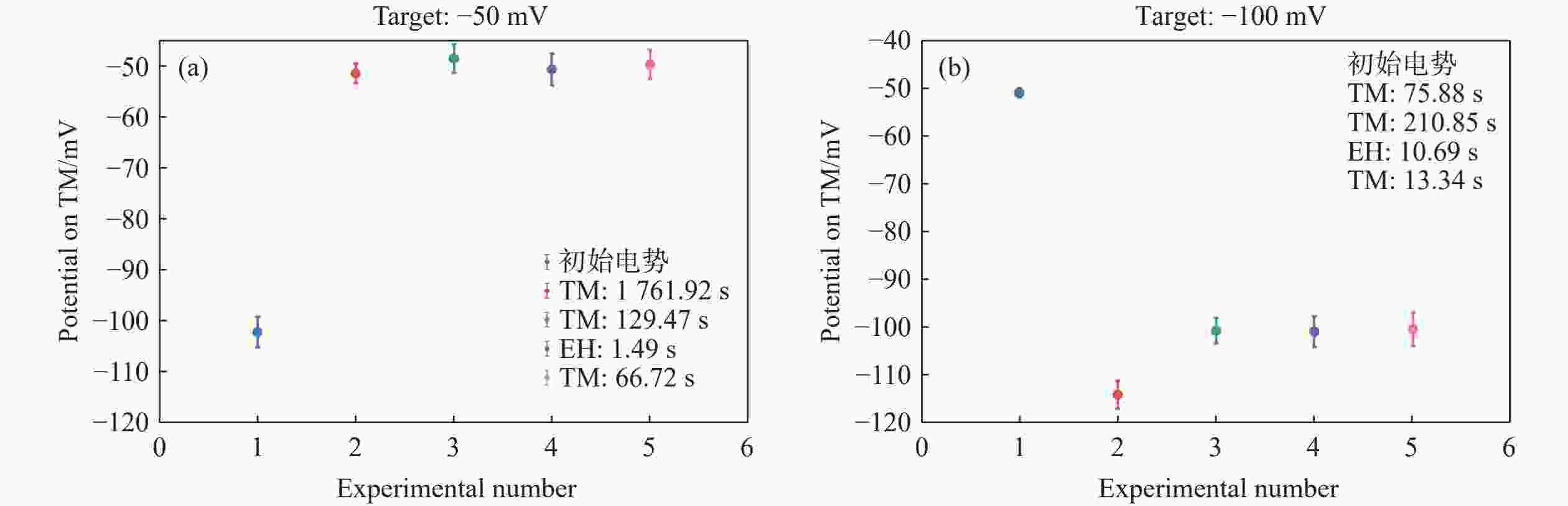
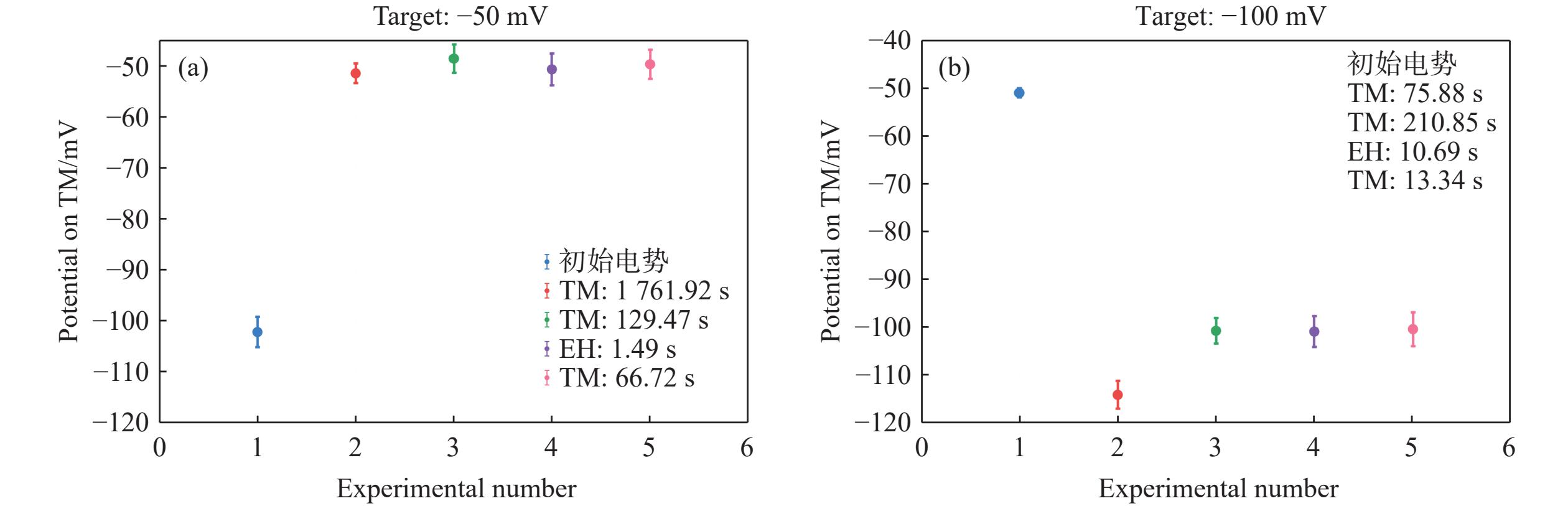
图 15 检验质量电荷控制结果。(a) 目标电势:−50 mV;(b) 目标电势:−100 mV
Figure 15. The charge control result of Test Mass. (a) target potential: −50 mV; (b) target potential: −100 mV
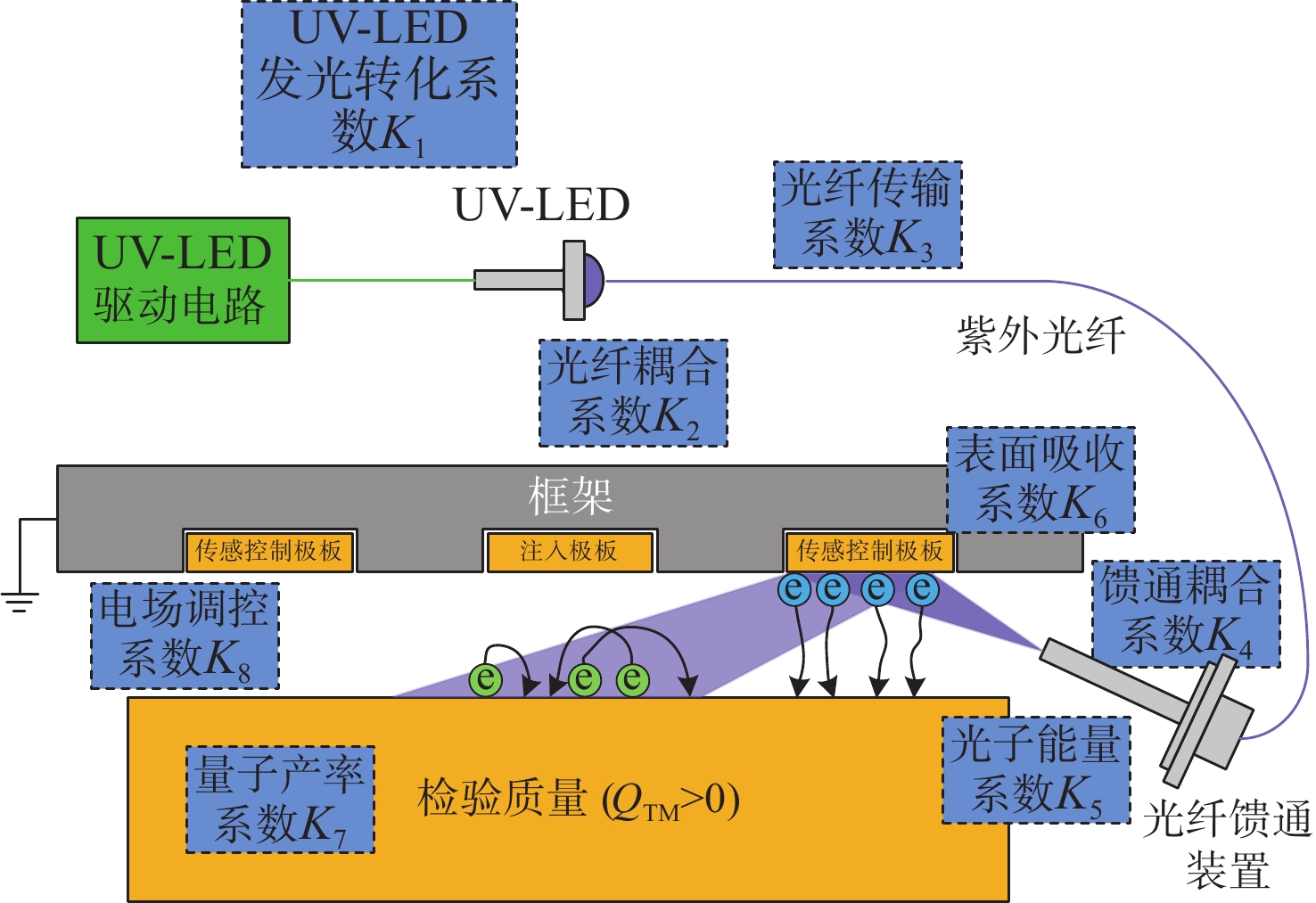
表 1 光路传导系数
Table 1. Optical path transmission coefficient
模型参数 理论值 实测值 K1 发光转化系数(μW/mA) 15.00 13.13±4.49 K2 光纤耦合系数 40% 36.07%±3.55% K3 光纤传输系数 80% K4 馈通耦合系数 100% 74.66%±4.05% K5 光子能量系数(/J) 1.28×10¹⁸ N.A. K6 表面吸收系数 66.48% N.A. K7 量子产率系数(e/Photon) N.A. (1.13±0.37)×10−5 K8 电场调控系数 100% 50%±10%  下载: 导出CSV
表 2 不同电荷管理策略的光功率与电流需求
Table 2. Optical power and current demand for different discharge strategies
放电方式 放电速率 紫外光功率 驱动电流 快速放电 1×10⁵ e/s 20 nW 5.9 μA 连续放电 10~100 e/s 2~20 pW 0.59~5.9 nA
下载: 导出CSV
-
[1] CAHILLANE C, MANSELL G. Review of the advanced LIGO gravitational wave observatories leading to observing run four[J]. Galaxies, 2022, 10(1): 36. doi: 10.3390/galaxies10010036 [2] BARAUSSE E, BERTI E, HERTOG T, et al. Prospects for fundamental physics with LISA[J]. General Relativity and Gravitation, 2020, 52(8): 81. doi: 10.1007/s10714-020-02691-1 [3] 王绪, 高雪荣, 李磐, 等. 太极计划中的不等臂干涉稳频方案设计及实验验证[J]. 中国光学(中英文), 2026, 19(4): 887-894. doi: 10.37188/CO.2022-0018WANG X, GAO X R, LI P, et al. Design and experimental verification of unequal-arm interferometric frequency stabilization scheme in taiji program[J]. Chinese Optics, 2026, 19(4): 887-894. (in Chinese). doi: 10.37188/CO.2022-0018 [4] 王铖锐, 白彦峥, 蔡林, 等. 高精度静电惯性传感器[J]. 中国科学: 物理学 力学 天文学, 2023, 53(5): 250401.WANG CH R, BAI Y ZH, CAI L, et al. High precision electrostatic inertial sensor[J]. Scientia Sinica Physica, Mechanica & Astronomica, 2023, 53(5): 250401. (in Chinese). [5] 邓剑峰, 蔡志鸣, 陈琨, 等. 无拖曳控制技术研究及在我国空间引力波探测中的应用[J]. 中国光学, 2019, 12(3): 503-514. doi: 10.3788/CO.20191203.0503DENG J F, CAI ZH M, CHEN K, et al. Drag-free control and its application in China's space gravitational wave detection[J]. Chinese Optics, 2019, 12(3): 503-514. (in Chinese). doi: 10.3788/CO.20191203.0503 [6] JAFRY. Y. R. Spurious Forces on the LISA Proof Masses Due to Electrostatic Charging.[J]. Advances in Space Research, 2003, 32(7): 1271-1275. doi: 10.1088/1361-6382/ad105a [7] WASS P J, SUMNER T J, ARAÚJO H M, et al. Simulating the charging of isolated free-falling masses from TeV to eV energies: detailed comparison with LISA Pathfinder results[J]. Physical Review D, 2023, 107(2): 022010. doi: 10.1103/PhysRevD.107.022010 [8] LIU L, BAI Y Z, ZHOU Z B, et al. Measurement of the effect of a thin discharging wire for an electrostatic inertial sensor with a high-quality-factor pendulum[J]. Classical and Quantum Gravity, 2012, 29(5): 055010. doi: 10.1088/0264-9381/29/5/055010 [9] ARMANO M, AUDLEY H, AUGER G, et al. Sub-Femto-g free fall for space-based gravitational wave observatories: LISA Pathfinder results[J]. Physical Review Letters, 2016, 116(23): 231101. doi: 10.1103/PhysRevLett.116.231101 [10] BUCHMAN S, QUINN T, KEISER G M, et al. Charge measurement and control for the Gravity Probe B gyroscopes[J]. Review of Scientific Instruments, 1995, 66(1): 120-129. doi: 10.1063/1.1145276 [11] LUO J, CHEN L SH, DUAN H Z, et al. TianQin: a space-borne gravitational wave detector[J]. Classical and Quantum Gravity, 2016, 33(3): 035010. doi: 10.1088/0264-9381/33/3/035010 [12] 王智, 马军, 李静秋. 空间引力波探测计划-LISA系统设计要点[J]. 中国光学, 2015, 8(6): 980-987. doi: 10.3788/CO.20150806.0980WANG ZH, MA J, LI J Q. Space-based gravitational wave detection mission: design highlights of LISA system[J]. Chinese Optics, 2015, 8(6): 980-987. (in Chinese). doi: 10.3788/CO.20150806.0980 [13] LEI CH, SU W, HONG W, et al. Simulation for the test mass charging rate in the Tianqin orbit[J]. Classical and Quantum Gravity, 2024, 41(2): 025001. [14] SU W, ZHOU Z B, WANG Y, et al. Evaluating residual acceleration noise for the TianQin gravitational waves observatory with an empirical magnetic field model[J]. Physical Review D, 2023, 108(10): 103030. doi: 10.1103/PhysRevD.108.103030 [15] PENG J H, ZHANG J X, HONG W, et al. Acceleration noise due to space magnetic field for heliocentric gravitational wave detector[J]. Scientific Reports, 2025, 15(1): 23287. doi: 10.1038/s41598-025-04287-8 [16] CHEN B X, HONG W, LI H G, et al. Using finite element simulation to evaluate charge measurement precision for space inertial sensors[J]. Measurement Science and Technology, 2024, 35(4): 045026. doi: 10.1088/1361-6501/ad1f2c [17] CHEN B X, LI Q Q, HONG W, et al. Effect of test mass position on the UV discharge rate of space inertial sensor[J]. IEEE Sensors Journal, 2025, 25(4): 6464-6472. doi: 10.1109/JSEN.2025.3525799 [18] YANG F CH, HONG W, LI H G, et al. Adaptive charge control for the space inertial sensor[J]. Classical and Quantum Gravity, 2023, 40(7): 075004. doi: 10.1088/1361-6382/acb7d4 [19] YANG F CH, ZHAO Y J, HONG W. Investigation of charge control methods for disturbances and parameter uncertainty in inertial sensor charge management system[J]. IEEE Sensors Journal, 2025, 25(16): 30906-30915. doi: 10.1109/JSEN.2025.3587823 [20] YANG F CH, PEI SH X, HONG W. Reinforcement learning-based control of the charge management system in inertial sensors[J]. Acta Astronautica, 2026, 239: 391-403. doi: 10.1016/j.actaastro.2025.11.024 [21] CHU L Y, BAI Y ZH, CHEN B X, et al. Optimizing electrostatic acceleration noise by precisely adjusting the differential potential between the electrodes and test mass for space inertial sensors[J]. International Journal of Modern Physics D, 2025, 34(1): 2450067. doi: 10.1142/S0218271824500676 [22] RUAN Y D, LI H G, JIA J X, et al. High efficiency deep ultraviolet micro-LED and optical fiber coupling for low power charge management applications[J]. Optics & Laser Technology, 2025, 181: 111902. doi: 10.1016/j.optlastec.2024.111902 [23] LI H G, YANG Q F, YANG F CH, et al. Coupling efficiency improvement of light source with a convex lens for space charge managements[J]. Optik, 2021, 248: 167999. doi: 10.1016/j.ijleo.2021.167999 [24] LI H G, ZHOU R F, HONG W, et al. Micro-LED embedded UV discharge solution for space charge management[J]. IEEE Sensors Journal, 2025, 25(3): 5417-5424. doi: 10.1109/JSEN.2024.3520127 [25] YANG F CH, BAI Y ZH, HONG W, et al. Investigation of charge management using UV LED device with a torsion pendulum for TianQin[J]. Classical and Quantum Gravity, 2020, 37(11): 115005. doi: 10.1088/1361-6382/ab8489 [26] YANG F CH, ZHU Y, JIN X F, et al. Actuation system for inertial sensors in high-precision space missions using a torsion pendulum[J]. Physical Review D, 2024, 110(10): 102005. doi: 10.1103/PhysRevD.110.102005 [27] YANG F CH, BAI Y ZH, HONG W, et al. A charge control method for space-mission inertial sensor using differential UV LED emission[J]. Review of Scientific Instruments, 2020, 91(12): 124502. doi: 10.1063/5.0013232 [28] HONG W, CHEN B X, CHU L Y, et al. Research progress of charge management system for TianQin project[C]. Proceedings of the 7th International Workshop on the TianQin Science Mission, Springer, 2024: 119-126. [29] 柴国志, 黄亮, 乔亮, 等. 星上剩磁对惯性传感器的影响[J]. 中国光学, 2019, 12(3): 515-525. doi: 10.3788/CO.20191203.0515CHAI G ZH, HUANG L, QIAO L, et al. Effect of the on-board residual magnetism on inertial sensors[J]. Chinese Optics, 2019, 12(3): 515-525. (in Chinese). doi: 10.3788/CO.20191203.0515 [30] LI H G, LI G L, HONG W, et al. Capacitive sensing-based charge measurement for space inertial sensors[J]. IEEE Transactions on Instrumentation and Measurement, 2024, 73: 6501509. doi: 10.1109/tim.2024.3351233 [31] LIU Y CH, ZHOU Z B. Progress in the development of space inertial sensor for TianQin project[J]. International Journal of Modern Physics D, 2026, 35(5): 2540007. doi: 10.1142/S0218271825400073 [32] ZHOU Z B, LIU Y L, ZHOU H, et al. Precision gravity measurement facility[J]. Frontiers of Engineering Management, 2025, 12(4): 1254-1258. doi: 10.1007/s42524-025-5505-0 [33] ZHOU Z B, LIU L, TU H B, et al. Seismic noise limit for ground-based performance measurements of an inertial sensor using a torsion balance[J]. Classical and Quantum Gravity, 2010, 27(17): 175012. doi: 10.1088/0264-9381/27/17/175012 -

 下载:
下载:

计量
- 文章访问数: 170
- HTML全文浏览量: 100
- PDF下载量: 8
- 被引次数: 0
