| Citation: | LI Lan-bin, DONG Peng. Layer-by-layer adaptive stripping of coupling noise in gravitational reference sensors using CNN-BiLSTM[J]. Chinese Optics. doi: 10.37188/CO.2026-0079

|
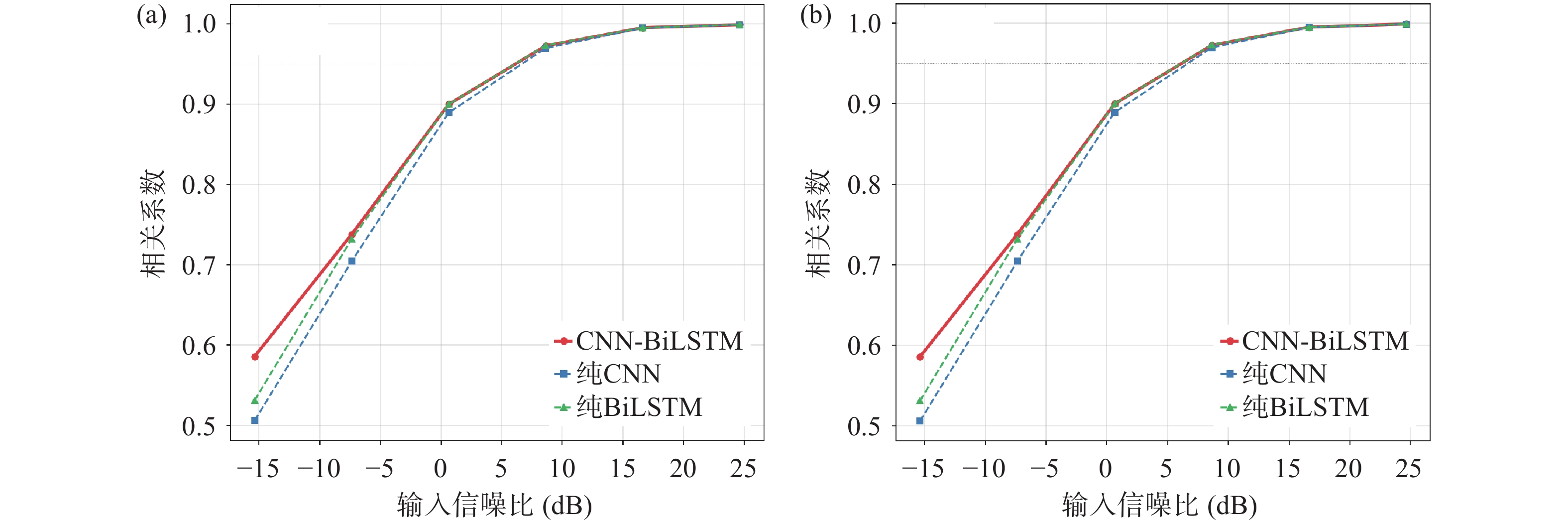
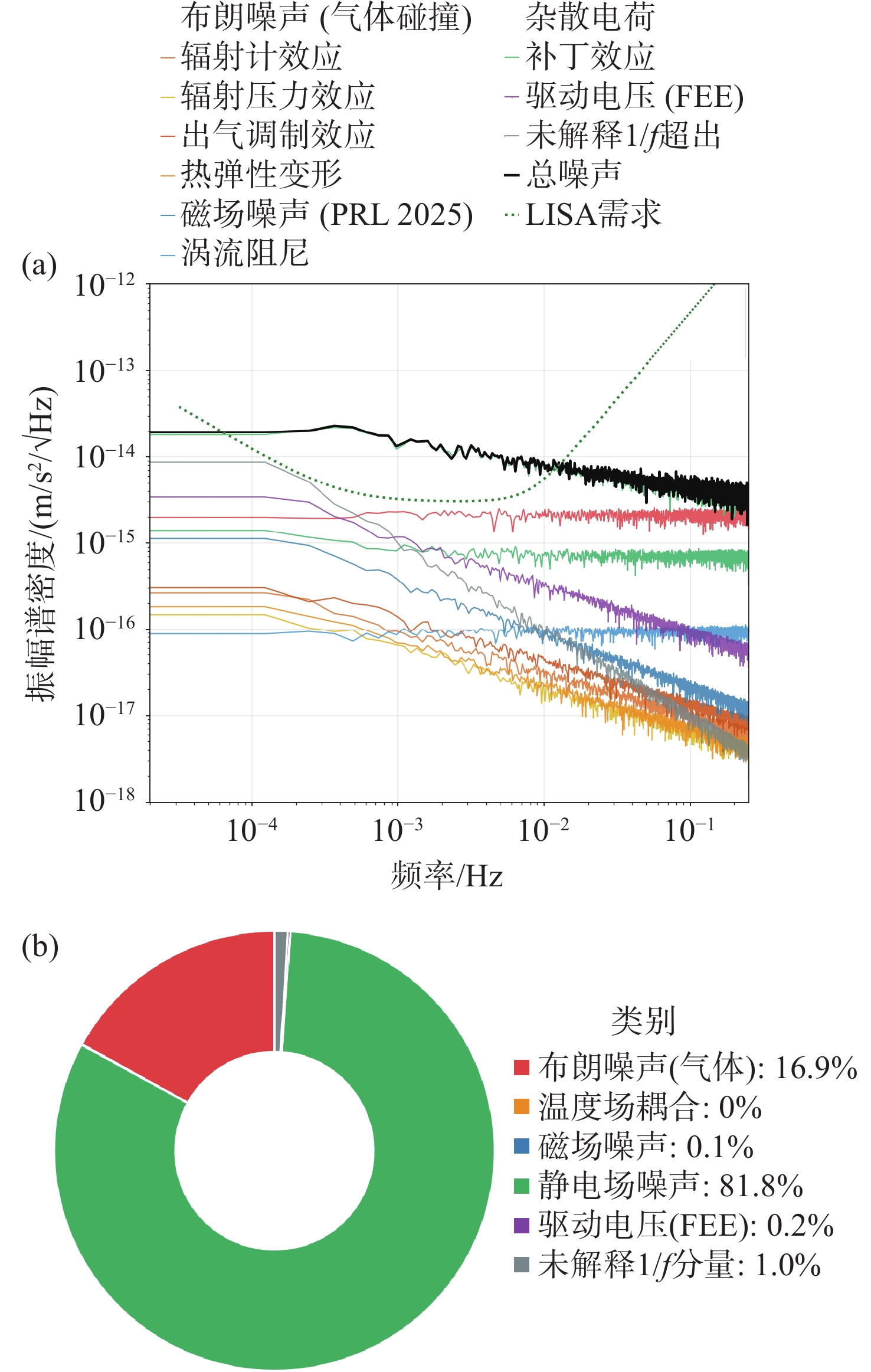
Objective: This study addresses the difficulty of interpreting and separating multi-source coupling noise in gravitational reference sensors (GRSs) for spaceborne gravitational-wave detection. Methods: A unified acceleration-noise spectrum model is established for Brownian noise, thermal-field coupling, magnetic noise, electrostatic noise, drive-voltage noise, and residual low-frequency noise, with key parameters calibrated against LISA Pathfinder measurements. CNN layers are used to extract local transient features, BiLSTM layers are used to capture long-range temporal dependence, and adaptive spectral subtraction is then applied sequentially by physical noise category. Results: At an input SNR of 10.2 dB, the proposed method achieves a recovery fidelity of

| [1] |
ABBOTT B P, ABBOTT R, ABBOTT T D, et al. Observation of gravitational waves from a binary black hole merger[J]. Physical Review Letters, 2016, 116(6): 061102. doi: 10.1103/PhysRevLett.116.061102
|
| [2] |
ABBOTT B P, ABBOTT R, ABBOTT T D, et al. GW170817: observation of gravitational waves from a binary neutron star inspiral[J]. Physical Review Letters, 2017, 119(16): 161101. doi: 10.1103/PhysRevLett.119.161101
|
| [3] |
AMARO-SEOANE P, AUDLEY H, BABAK S, et al. Laser interferometer space antenna[EB/OL]. [2017-02-23]. arXiv: 1702.00786. https://arxiv.org/abs/1702.00786 (查阅网上资料,不确定本条文献类型及格式是否正确,请确认).
|
| [4] |
HU W R, WU Y L. The Taiji Program in Space for gravitational wave physics and the nature of gravity[J]. National Science Review, 2017, 4(5): 685-686. doi: 10.1093/nsr/nwx116
|
| [5] |
LIU H SH, WANG J, TAO W, et al. Recent development of the laser interferometer for Taiji space gravitational wave detection[J]. Research, 2026, 9: 1252. doi: 10.34133/research.1252
|
| [6] |
LUO J, CHEN L SH, DUAN H Z, et al. TianQin: a space-borne gravitational wave detector[J]. Classical and Quantum Gravity, 2016, 33(3): 035010. doi: 10.1088/0264-9381/33/3/035010
|
| [7] |
王智, 马军, 李静秋. 空间引力波探测计划-LISA系统设计要点[J]. 中国光学, 2015, 8(6): 980-987. doi: 10.3788/CO.20150806.0980
WANG ZH, MA J, LI J Q. Space-based gravitational wave detection mission: design highlights of LISA system[J]. Chinese Optics, 2015, 8(6): 980-987. (in Chinese). doi: 10.3788/CO.20150806.0980
|
| [8] |
邓剑峰, 蔡志鸣, 陈琨, 等. 无拖曳控制技术研究及在我国空间引力波探测中的应用[J]. 中国光学, 2019, 12(3): 503-514. doi: 10.3788/CO.20191203.0503
DENG J F, CAI ZH M, CHEN K, et al. Drag-free control and its application in China's space gravitational wave detection[J]. Chinese Optics, 2019, 12(3): 503-514. doi: 10.3788/CO.20191203.0503
|
| [9] |
刘河山, 高瑞弘, 罗子人, 等. 空间引力波探测中的绝对距离测量及通信技术[J]. 中国光学, 2019, 12(3): 486-492. doi: 10.3788/CO.20191203.0486
LIU H SH, GAO R H, LUO Z R, et al. Laser ranging and data communication for space gravitational wave detection[J]. Chinese Optics, 2019, 12(3): 486-492. doi: 10.3788/CO.20191203.0486
|
| [10] |
王登峰, 姚鑫, 焦仲科, 等. 面向天基引力波探测的时间延迟干涉技术[J]. 中国光学, 2021, 14(2): 275-288. doi: 10.37188/CO.2020-0098
WANG D F, YAO X, JIAO ZH K, et al. Time-delay interferometry for space-based gravitational wave detection[J]. Chinese Optics, 2021, 14(2): 275-288. doi: 10.37188/CO.2020-0098
|
| [11] |
叶磊巧, 杜明辉, 徐鹏, 等. 空间引力波探测“太极计划”星间姿态-光程耦合噪声迭代拟合与高精度抑制方法[J]. 中国光学(中英文), 2025, 18(3): 583-595. doi: 10.37188/CO.2025-0042
YE L Q, DU M H, XU P, et al. Iterative estimation and precision suppression of inter-spacecraft tilt-to-length coupling noise for the Taiji space gravitational wave detection mission[J]. Chinese Optics, 2025, 18(3): 583-595. doi: 10.37188/CO.2025-0042
|
| [12] |
ARMANO M, AUDLEY H, AUGER G, et al. Sub-Femto-g free fall for space-based gravitational wave observatories: LISA Pathfinder results[J]. Physical Review Letters, 2016, 116(23): 231101. doi: 10.1103/PhysRevLett.116.231101
|
| [13] |
ARMANO M, AUDLEY H, BAIRD J, et al. Beyond the required LISA free-fall performance: new LISA Pathfinder results down to 20 μ Hz[J]. Physical Review Letters, 2018, 120(6): 061101. doi: 10.1103/PhysRevLett.120.061101
|
| [14] |
DOLESI R, BORTOLUZZI D, BOSETTI P, et al. Gravitational sensor for LISA and its technology demonstration mission[J]. Classical and Quantum Gravity, 2003, 20(10): S99-S108. doi: 10.1088/0264-9381/20/10/312
|
| [15] |
WEBER W J, BORTOLUZZI D, CAVALLERI A, et al. Position sensors for flight testing of LISA drag-free control[J]. Proceedings of SPIE, 2003, 4856: 31-42. doi: 10.1117/12.458564
|
| [16] |
LECUN Y, BOTTOU L, BENGIO Y, et al. Gradient-based learning applied to document recognition[J]. Proceedings of the IEEE, 1998, 86(11): 2278-2324. doi: 10.1109/5.726791
|
| [17] |
KRIZHEVSKY A, SUTSKEVER I, HINTON G E. ImageNet classification with deep convolutional neural networks[J]. Communications of the ACM, 2017, 60(6): 84-90. doi: 10.1145/3065386
|
| [18] |
GOODFELLOW I, BENGIO Y, COURVILLE A. Deep Learning[M]. Cambridge: MIT Press, 2016.
|
| [19] |
GEORGE D, HUERTA E A. Deep learning for real-time gravitational wave detection and parameter estimation: results with Advanced LIGO data[J]. Physics Letters B, 2018, 778: 64-70. doi: 10.1016/j.physletb.2017.12.053
|
| [20] |
GABBARD H, WILLIAMS M, HAYES F, et al. Matching matched filtering with deep networks for gravitational-wave astronomy[J]. Physical Review Letters, 2018, 120(14): 141103. doi: 10.1103/PhysRevLett.120.141103
|
| [21] |
CHATTERJEE C, WEN L Q, VINSEN K, et al. Using deep learning to localize gravitational wave sources[J]. Physical Review D, 2019, 100(10): 103025. doi: 10.1103/PhysRevD.100.103025
|
| [22] |
HUERTA E A, ALLEN G, ANDREONI I, et al. Enabling real-time multi-messenger astrophysics discoveries with deep learning[J]. Nature Reviews Physics, 2019, 1(10): 600-608. doi: 10.1038/s42254-019-0097-4
|
| [23] |
CUOCO E, POWELL J, CAVAGLIÀ M, et al. Enhancing gravitational-wave science with machine learning[J]. Machine Learning: Science and Technology, 2020, 2(1): 011002. doi: 10.1088/2632-2153/abb93a
|
| [24] |
ZEVIN M, COUGHLIN S, BAHAADINI S, et al. Gravity Spy: integrating advanced LIGO detector characterization, machine learning, and citizen science[J]. Classical and Quantum Gravity, 2017, 34(6): 064003. doi: 10.1088/1361-6382/aa5cea
|
| [25] |
CHATTERJEE C, WEN L Q, DIAKOGIANNIS F, et al. Extraction of binary black hole gravitational wave signals from detector data using deep learning[J]. Physical Review D, 2021, 104(6): 064046. doi: 10.1103/PhysRevD.104.064046
|
| [26] |
ZHANG X L, LIU S J, ZHAO J, et al. Detecting gravitational-wave signals from non-stationary noise with DenseNet[J]. Physics Letters B, 2024, 851: 138580. https://doi.org/10.1016/j.physletb.2024.138580 (查阅网上资料,未找到本条文献信息,请确认).
|
| [27] |
RAZZANO M, CUOCO E. Image-based deep learning for classification of noise transients in gravitational wave detectors[J]. Classical and Quantum Gravity, 2018, 35(9): 095016. doi: 10.1088/1361-6382/aab793
|
| [28] |
COLGAN R E, CORLEY K R, LAU Y, et al. Efficient gravitational-wave glitch identification from environmental data through machine learning[J]. Physical Review D, 2020, 101(10): 102003. doi: 10.1103/PhysRevD.101.102003
|
| [29] |
REN ZH X, ZHAO T Y, CAO ZH J, et al. Taiji data challenge for exploring gravitational wave universe[J]. Frontiers of Physics, 2023, 18(6): 64302. doi: 10.1007/s11467-023-1318-y
|
| [30] |
LI E K, WANG H, CHEN H Y, et al. GWSpace: a multi-mission science data simulator for space-based gravitational wave detection[J]. Classical and Quantum Gravity, 2025, 42(16): 165005. doi: 10.1088/1361-6382/adf409
|
| [31] |
ARMANO M, AUDLEY H, BAIRD J, et al. In-depth analysis of LISA Pathfinder performance results: time evolution, noise projection, physical models, and implications for LISA[J]. Physical Review D, 2024, 110(4): 042004. doi: 10.1103/PhysRevD.110.042004
|
| [32] |
ARMANO M, AUDLEY H, BAIRD J, et al. Magnetic-induced force noise in LISA Pathfinder free-falling test masses[J]. Physical Review Letters, 2025, 134(7): 071401. doi: 10.1103/PhysRevLett.134.071401
|
| [33] |
HOCHREITER S, SCHMIDHUBER J. Long short-term memory[J]. Neural Computation, 1997, 9(8): 1735-1780. doi: 10.1162/neco.1997.9.8.1735
|
| [34] |
SCHUSTER M, PALIWAL K K. Bidirectional recurrent neural networks[J]. IEEE Transactions on Signal Processing, 1997, 45(11): 2673-2681. doi: 10.1109/78.650093
|
| [35] |
SAINATH T N, VINYALS O, SENIOR A, et al. Convolutional, long short-term memory, fully connected deep neural networks[C]. 2015 IEEE International Conference on Acoustics, Speech and Signal Processing (ICASSP), IEEE, 2015: 4580-4584. https://doi.org/10.1109/ICASSP.2015.7178838.
|
| [36] |
YIN R, LUO Z, ZHUANG P, et al. Multi-scale CNN-BiLSTM with attention mechanism for time series classification[J]. Neurocomputing, 2021, 462: 329-340. https://doi.org/10.1016/j.neucom.2021.07.088 (查阅网上资料,未找到本条文献信息,请确认).
|
| [37] |
BOLL S F. Suppression of acoustic noise in speech using spectral subtraction[J]. IEEE Transactions on Acoustics, Speech, and Signal Processing, 1979, 27(2): 113-120. doi: 10.1109/TASSP.1979.1163209
|
| [38] |
EPHRAIM Y, MALAH D. Speech enhancement using a minimum-mean square error short-time spectral amplitude estimator[J]. IEEE Transactions on Acoustics, Speech, and Signal Processing, 1984, 32(6): 1109-1121. doi: 10.1109/TASSP.1984.1164453
|
| [39] |
GONG Y G, LUO J, WANG B. Concepts and status of Chinese space gravitational wave detection projects[J]. Nature Astronomy, 2021, 5(9): 881-889. doi: 10.1038/s41550-021-01480-3
|
Figures(11)




 DownLoad: