| Citation: | LI Zhao-xiong, HAN Shi-hao, ZHI Shuai, YAN Hao-dong, ZHANG Yong-he, ZHU Zhen-cai, DING Guo-peng. Adaptive integration method based on residual accumulating surface for event-based star sensors[J]. Chinese Optics. doi: 10.3724/CO.2026-0105

|
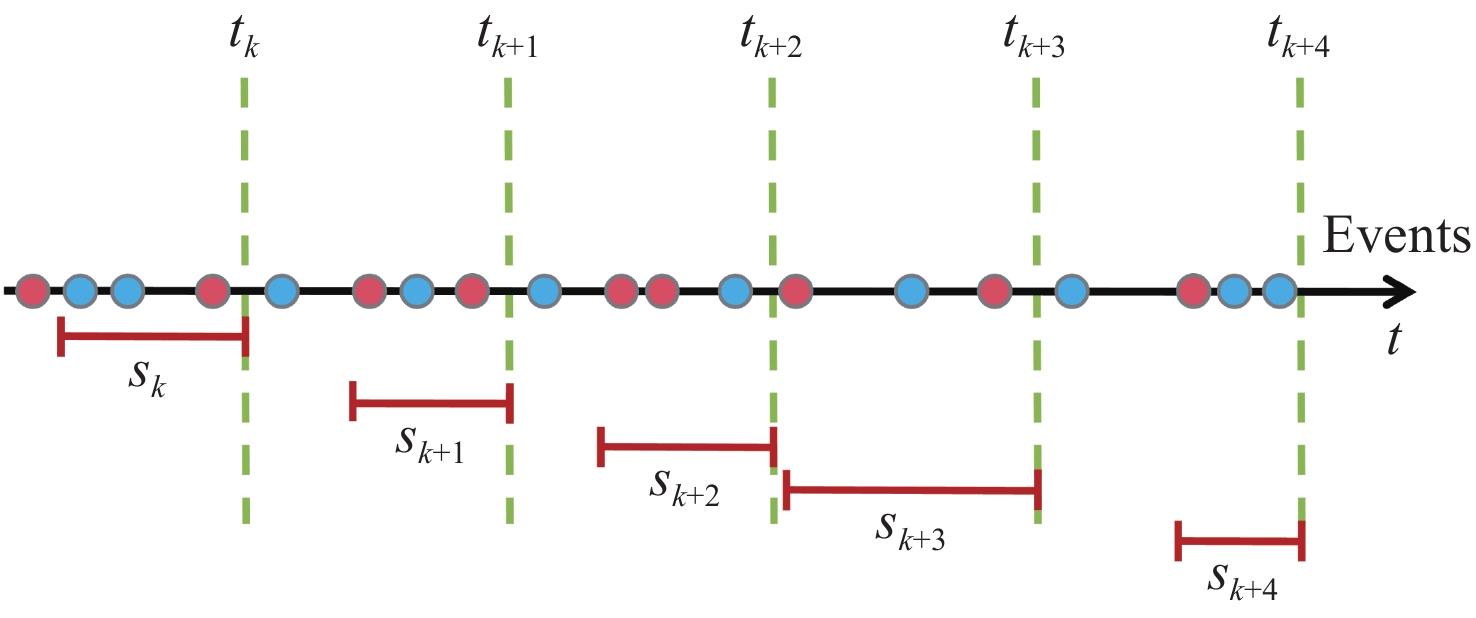
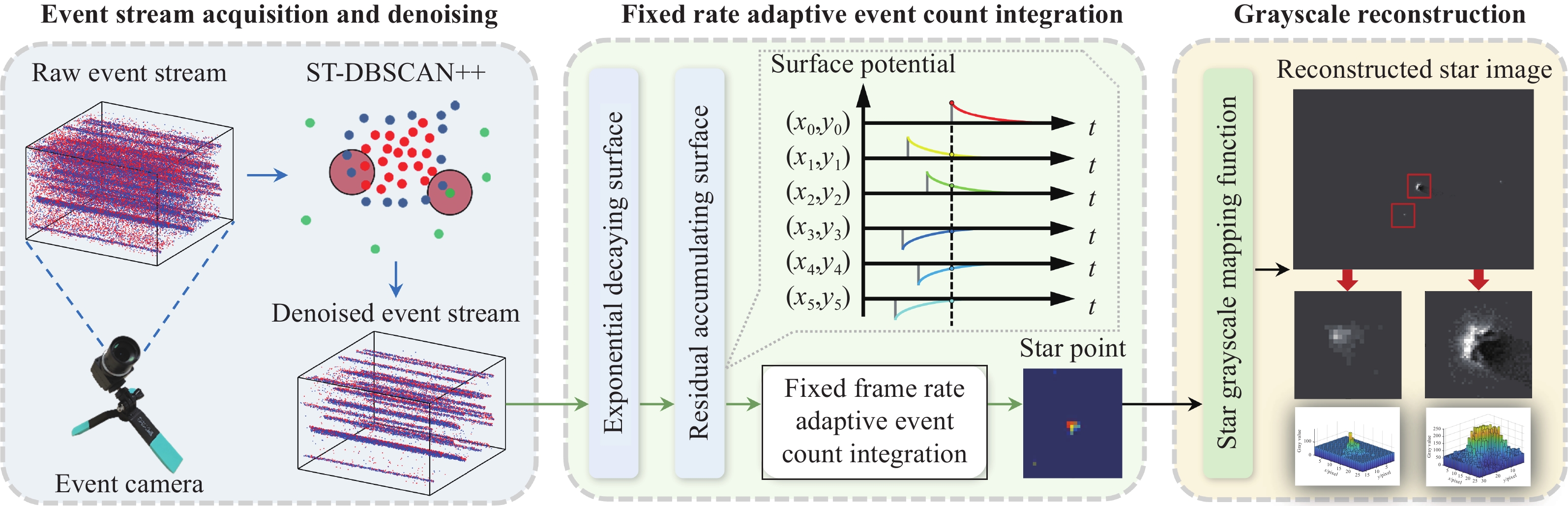
To improve star spot imaging quality and centroid extraction accuracy of event-based star sensors under high-dynamic conditions, and to address the issues of star trailing caused by conventional fixed-time integration, unstable image publication rate of adaptive-time integration, and the lack of continuous response levels in binary event-integrated images, this paper proposes a residual accumulating surface adaptive integration method for event-based star sensors. First, a progressive spatiotemporal denoising method is designed, which employs rapid spatial-domain preprocessing combined with spatiotemporal clustering refinement to suppress background noise events. Subsequently, an integration strategy combining a fixed publication rate with an adaptive event count is proposed, in which the number of integrated events is dynamically adjusted through elliptical morphology analysis of star spots, thereby suppressing star trailing while maintaining a stable a stable event-frame publication rate. A residual accumulating surface is then constructed using an exponential-decay recursive mechanism to continuously encode the event-triggering frequency, thereby forming a relative pseudo-grayscale response jointly determined by the event-triggering frequency and temporal recency. Finally, the residual accumulating surface is converted into a pseudo-grayscale star image via piecewise linear mapping, and sub-pixel centroid localization is accomplished through Gaussian fitting. Experiments on a real star event stream dataset demonstrate that, under a focal-plane image-motion velocity of

| [1] |
SANG P, LIU W B, CAO Y, et al. Research on precise attitude measurement technology for satellite extension booms based on the star tracker[J]. Sensors, 2024, 24(20): 6671. doi: 10.3390/s24206671
|
| [2] |
支帅, 丁国鹏, 韩世豪, 等. 基于单相机的空间目标相对位姿测量系统[J]. 中国光学(中英文), 2025, 18(5): 1111-1123.
ZHI SH, DING G P, HAN SH H, et al. Monocular camera-based relative position and orientation estimation system for space targets[J]. Chinese Optics, 2025, 18(5): 1111-1123. (in Chinese).
|
| [3] |
MA L H, DAI D K, NI Y M. How to improve the attitude accuracy of the star sensor under dynamic conditions: a review[J]. Acta Astronautica, 2025, 233: 42-54. doi: 10.1016/j.actaastro.2025.03.043
|
| [4] |
DU J Y, WEI X G, LI J, et al. Star spot extraction for multi-FOV star sensors under extremely high dynamic conditions[J]. IEEE Sensors Journal, 2024, 24(21): 35167-35180. doi: 10.1109/JSEN.2024.3459001
|
| [5] |
YI J H, MA Y B, ZHU Z F, et al. A blurred star image restoration method based on gyroscope data and enhanced sparse model[J]. Measurement Science and Technology, 2023, 34(11): 115105. doi: 10.1088/1361-6501/ace730
|
| [6] |
阮宇翔, 董磊. 干涉星敏感器测角精度影响因素的研究[J]. 中国光学(中英文), 2023, 16(6): 1433-1441.
RUAN Y X, DONG L. Influencing factors of angle measurement accuracy of an interferometer star tracker[J]. Chinese Optics, 2023, 16(6): 1433-1441. (in Chinese).
|
| [7] |
王燕清, 杜伟峰, 吴永康, 等. 星敏感器在轨精度分析[J]. 光学学报, 2025, 45(12): 1228002. doi: 10.3788/AOS241726
WANG Y Q, DU W F, WU Y K, et al. Analysis of star sensor in-orbit accuracy[J]. Acta Optica Sinica, 2025, 45(12): 1228002. (in Chinese). doi: 10.3788/AOS241726
|
| [8] |
HAN J X, NIU ZH D, HE J. Restoration of non-uniform motion-blurred star images based on dynamic strip attention[J]. Journal of Imaging, 2026, 12(3): 103. doi: 10.3390/jimaging12030103
|
| [9] |
ZHANG B F, ZHAO SH Y, LIU Z Y. A review of image restoration methods based on the Richardson-Lucy algorithm[J]. Digital Signal Processing, 2026, 169: 105768. doi: 10.1016/j.dsp.2025.105768
|
| [10] |
LIU D, CHEN X Y, LIU X. An improved Richardson-Lucy algorithm for star image deblurring[C]. 2019 IEEE International Instrumentation and Measurement Technology Conference (I2MTC), IEEE, 2019: 1-5.
|
| [11] |
GEHRIG D, SCARAMUZZA D. Low-latency automotive vision with event cameras[J]. Nature, 2024, 629(8014): 1034-1040. doi: 10.1038/s41586-024-07409-w
|
| [12] |
LI ZH X, YAN H D, DING G P, et al. Dual-modality event-frame fusion for blind star image motion deblurring via sparse residual learning[J]. Optics and Lasers in Engineering, 2025, 195: 109368. doi: 10.1016/j.optlaseng.2025.109368
|
| [13] |
BAGCHI S, CHIN T J. Event-based star tracking via multiresolution progressive Hough transforms[C]. Proceedings of the IEEE Winter Conference on Applications of Computer Vision, IEEE, 2020: 2132-2141.
|
| [14] |
COHEN G, AFSHAR S, MORREALE B, et al. Event-based sensing for space situational awareness[J]. The Journal of the Astronautical Sciences, 2019, 66(2): 125-141. doi: 10.1007/s40295-018-00140-5
|
| [15] |
曾思康, 赵汝进, 马跃博, 等. 基于事件的高动态星敏感器星点提取方法[J]. 光子学报, 2022, 51(9): 0912003. doi: 10.3788/gzxb20225109.0912003
ZENG S K, ZHAO R J, MA Y B, et al. An event-based method for extracting star points from high dynamic star sensors[J]. Acta Photonica Sinica, 2022, 51(9): 0912003. (in Chinese). doi: 10.3788/gzxb20225109.0912003
|
| [16] |
朱立华, 张强, 高建东, 等. 事件星敏感器自适应积分时间曲面算法[J]. 中国惯性技术学报, 2023, 31(10): 1016-1022. doi: 10.13695/j.cnki.12-1222/o3.2023.10.009
ZHU L H, ZHANG Q, GAO J D, et al. Adaptive integration time surface algorithm for event-based star tracker[J]. Journal of Chinese Inertial Technology, 2023, 31(10): 1016-1022. (in Chinese). doi: 10.13695/j.cnki.12-1222/o3.2023.10.009
|
| [17] |
RALPH N O, MARCIREAU A, AFSHAR S, et al. Astrometric calibration and source characterisation of the latest generation neuromorphic event-based cameras for space imaging[J]. Astrodynamics, 2023, 7(4): 415-443. doi: 10.1007/s42064-023-0168-2
|
| [18] |
LIU H N, SUN T, TIAN Y, et al. Measurement techniques for highly dynamic and weak space targets using event cameras[J]. Sensors, 2025, 25(14): 4366. doi: 10.3390/s25144366
|
| [19] |
BAGCHI S, ANASTASIOU P, TETLOW M, et al. Event-based star tracking under spacecraft jitter: the e-STURT dataset[J]. IEEE Transactions on Aerospace and Electronic Systems, 2026, 62: 4629-4645. doi: 10.1109/TAES.2026.3653351
|
| [20] |
REED A W, HASHEMI C, MELAMED D, et al. EBS-EKF: accurate and high frequency event-based star tracking[C]. Proceedings of the IEEE/CVF Conference on Computer Vision and Pattern Recognition, IEEE, 2025: 6510-6519.
|
| [21] |
CAPOGROSSO L, BONAZZI P, MAGNO M. Event-based vision in space: applications, trends, and future directions[J]. arXiv preprint arXiv: 2606.01280, 2026. (查阅网上资料, 请核对文献类型及格式是否正确).
|
| [22] |
COCKRAM M, MARTINEZ REY N. Event-based detectors for laser guide star tip-tilt sensing[J]. Optical Engineering, 2025, 64(4): 043102. doi: 10.1117/1.oe.64.4.043102
|
| [23] |
CHIN T J, BAGCHI S, ERIKSSON A, et al. Star tracking using an event camera[C]. Proceedings of the IEEE/CVF Conference on Computer Vision and Pattern Recognition Workshops, IEEE, 2019: 1646-1655.
|
| [24] |
VITORIA P, GEORGOULIS S, TULYAKOV S, et al. Event-based image deblurring with dynamic motion awareness[C]. Proceedings of the 17th European Conference on Computer Vision, Springer, 2022: 95-112.
|
| [25] |
CHEN K, YU L. Motion deblur by learning residual from events[J]. IEEE Transactions on Multimedia, 2024, 26: 6632-6647. doi: 10.1109/TMM.2024.3355630
|
| [26] |
闫浩东, 支帅, 陈旭睿, 等. 基于模型和样条的星敏感器在轨自标定方法[J]. 光学学报, 2024, 44(12): 1212004. doi: 10.3788/AOS240580
YAN H D, ZHI SH, CHEN X R, et al. On-orbit self-calibration method for star sensors based on models and splines[J]. Acta Optica Sinica, 2024, 44(12): 1212004. (in Chinese). doi: 10.3788/AOS240580
|
| [27] |
HE X, ZHANG L, HE J W, et al. A voting-based star identification algorithm using a partitioned star catalog[J]. Applied Sciences, 2025, 15(1): 397. doi: 10.3390/app15010397
|
| [28] |
顾佳林, 吕恒毅, 李卓贤, 等. 融合特征增强与轻量级注意力的事件去模糊[J/OL]. 中国光学(中英文), (2026-04-22). https://doi.org/10.37188/CO.2026-0011. (查阅网上资料,请补充引用日期).
GU J L, LV H Y, LI ZH X, et al. Event deblurring via feature enhancement and lightweight attention[J/OL]. Chinese Optics. (2026-04-22). https://doi.org/10.37188/CO.2026-0011. (in Chinese).
|
| [29] |
LI J N, XU J T, GAO J D. Clustering-based temporal deep neural network denoising method for event-based sensors[J]. Optoelectronics Letters, 2025, 21(7): 441-448. doi: 10.1007/s11801-025-4091-z
|
| [30] |
JIANG H Y, WANG X SH, TANG W, et al. Event stream denoising method based on spatio-temporal density and time sequence analysis[J]. Sensors, 2024, 24(20): 6527. doi: 10.3390/s24206527
|
| [31] |
吕媛媛. 基于事件相机的物体振动特性测量技术研究[D]. 西安: 中国科学院大学(中国科学院西安光学精密机械研究所), 2024.
LV Y Y. Research on measurement technology of object vibration characteristics based on event camera[D]. Xi’an: University of Chinese Academy of Sciences (Xi’an Institute of Optics & Precision Mechanics, Chinese Academy of Sciences), 2024. (in Chinese).
|
| [32] |
LANG D, HOGG D W, MIERLE K, et al. Astrometry. net: blind astrometric calibration of arbitrary astronomical images[J]. The Astronomical Journal, 2010, 139(5): 1782-1800. doi: 10.1088/0004-6256/139/5/1782
|
| [33] |
HØG E, FABRICIUS C, MAKAROV V V, et al. The Tycho-2 Catalogue of the 2.5 million brightest stars[J]. Astronomy & Astrophysics, 2000, 355(2): L27-L30.
|
| [34] |
LINDEGREN L, HERNÁNDEZ J, BOMBRUN A, et al. Gaia data release 2-the astrometric solution[J]. Astronomy & Astrophysics, 2018, 616: A2.
|
Figures(12) / Tables(7)




 DownLoad: